ACH vs Credit Card Payments for Business Disbursements
ACH costs less for large recurring payments; cards win on speed and small transactions.
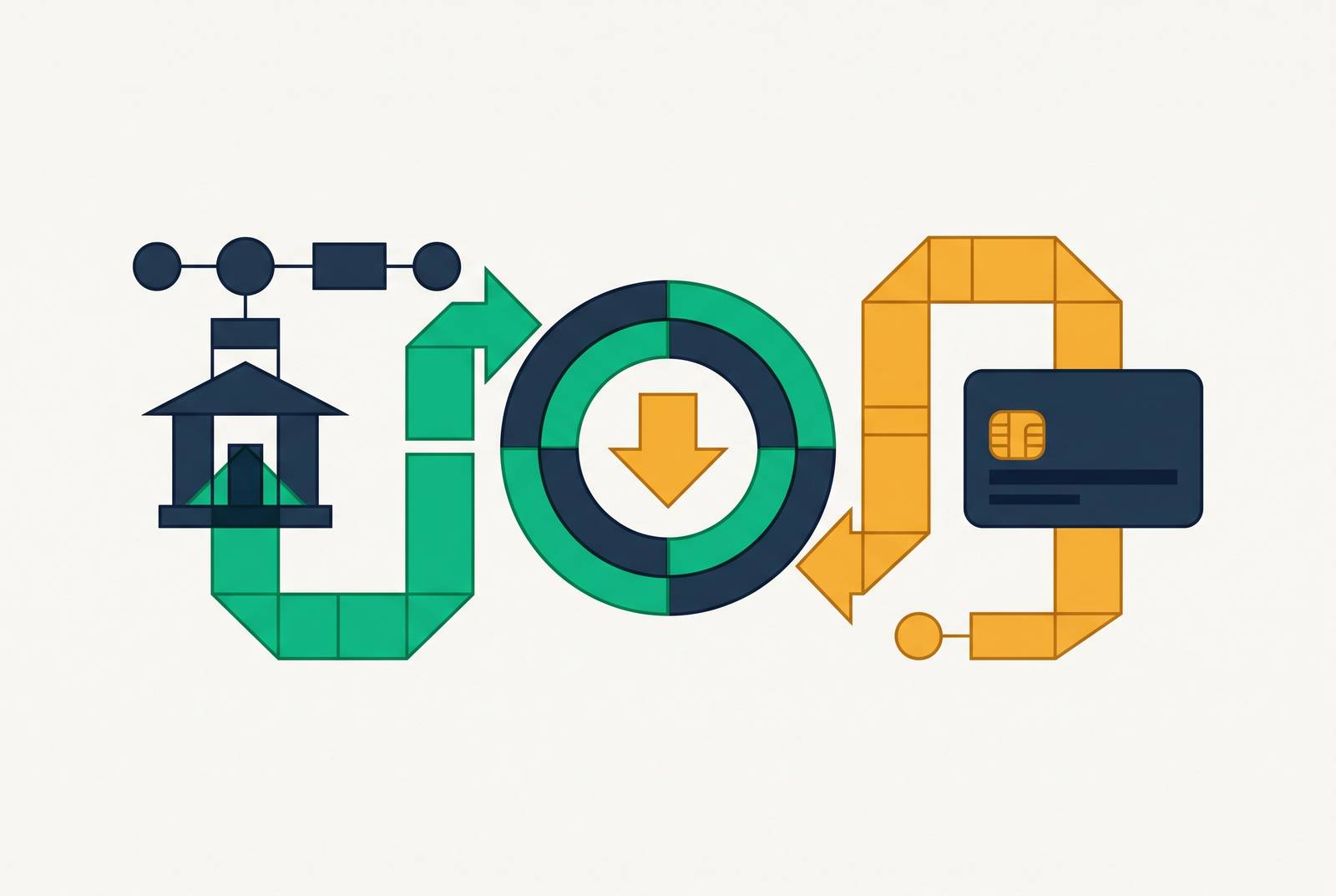
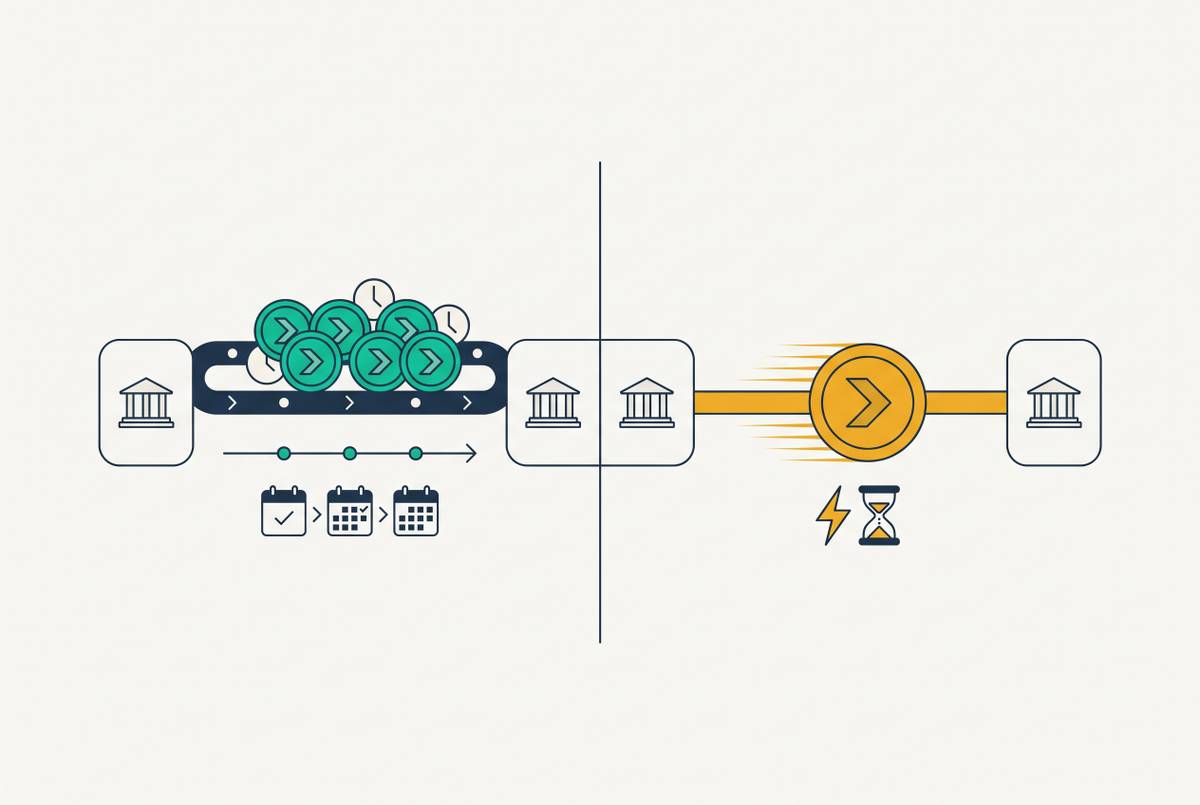
Most finance teams pick a payment rail the way they pick a parking spot: whatever's open and closest gets used, and nobody revisits the decision until something goes wrong. This habit deserves scrutiny. The rail a business chooses for disbursements sets its cost structure, its fraud exposure, its settlement timing, and its compliance obligations, all at once. ACH and credit cards are both mature rails with wide support, but their architectures are entirely different. ACH moves funds directly between bank accounts over a batch-processing network governed by Nacha's Operating Rules, so it settles in scheduled windows, not the instant you approve a payment. Credit cards route through card networks like Visa, Mastercard, Amex, and Discover, authorizing in real time but charging fees that scale as a percentage of the transaction.
That structural split matters more as the dollar amounts grow. ACH charges a flat fee per transaction, so a business running high-value recurring disbursements through card rails absorbs a fee structure that compounds against it, while the same volume moved through ACH costs a fraction of that. One might argue that card fees are a reasonable price for speed and certainty. For small, one-off payments, that argument holds up fine. But for recurring, high-value B2B volume, the math stops favoring convenience, and the market has already voted on this. Nacha reports that the ACH Network moved tens of billions of payments worth $93 trillion in 2025, and B2B ACH volume climbed sharply over the prior decade. Commercial cards still carry a meaningful share of global B2B payment volume, but it's concentrated in travel, procurement, and recurring vendor spend, not the broad base of accounts payable disbursement that ACH now handles.
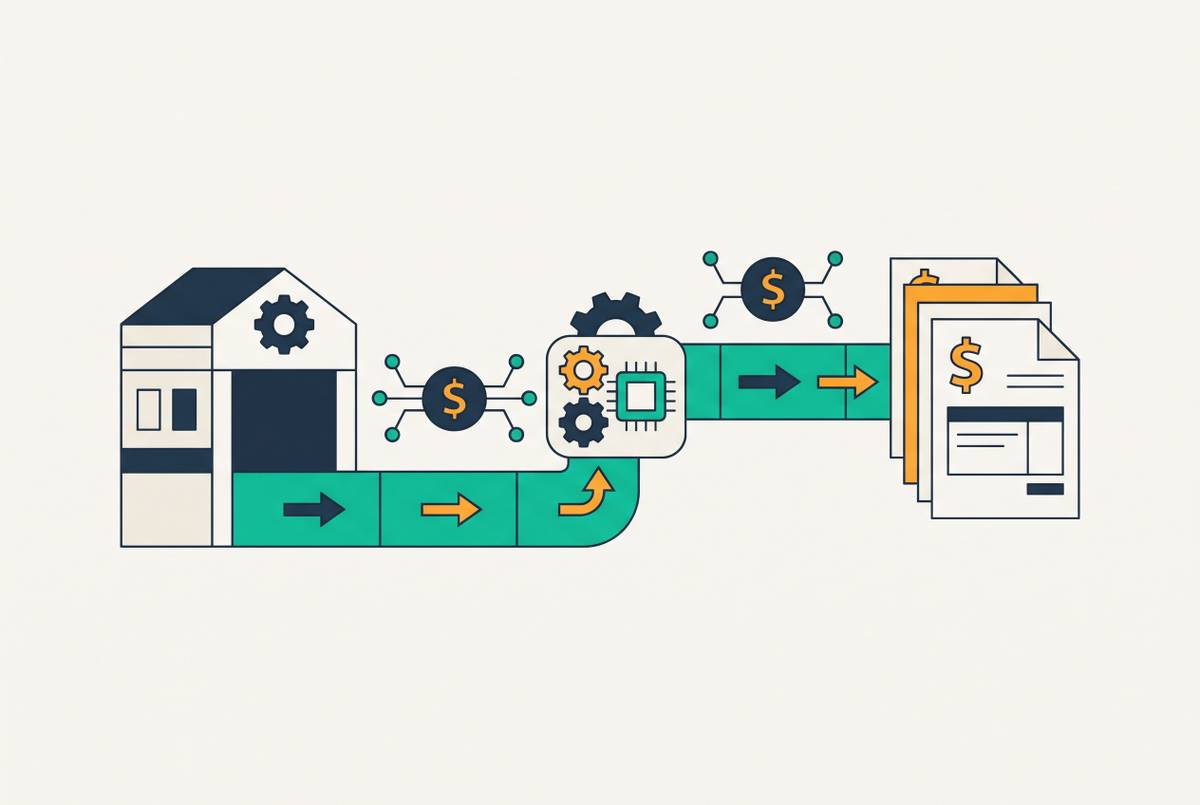
The architectural choice between ACH and card rails determines cost structure, fraud exposure, and compliance obligations all together, and that makes it a decision institutions need to make on purpose rather than by default. Agentic AI platforms built for banking, including PaymanAI, are designed around that premise: the system initiating a payment has to be configured to respect the rail's cost and control profile, so that disbursement logic reflects transaction size, frequency, and risk posture instead of defaulting to whatever's already wired up. From here, you can see why that framing holds, starting with how ACH actually moves money.
How ACH Payments Move Money
ACH's batch-processing model is the source of both its cost advantage and its timing limits, and the four parties involved in every transaction explain where delays and errors tend to enter the system. The originator is the business or individual initiating the payment, and it carries the primary responsibility for getting authorization right. The originator's bank, called the Originating Depository Financial Institution or ODFI, validates the payment instructions and transmits them into the network. Not every financial institution takes on ODFI status, because the compliance obligations that come with it are significant.
From there, the payment passes through an ACH Operator, either the Federal Reserve Bank's FedACH system or The Clearing House's EPN. The two are fully interoperable: a payment originating at a FedACH-connected bank can land at an EPN-connected bank without a hitch. The last stop is the Receiving Depository Financial Institution, or RDFI, the recipient's bank, which takes in the routed entry and posts the funds to the recipient's account.
So why does this four-party structure produce delay where a card swipe doesn't? Transactions don't move one at a time. They accumulate in batches that travel through the network on scheduled settlement windows. Standard ACH settles in one to three business days. Same Day ACH exists, but you pay a higher per-transaction fee for it, and processors often set their own cutoff times earlier than the deadlines Nacha publishes, so if you file a same-day request late in the day, you may miss the window it seems to offer.
Disbursement design also hinges on the direction of the transaction. An ACH credit is a push, where the originating business sends funds to the recipient's account. Payroll direct deposit is the clearest example. An ACH debit is a pull, where the originating business draws funds from a customer's account, as in recurring billing. For outbound business disbursements, credits are the primary tool, and their fraud exposure looks different from debits, which the next section unpacks.
Credit cards work the opposite way on timing. They authorize in real time but settle later: the payment travels through the card network to the issuing bank, gets authorized instantly, and the funds are captured and settled on a separate track. A merchant knows within seconds whether the payment will clear. That instant certainty is the real operational edge cards hold over ACH, and it matters most in settings where knowing a payment succeeded at the moment of the transaction is the whole point, like point-of-sale retail.
Understanding this four-party structure and the batch cycle is the foundation for designing a disbursement workflow that accounts for settlement timing and who's responsible at each step. When AI agents handle disbursement routing, as PaymanAI's platform does, that four-party logic and the settlement window have to be built directly into the system's transaction decisioning, so the system knows which rail to use and when to start the payment based on how funds actually move, not an assumption about how fast they move.
Where the Cost Gap Between ACH and Card Rails Is Real
ACH's flat-fee-per-transaction model produces a real cost advantage that grows as the transaction size grows, appearing only where ACH fits the disbursement. ACH fees stay flat no matter the dollar amount moving through, so the rail gets more efficient, dollar for dollar, as your payments get larger. Credit card fees work in the opposite direction: interchange, network fees, and processor margin all scale as a percentage of the payment, so a bigger payment produces a proportionally bigger fee no matter how simple the transaction actually is. Across a year of recurring, high-value vendor payments, a business routing that volume through card rails absorbs fees that dwarf what the same payments would have cost over ACH.
Same Day ACH changes the timing, but it doesn't touch the underlying cost advantage. Its fees run higher than standard ACH, but they stay a fraction of what card processing costs, so even if you genuinely need faster settlement, you still come out ahead on ACH. A processor's internal cutoff time can land earlier than the deadline Nacha publishes, and that gap matters a great deal when same-day settlement is the whole reason for choosing it.
So when does the math flip toward cards? Small, one-time, consumer-preference purchases are the clearest case. If you set up ACH authorization for a single low-value transaction, the operational overhead outweighs the fee savings, so a $30 order rarely earns the effort. International payments are another clear case: ACH only works with U.S. bank accounts, so any cross-border disbursement needs a different rail. Cards also offer that instant authorization advantage discussed earlier, which carries real operational value in point-of-sale or time-sensitive settings where a business needs to know, right then, whether a payment is going through. Virtual cards sit somewhere between the two: they borrow card-network authorization while trying to capture some of the control you'd get with ACH.
The larger and more predictable the payment, the stronger the case for ACH. A one-off $30 purchase probably doesn't justify setting up ACH authorization, but a recurring monthly invoice worth thousands of dollars almost always does. Most mature payment programs don't pick one rail and stick with it everywhere. They route recurring, high-value, and B2B volume over ACH, and keep cards available for one-time purchases, consumer-preference situations, and anything crossing a border.
None of this plays out automatically, though. The cost advantage of ACH over cards is clear enough on paper, but it appears in practice only when disbursements actually get routed to the cheaper rail, which takes active, informed decision-making at the point of payment rather than a passive default to whatever card is already on file. That's where institutional control over routing logic earns its keep: the ability to configure which disbursements flow over ACH versus cards, with the routing decision fully auditable after the fact, has a direct line to the finance team's bottom line.
Why ACH credits are now the higher-risk instrument
The cost case for ACH is strong, but it comes paired with a fraud exposure profile that finance teams have to manage actively, particularly on outbound credit payments. Credit-push fraud, where a legitimate account gets used to send funds to a fraudulent destination, is the dominant threat facing business disbursements today, and transaction size limits or standard authorization checks alone don't stop it.
Why doesn't authorization solve this the way it used to? Historical ACH fraud happened when an attacker pulled funds from an account they didn't control, and debit blocks and basic monitoring could catch that. Credit-push fraud flips that script. The legitimate account holder gets deceived into initiating a payment that looks entirely normal, sending it to a criminal's account, or a compromised account gets used to push funds out directly. The most common version is business email compromise: an attacker poses as a vendor, supplies fraudulent bank account details, and the business initiates a perfectly valid ACH credit, fully authorized, to the wrong account.
Nacha's rules account for this by recognizing that authorization alone doesn't prove a payment is legitimate. A transaction can be fully authorized by the account holder and still count as fraud under Nacha's "False Pretenses" definition, because the authorization itself was obtained through deception. So catching credit-push fraud takes behavioral and account-context signals, not just a checkmark confirming the payment was authorized.
Credit cards carry a structural protection here that ACH doesn't replicate. Card payments come with dispute rights for the buyer, and chargebacks give the payor recourse after the money has already moved. ACH credits don't offer an equivalent once they've settled. The recourse window is narrow, and getting the money back is never guaranteed.
That asymmetry creates a liability problem for the originating business. When a fraudulent ACH transaction clears and the originator can't show that controls were actually operating, the originator absorbs the liability. This risk is the enforcement posture written into the 2026 Nacha rules, covered next.
Account verification is the direct countermeasure to credit-push fraud. Confirming that the destination account actually belongs to the intended payee, before an ACH credit goes out, is the most effective defense against business-email-compromise-style misdirection. Skipping that step means a single spoofed email can redirect a large disbursement to a criminal's account with nothing technically wrong to flag it. None of this erases the cost advantage ACH holds. It just means that advantage depends on the controls being in place, not on hoping fraud doesn't show up.
What the 2026 Nacha Rule Changes Require
The 2026 Nacha fraud rule changes extended mandatory risk-based fraud monitoring to every non-consumer business that originates ACH payments, regardless of size, rolled out in two phases that make AP departments direct compliance actors for the first time. Phase 1 took effect March 20, 2026, and applied to large payment originators and third-party service providers handling ACH entry volume above a defined annual threshold tied to 2023 activity, along with large receiving financial institutions, which had to start monitoring incoming ACH credit entries for fraud indicators. Phase 2 extended those requirements to all non-consumer ACH participants, with Nacha's own rule page setting the effective date as June 19, 2026, though that date falls on a federal holiday, so the practical effective date shifts to the next banking day, Monday, June 22, 2026. So in practice, virtually every business that originates ACH payments through a processor now needs a documented compliance framework, not just the largest originators.
What do the rules actually ask for? A documented, risk-based fraud monitoring framework, not a mandated piece of technology, built proportionally to the business's payment volume and risk profile, covering fraud detection, account validation, and risk mitigation procedures. You also need a mandatory risk-based process for verifying account ownership before you send an ACH credit, which is the direct control against the credit-push fraud pattern described above. The rules add two new standardized company entry descriptions, "PAYROLL" and "PURCHASE," meant to improve transparency across the network so receiving institutions can better judge whether a transaction fits the pattern it claims to.
Auditors treat documentation as part of the control itself, not a formality layered on top of it. They look for documented risk-based monitoring processes, evidence that the monitoring runs and produces decisions that can be traced, proof that an annual review took place, and records showing that any issues found were remediated. A monitoring system that works but produces no paper trail still fails the audit, because the paper trail carries as much weight as the monitoring itself.
Several concrete controls satisfy these requirements in practice. ACH Positive Pay allows only pre-approved transactions to post, and it ranks among the most effective controls a business can put in place. ACH Debit Blocks stop unauthorized pulls from a business account before they can happen. Dual Authorization requires two separate approvers to sign off on large ACH transactions, so it cuts down on internal fraud exposure as well as external. Taken together, these rules mean the compliance burden now sits with AP operations directly, not just with banking partners or treasury teams watching from a distance.