ACH Payment vs Wire Transfer
Wire transfers settle in minutes; ACH batches take days but cost far less.
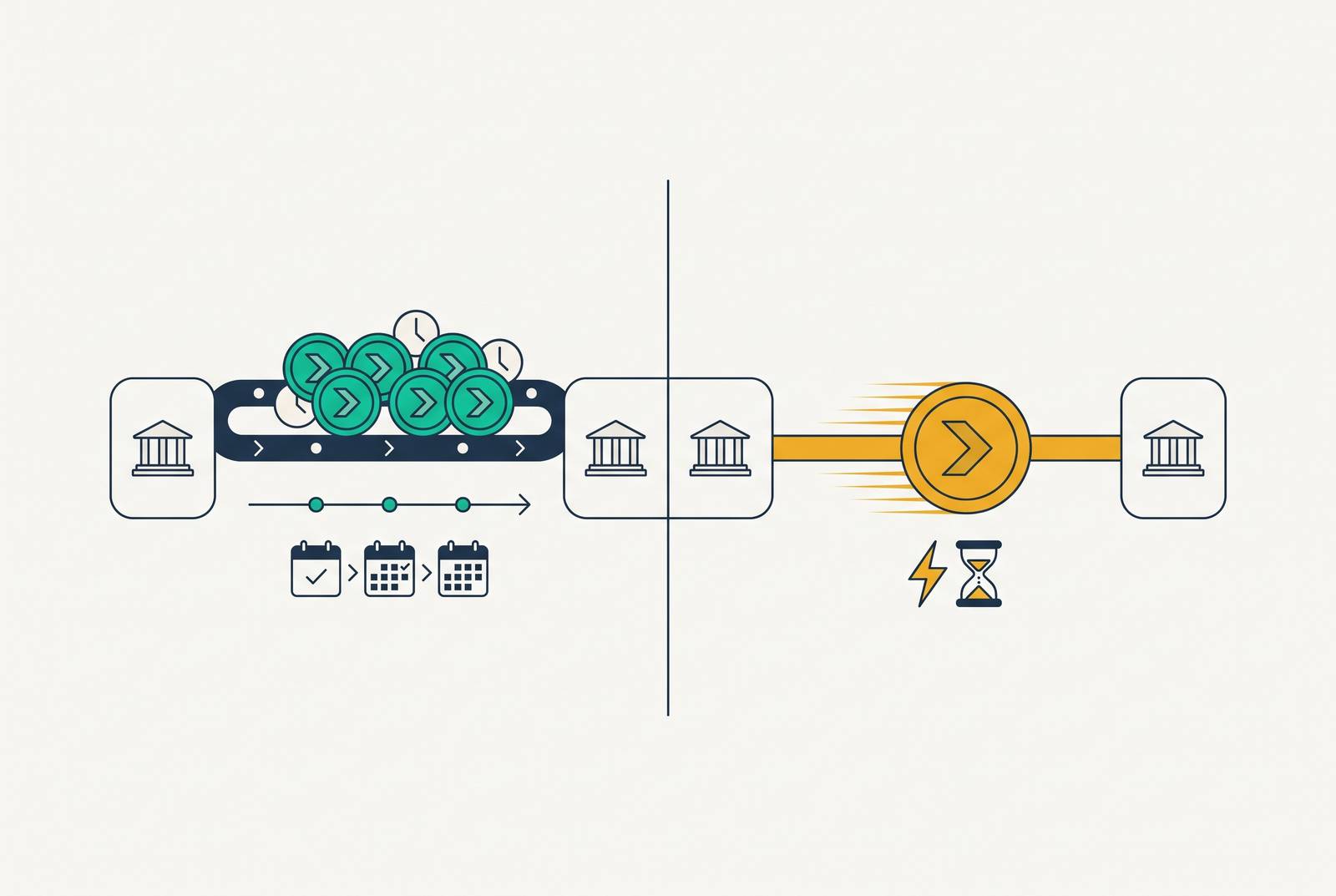
ACH and wire move money through completely different mechanics, and that mechanical difference decides which rail fits a given payment. ACH batches instructions and settles them a few times a day through a central operator. Wire sends money straight from one bank to another, no batching, no waiting on a window. Get the mechanics straight, and speed, cost, size limits, and risk mostly sort themselves out.
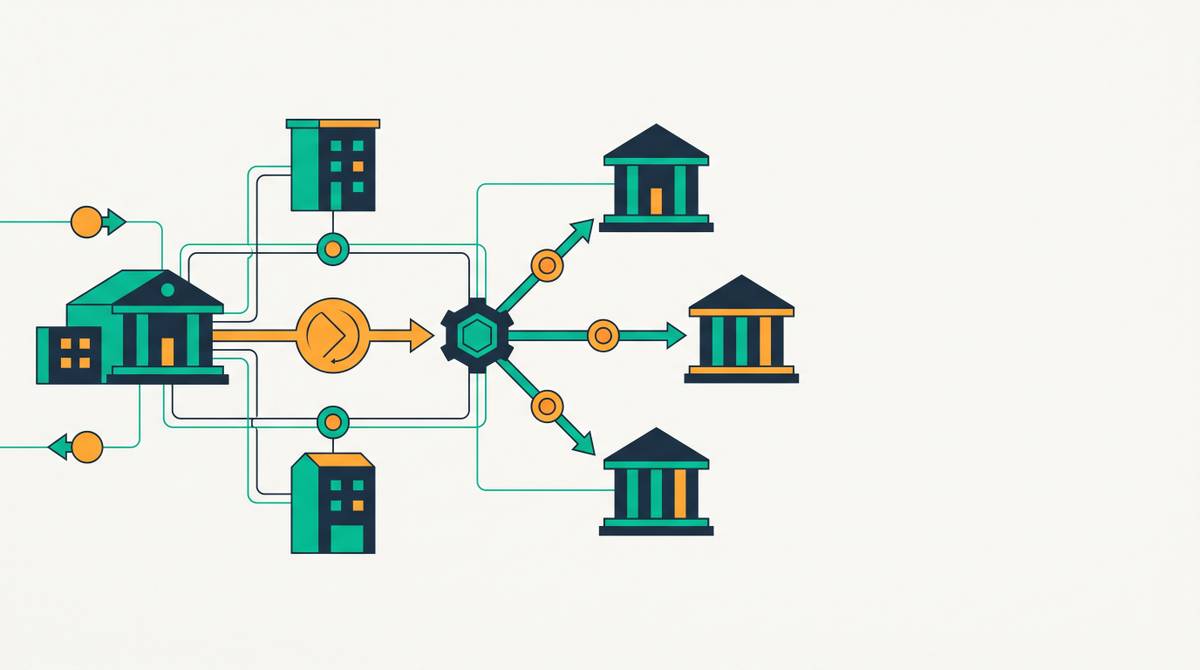
Start with the batching, because everything else traces back to it. The sender's bank (the originating institution, in the network's own language) bundles a stack of payment instructions and sends them to an operator, either the Federal Reserve or The Clearing House. That operator sorts the batch by receiving bank and settles multiple times a day. Wire skips all of that. The sending institution transmits the instruction straight to the receiving institution, no clearinghouse in between for domestic transfers. Domestic wires run over Fedwire (the Fed's own network) or CHIPS (the Clearing House Interbank Payment System). International wires route through SWIFT, which links roughly 11,000 financial institutions across more than 200 countries.
One more difference worth naming early: ACH can push or pull. Credits push money out, debits pull money in, which is the mechanism behind autopay and subscription billing. Wires are almost always sender-initiated pushes. The paperwork differs too. ACH needs a routing number and an account number. Wire needs that plus the recipient's full name, address, and a stated reason for the payment. More friction, but more identity attached to the money as it moves.
So what actually rides on each rail? Direct deposit, direct debit, payroll, and most peer-to-peer app settlements (Venmo, Cash App) move over ACH. Real estate closings, business acquisitions, and large institutional settlements are wire's home turf. The volume gap tells the story: ACH processed 35.2 billion transactions in 2025, according to Nacha, while Fedwire handled just over 217 million wire transfers that same year. One rail is built for volume. The other is built for size, and mixing the two up is where most routing mistakes start.
Speed: where the gap between the two rails is real and where it is closing
Standard ACH credits take one to three business days. Debits follow their own timing rules depending on the transaction type and bank. Same Day ACH tightens that window: three processing runs every business day, at 10:30 a.m., 2:45 p.m., and 4:45 p.m. Eastern. Land in one of those windows, pay the extra fee, and the payment clears and settles that same day.
Wire still wins on raw speed. Once the receiving bank signs off on the incoming message, funds clear within minutes. Fedwire will settle and disburse immediately if the sender pays for it. CHIPS transactions might settle by early evening, assuming the sender beats the bank's mid-day cutoff.
Clearing and availability are not the same thing, and that gap is where a lot of confusion lives. A wire can clear on the network and still sit in review at the receiving bank, held up by internal posting policies or cutoff times. Cleared doesn't mean the recipient can spend it that afternoon.
For anything routine and non-urgent, standard ACH does the job, and reaching for wire here is usually just paying for speed nobody needed. For same-day certainty, the field narrows to two options: Same Day ACH, if the amount qualifies, or wire. That qualifier is exactly where the next section picks up.
Transaction limits: how the $1 million Same Day ACH cap and the coming $10 million ceiling reshape the routing calculus
Standard ACH carries no network-wide dollar ceiling. Banks and processors set their own limits, but the rail itself doesn't cap anyone. Same Day ACH does: $1 million per transaction, a limit Nacha raised from just $25,000 back in March 2022. Another jump is already locked in. Nacha members approved raising the Same Day ACH cap to $10 million effective September 17, 2027, bringing it in line with the ceilings already sitting on RTP and FedNow.
Wire has no practical network-level ceiling at all. Banks set their own per-account limits, but as a rail, wire is the only option today for anything above $1 million that needs same-day settlement. A $3 million vendor payment right now has to go by wire, no way around it. After September 2027, that same payment could move through Same Day ACH instead, assuming the timing lines up, at a fraction of the cost. That date is worth circling. It's the point where a real chunk of what currently forces companies onto wire simply stops forcing them.
The average transaction size on each rail makes the split obvious. Per 2024 network data, ACH averaged around $2,600 per transaction across 33 billion payments totaling $86.2 trillion. Fedwire averaged roughly $5.4 million per transaction across 199 million transfers, totaling $1,133 trillion. Same universe, completely different customer, and confusing the two is how companies end up either overpaying on wire fees or under-protected on a payment size that exceeds what ACH was built to carry.
Cost: the fee structure that makes ACH the high-volume rail and wire the premium option
ACH is cheap, often free to the sender, with underlying per-transaction costs typically running $0.20 to $1.50. Wire is not cheap. Domestic outgoing wires usually run $25 to $30. International wires run $45 to $50.
What sits under that bank fee? The Federal Reserve's 2026 fee schedule, effective January 1, 2026, prices a Fedwire transfer at $0.97 under Tier 1 pre-incentive pricing, plus a $125 monthly participation fee charged to the institution. The $25 to $30 a customer pays runs well above the Fed's cost. It's the bank's own fee stacked on top of its infrastructure cost, and that markup is most of what a customer is actually buying when they pay for a wire.
At scale, this math turns brutal fast. A company running thousands of payroll or vendor payments a month is looking at a real cost gap between the two rails, and it compounds in a way ACH fees simply don't. Receiving banks can charge their own fee too on a wire, depending on the institution.
Use ACH for anything routine and recurring. Save wire for the cases where same-day finality or transaction size actually demands it. Cost alone never justifies picking wire for volume payments, and any business doing that is paying a premium for speed it isn't using. Multiplying a $28 wire fee against a few thousand vendor payments a month produces a number that gets hard to defend to a CFO.
Reversibility and finality: why ACH's error window is a feature and wire's finality is a risk
Wires are final the moment the receiving bank accepts the instruction. Funds can't be clawed back, not even in confirmed fraud cases. The sending bank might try to coordinate with the receiving bank after the fact, but there's little real recourse once the money's been withdrawn. The one narrow escape hatch is cancellation before the wire clears, and that window can run a matter of minutes.
ACH works the opposite way, and it's worth sitting with why. Credit reversals can be requested within five business days for genuine errors: wrong account, wrong amount, an accidental duplicate. Debit disputes give the payer up to 60 days after the statement date to flag something as unauthorized. Returns for insufficient funds carry a two-business-day window. None of that makes ACH immune to fraud, but it builds a correction period into the timeline that wire simply doesn't have.
Nacha's 2026 rule changes push this further, requiring ACH network participants to build proactive, risk-based processes for spotting entries that look authorized under false pretenses. That raises the bar for originators, and it reinforces the underlying pattern: ACH assumes mistakes happen and designs a fix into the schedule.
So which is the bug and which is the feature? It depends entirely on what the payment is for. Wire's finality is exactly what makes it right for a real estate closing or a business acquisition, where the seller needs certainty the money isn't coming back. That same finality turns dangerous the moment the instruction is wrong or fraudulent. Business email compromise scams that redirect a wire have no recovery path once it settles. ACH fraud runs into a defined dispute clock instead, which is a big part of why ACH is the safer default for routine payables. Treat wire's speed as a liability whenever the payment details aren't triple-checked, because there's no undo button waiting on the other side.
Geographic reach: where ACH stops at the border and wire goes global
Standard ACH is a domestic system, full stop. International ACH Transactions (IAT) does allow cross-border ACH, but availability depends on the specific bank, the destination country, the gateway operator, and whatever partner rails are involved. Not universal, and it comes with extra compliance layered on top.
Wire was built for crossing borders. SWIFT connects roughly 11,000 financial institutions in more than 200 countries, and an international wire might pass through one or two correspondent banks before it reaches the recipient. That extra infrastructure is exactly why international wire fees run higher, typically $45 to $50 outgoing.
For any payment leaving the country, where IAT isn't already set up at the specific bank, wire is the default by elimination. The debate between the two rails mostly evaporates once a payment crosses a border, unless the sending institution happens to support IAT to that particular destination.
A third option entering the frame: FedNow and RTP and where they sit relative to ACH and wire
Two newer networks complicate the picture, in a good way. RTP and FedNow are instant payment rails that both share a $10 million per-transaction ceiling.
Speed-wise, both offer near-instant settlement, 24/7, including weekends and holidays. Neither ACH, tied to business-day processing windows, nor Fedwire, tied to business hours, can match that kind of round-the-clock availability. And the cost on both instant rails lands close to Same Day ACH pricing, well under wire fees. Instant settlement at near-ACH cost is the entire pitch, and it's a genuinely good one.
If a bank supports RTP or FedNow, and the transaction falls under $10 million, instant rails deliver wire-like speed at a fraction of the price, around the clock. They don't replace wire everywhere, though. Anything above $10 million, anything international, or any case where the receiving institution simply isn't on either instant network still has to go by wire.
One more shift worth naming: Fedwire and SWIFT have both been moving toward the ISO 20022 messaging standard. That richer, structured data format sharpens fraud detection and automation, and cuts down manual review across the wire network generally.
None of this makes the question of which rail to use obsolete. It adds a third lane to the decision, which makes the routing calculus more layered, not simpler.
Matching method to moment: a practical routing framework for banks and their customers
Walk it through as a sequence of questions, in order, and the right rail tends to fall out on its own.
Is the payment domestic or international? If it's international with no IAT arrangement in place, wire is the only option, no further questions needed. Is same-day settlement required? If yes, the choice narrows to wire, Same Day ACH under the $1 million cap, or an instant rail if the bank supports it and the amount is under $10 million. Is the amount above the current $1 million Same Day ACH ceiling, or the $10 million ceiling arriving in September 2027? Anything above that threshold needs wire or an instant rail. Does the counterparty need certainty, the way a seller in a real estate closing does? Wire delivers that certainty. Is the payment routine, recurring, or something that might need correcting later? ACH's cost and reversal window make it the better fit. And finally: does the bank actually support FedNow or RTP for this transaction size? If so, that instant rail can cut the wire premium out of the equation entirely.
Mapped to real use cases: payroll, direct deposit, recurring vendor payments, and subscription billing run on standard ACH. Urgent same-day payables under $1 million go through Same Day ACH. Real estate closings, acquisitions, and large institutional settlements go by wire. Emergency transfers or time-sensitive B2B payments move through FedNow or RTP where the bank supports them. International supplier payments go through wire via SWIFT.
Business behavior already reflects most of this logic. B2B ACH volume hit 8.1 billion payments in 2025, up 9.9% from 2024, which says businesses are already defaulting to ACH for the bulk of routine payables. The framework above mostly confirms an instinct that's already in place.
One compliance note worth flagging directly: under the Bank Secrecy Act, transfers of $3,000 or more trigger recordkeeping requirements, and unusually large or unusual transfers might prompt additional verification. That's routine oversight, not a red flag on the payment itself, and it should be treated as a normal part of moving money at scale.
How agentic AI changes payment rail routing at the operational level
Everything above is a decision tree, and decision trees are exactly what software is good at automating. That's where agentic AI enters the picture. Agentic systems don't just recommend a rail, they sense conditions, apply routing logic, and run the multi-step payment workflow on their own. That's a real jump from a system that suggests an action to one that takes it.
Industry observers have described AI agents that can independently manage liquidity and prioritize payments inside real-time gross settlement systems, mirroring cash management practices treasury teams have used for decades. Applied to ACH and wire routing, an agentic system could handle initiation, pick the rail based on amount, urgency, and destination, run compliance checks, watch settlement, and escalate exceptions, the whole framework above, running automatically.
But this is exactly where the earlier point about reversibility stops being informative and starts being urgent. Wire transfers are final. They can't be recalled. So an agentic system should never send a wire without structural guardrails: human confirmation at set thresholds, spend limits, dual-authorization scaled to transaction size. Kill switch design matters here too, and it should be graduated rather than absolute: a hold, then a flag, then an escalation, not an abrupt shutdown. Authority should sit distributed across the system, not centralized in one place, with a clear chain of accountability and every action logged for audit. A bank that lets an agent send an uncapped wire without a human in the loop is one prompt injection away from a very expensive lesson.
Regulation hasn't caught up, and that fact deserves to be stated without softening. Existing model risk guidance has not fully caught up to generative and agentic AI, calling it novel and still moving too fast to govern formally. Banks deploying payment agents right now are building their own governance ahead of any formal regulatory floor, which is a strange place for an industry this regulated to find itself.
The readiness gap underneath all this deserves attention. The Cisco AI Readiness Index (2025) found that only 31% of organizations say they're fully equipped to control and secure agentic AI systems, even though 83% plan to deploy them anyway. In most industries that's a readiness statistic to shrug at. In payments, that gap is a wire-fraud exposure sitting in plain sight, and it should worry anyone signing off on a deployment timeline.
What does responsible deployment actually look like? Configurable controls, a full audit trail on every AI-initiated transaction, and human oversight kept firmly in place for anything irreversible. Automation and accountability have to work as partners, not as a trade-off where one gets sacrificed for the other. Some emerging banking platform architectures illustrate this approach in practice, with a supervisory layer that checks every actor's permissions against bank policy before letting an action through, and logs each one afterward. Deployments of this kind are emerging across a range of financial institutions.
Which brings the whole piece back to where it started. The routing logic laid out earlier, speed against cost, size against finality, domestic against cross-border, is exactly the logic these systems now encode into software. Knowing it by hand still matters, maybe more now than before: it's the only way to tell whether the machine making that call is making it correctly.