Deploying AI Agents on Existing Core Banking Infrastructure
Banks can deploy AI agents on existing systems without replacing their core infrastructure.
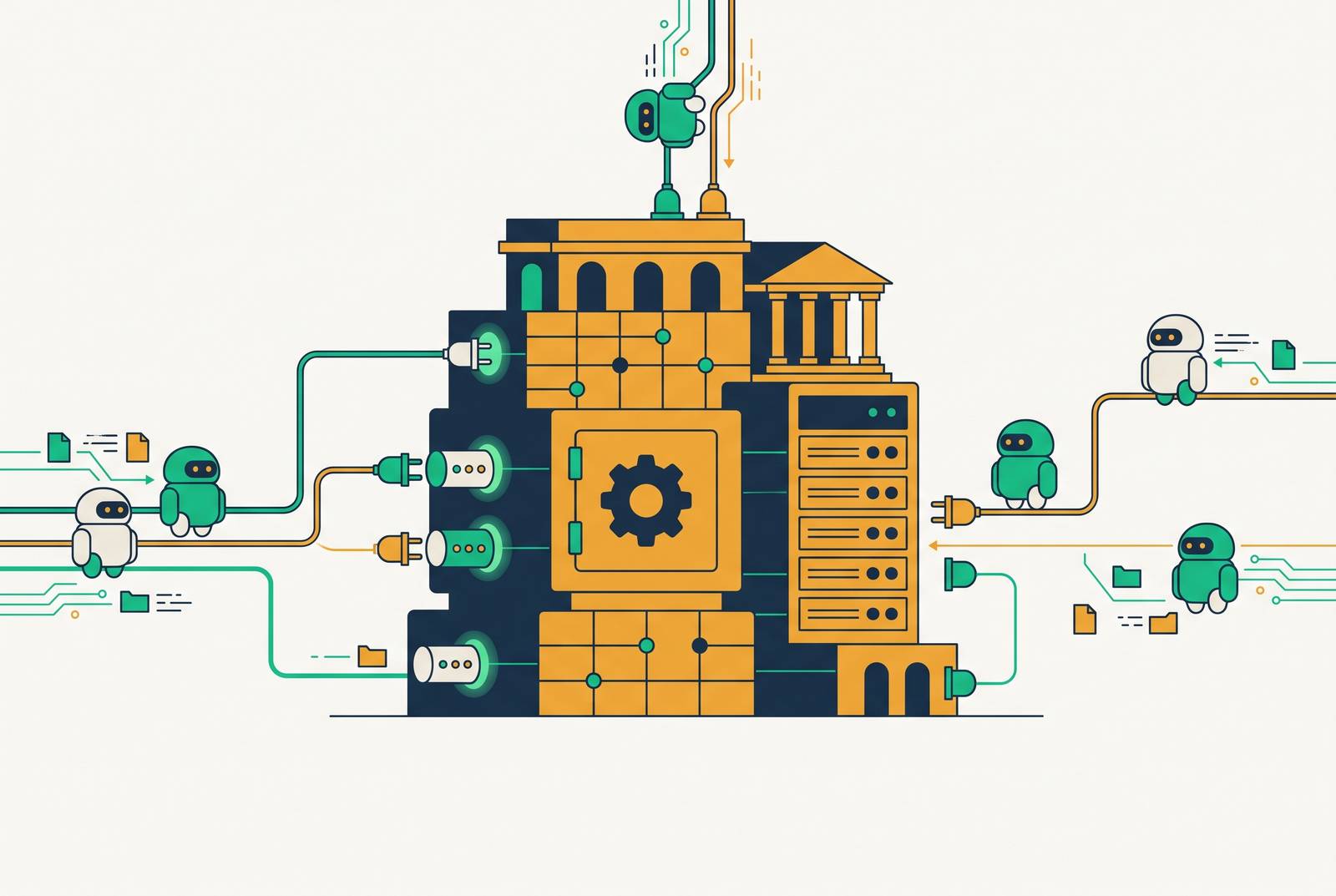
Deploying AI agents in banking does not require ripping out the core system. The practical path runs through the infrastructure banks already have: integrating agents into existing rails, so the institution gets faster time to value and lower risk than a rebuild would ever allow.
Too many decision-makers still hear "deploy AI agents" and translate it, in their heads, to "replace the core." That translation is wrong, and it's an expensive mistake to keep making. The AI agents market in financial services was valued at $1.79 billion in 2025 and is projected to hit $6.54 billion by 2035, growing at 13.84% a year. Industry analysts have put a finer point on the timeline, with major banks moving quickly to deploy AI agents for back-office tasks in 2026. Institutions waiting around for a clean-slate moment are, whether they realize it or not, competing against peers who already stopped waiting.
Chasing whatever's trending is beside the point here. It's about not being the bank that misread what deploying AI actually takes. What follows lays out the architecture for running agents on the rails already in place, no rip-and-replace required.
What agentic AI actually does that earlier automation couldn't
Older AI tools responded to inputs. They'd surface a recommendation, flag something odd, then hand the decision to a person. Agentic AI does something structurally different: it plans a sequence of steps, picks the right tool for each one, executes across systems, and closes the loop, all without a human directing every move.
Take fraud detection. Older automation flags a suspicious transaction and stops there. An agent picks up that flag, investigates across multiple systems, drafts the suspicious activity report, and logs what it did. Same shift on the lending side: instead of just recommending approval, an agent pulls the supporting documents, verifies income against payroll or tax data, and updates the loan management system directly.
That's the part worth sitting with for a second. An agent that acts across systems has to actually touch those systems, in sequence, correctly. A regulated fintech, on average, runs a ledger, a card processor, a KYC vendor, an identity provider, a fraud engine, a CRM, a ticketing system, a contact-center platform, and at least one in-house billing or risk tool, often more than that before a single customer call gets resolved. None of that stack goes away when an agent shows up. The agent has to learn to move through it, not replace it.
So the frame that matters here: agentic AI is an execution layer running on top of what already exists. It doesn't absorb the systems underneath it. It works them.
The actual state of legacy infrastructure in banking and what it means for integration
Here's where the friction actually lives. Legacy banking systems, mainframe architecture, COBOL codebases, SOAP-based services, fixed-length data records, weren't built with modern AI platforms in mind. Each of those four things creates its own specific translation headache, not a vague "legacy is old" problem but a concrete engineering one.
A SOAP-based core doesn't talk to a REST API without middleware in between doing the translation. A system built on fixed-length records doesn't hand data to a schema-flexible agent platform without a custom serialization adapter sitting in the middle. And older authentication schemes with no OAuth support need a secure token proxy layered on top just so the agent can log in safely. None of these are exotic problems. They're bounded, well-understood integration tasks. But they're real, and they take work.
About 70% of banks say integrating with legacy systems is at least "somewhat" of an obstacle to modernization. And the environment keeps getting more tangled: financial services firms manage roughly 601 APIs on average, a number that keeps climbing as modernization projects and AI rollouts pile on top of each other.
None of this should get waved away. Legacy friction is real, and pretending otherwise sets a project up to blow its timeline. But the fix for friction is an integration layer, not a core replacement. Integration work costs money and time, sure, but the cost is bounded and reversible. A full core migration is neither.
The integration architecture that makes agents work on existing rails
Agents don't plug into the mainframe directly. They connect to an integration layer, and that layer is what exposes legacy functionality in a form the agent can actually use. Four patterns show up again and again in practice.
AI overlays sit on top of existing systems, connecting through APIs and real-time data feeds. They add capability without anyone touching the core underneath. The system stays exactly as it was; the overlay just gives the agent somewhere to reach in from.
Enterprise service buses and API management platforms handle the translation work between legacy systems and modern AI services: data transformation, protocol translation, traffic routing, all while keeping security and audit logging intact.
Middleware solves the SOAP-to-REST problem, the serialization mismatch, the authentication proxy issue, all the specific headaches from the section above. It has to run fast, too. An autonomous workflow that's supposed to resolve a customer issue in seconds can't sit around waiting on a slow data pull from three systems back.
Pre-built core connectors round it out. Modern agent platforms now connect to major banking cores, along with AML platforms, CRM tools, and document management systems, through connectors that are already built and already tested. That's a meaningful head start over building integration from scratch.
Put those four together and what comes out the other end is a unified view of the bank's data that the agent operates against. The agent sees one coherent picture. The systems underneath stay exactly as they were.
But that raises an obvious question: if an agent can touch nine systems in one workflow, who's watching what it does across all nine? At that point it stops being a data problem. That's an authority problem, and it needs its own layer entirely.
Governance and control architecture: what has to be built alongside the integration layer
An agent with the reach to touch a ledger, a fraud engine, and a loan system in a single workflow also has the reach to cause damage across that same footprint. So authority has to be scoped tightly, and every action has to leave a trail.
A governance setup that actually holds up has a few non-negotiable pieces. Permission checks run before an action executes, not after the fact, validated against whatever policy the bank has set. Every action gets logged with a timestamp, the context around it, and the outcome, the exact record a compliance examiner needs and, just as much, the record a loan officer needs when a customer calls asking what happened. Institutions set their own boundaries on which workflows run autonomously, which need a human to sign off, and which are off-limits altogether, and that boundary is the bank's call, not the vendor's. And a human can step in at any point, taking over with the full context of whatever the agent already did, no starting from scratch.
Regulators are already building toward this. The NCUA put together a full AI Compliance Plan and brought on dedicated AI oversight leadership for 2025 and 2026. In December 2025, the agency folded its guidance into an updated AI Resource Hub, giving credit unions one place to check across several frameworks, including NIST's AI guidance, COSO's enterprise risk management standards, and CISA's cybersecurity rules. Governance architecture needs to be built against that framework from day one, not patched on after the agent's already live.
Security and audit certifications, at this point, are baseline expectations for any AI system touching regulated financial data.
None of this fights against automation, either. The integration layer gives the agent its reach. The governance layer is what keeps that reach under the institution's control.
Where to deploy first: the workflows that prove the model without betting the institution
Start small, in a workflow that's isolated and low-stakes. Prove it works. Then expand into more sensitive territory once the governance setup has actually been tested under real conditions, not theoretical ones.
Contact centers are the most proven starting point. A traditional phone menu system resolves maybe 20 to 30% of calls without pulling in a human agent. Great Lakes Credit Union switched to Voice AI and got call containment up to 60 to 75%, agents handling inquiries, authenticating members, and routing anything complicated to a person with the full case history already attached.
Loan operations tell a similar story. FORUM Credit Union, a $2.3 billion institution in Fishers, Indiana, grew loan processing volume by 70% using custom AI, without hiring a single additional person. Document classification that used to eat 15 to 20 minutes now takes seconds. Underwriting prep dropped dramatically, with classification accuracy running above 95%.
Fraud and compliance show the same pattern. Institutions deploying AI agents for fraud and compliance use them to flag odd transactions and draft reports, materially cutting the manual work involved. Suncoast Credit Union, Florida's largest, with more than 1.4 million members, now runs 100% of check processing through AI-driven automation. It stopped roughly $800,000 in losses in the first six months alone, and that number has grown to $3.3 million in prevented fraud losses since. On the AML side, On the AML side, multi-agent copilots can automate credit memo preparation and flag anomalies, cutting turnaround time while keeping the audit trail intact.
Clearview Federal Credit Union's approach is worth naming directly. CIO Raymond George didn't launch everything at once. He rolled AI into individual workflows one at a time, Zelle fraud monitoring first, then automated underwriting through Zest AI, then internal productivity tools, with manager training built in before each expansion. Staged, not big-bang.
Each phase like this leaves behind a clean audit record. That record becomes the evidence an institution needs to justify handing the agent more authority in the next phase.
What platforms for this deployment model actually look like in 2026
A survey of 250 banking executives by MIT Technology Review Insights, done with EY, found 70% of banking institutions already running agentic AI, either live or in active pilots. Among the ones already deployed, 90% report satisfaction with the results, according to MIT Technology Review. That's a high bar for a technology this new.
A handful of platforms lead the pack going into 2026, each with a slightly different angle. Kore.ai was named a Leader in The Forrester Wave for Cognitive Search Platforms, Q4 2025. Forrester specifically credited it with capitalizing on "the rush to deploy 'ChatGPT for the enterprise'" over the past few years. It offers pre-built banking agents, connectors into existing cores, and a governance layer built in from the start.
Backbase launched an AI-native Banking OS in 2026, an operating layer that sits above the core, above payments, above CRM, where customers, employees, and agents all work inside one shared model. It operates as an integrated layer where customers, employees, and agents share a common data model, with permission checks running against bank policy before any action executes and each action logged as it happens. Backbase serves more than 120 financial institutions, pulled in over $350 million in 2025 revenue, and counts Navy Federal Credit Union, TD Bank, and KeyBank among its named clients.
Eltropy, based in Santa Clara, runs a unified conversations platform across more than 750 community financial institutions. It launched a governed agentic AI platform for credit unions, a unified environment for building, governing, and deploying agents, backed by more than 50 core and fintech integrations.
Informed.IQ has arguably pushed furthest on the lending side specifically. Its vertical agents automate income and employment verification, document intelligence, fraud checks, and compliance across the loan lifecycle, trained on a proprietary dataset built from more than 2 billion data points pulled from over 100 million loan documents. The company raised $63 million in December 2025, led by Invictus Growth Partners.
Beyond those, broader enterprise platforms, including names like Boost.ai, ServiceNow, and Salesforce, show up in banking-focused platform roundups too, offering banking workflow capability even if they weren't purpose-built for banking the way the platforms above were.
What actually separates these platforms comes down to distance: how much custom engineering, integration work, and compliance configuration stands between an institution and a live workflow. Pre-built connectors to named cores and a governance layer that's already built in shrink that distance considerably. For community banks and credit unions especially, going through a vendor or CUSO partnership is often the most realistic route, since the integration and compliance groundwork is largely already done. The institution configures. It doesn't build from zero.
The adoption gap that makes sequencing and governance the real differentiator now
Wipfli's 2026 State of the Credit Union Industry report found that 67% of credit unions are implementing AI somewhere in their organization. Only 16% have an actual enterprise-wide roadmap for it. That gap is the whole story right now: deployment is everywhere, but governance depth is thin in most places.
The membership data makes the stakes concrete. Top-performing, AI-forward credit unions grew membership nearly three times faster in 2025 than institutions that sat on the sidelines. Among the top performers, 74% grew membership year over year. Among the laggards, 26% saw membership shrink. The gap opens up now, not hypothetically somewhere down the road. It's already showing up in the numbers.
Members are picking up on it, too. Consumers who've already left a credit union are 122% more likely than average to say they want AI-driven chat support. They didn't leave over rates. They left because the service wasn't good enough, and it's a fair bet AI capability is part of what they were missing.
Deploying on existing rails is what makes all of this possible without a multi-year core replacement hanging over the timeline. No migration delay. Legacy systems stay intact and stable. And every phase generates the audit evidence that justifies expanding what the agent's allowed to do next.
The question decision-makers should be asking has shifted. It's no longer "can we afford to deploy AI on the infrastructure we've already got?" It's closer to: can an institution afford to keep using its infrastructure as an excuse not to?
Deloitte projects 80% of banks plan to fold autonomous AI agents into core operations by 2026, with cost reductions running as high as 30% in manual processing and compliance work. The institutions that get there first won't be the ones with the newest core. They'll be the ones that sequenced deployment carefully and built governance in from the start, rather than bolting it on after the fact.