FFIEC Guidance on AI and Automated Decision-Making in Banking
Banks must implement controls for AI systems, even where regulators haven't written formal rules.

FFIEC guidance on AI and automated decision-making is building a real compliance architecture, whether the industry has fully absorbed that yet or not. It touches model risk, audit trails, governance, and vendor contracts, and any bank or credit union rolling out an AI system needs to understand it before going live. Regulators' actual expectations line up with what a careful AI deployment should be doing anyway: control over the system, transparency about how it decides things, and a paper trail for every step.
The name gets thrown around like it's a single regulator, and that's the first thing worth correcting. It's a council: five federal agencies, the OCC, the Federal Reserve, the FDIC, the NCUA, and the CFPB, plus the Chair of the State Liaison Committee sitting in as a sixth voting member. None of these agencies write AI rules through the FFIEC directly. What the Council does is push for uniformity, so an examiner from the OCC and an examiner from the NCUA are, in theory, applying the same standard when they show up at the door.
That distinction shapes everything downstream. FFIEC guidance becomes examination scaffolding, the actual checklist an examiner carries in when they walk through the door. It's the shared standard that shapes what "up to code" looks like across thousands of institutions. The FFIEC IT Handbook already covers third-party service provider risk management, retail payment systems, and large-value payment transmission. None of that was written with AI in mind, but all of it applies the moment a bank plugs an AI vendor into those systems. AI doesn't enter some fresh regulatory vacuum: it walks straight into territory the FFIEC has been governing for years.
The current regulatory stack: guidance in force, soft law, and the gaps
Three layers make up the current picture, and confusing them is where a lot of compliance teams get into real trouble. Get this wrong and a bank ends up either over-engineering controls for guidance that carries no legal weight, or treating a genuine gap in the rules as if someone already covered it. Neither mistake is cheap to unwind once an exam finds it.
The first layer is binding, full stop. Existing model risk management guidance from the Fed, OCC, and FDIC, revised April 2026, falls here and applies to traditional AI/ML models. For institutions with EU exposure, EU AI Act high-risk enforcement for credit scoring AI is now scheduled to begin December 2, 2027, with the Annex III deadline moved by Regulation (EU) 2026/1744. Neither one is optional reading.
The second layer is soft law, a strange animal because it carries real weight without carrying the force of law. Nothing requires a bank to follow it to the letter, but soft law has a way of hardening fast once every examiner starts treating it as the default anyway.
The third layer is the gap, and it's the one that should worry compliance officers most. The April 2026 model risk guidance carves out generative AI and agentic AI entirely, and Federal Reserve Vice Chair for Supervision Michelle Bowman confirmed exactly that in May 2026. So what happens to a bank running an agentic AI system right now? No binding rule governs it directly, but no safe harbor exists either. Institutions are left filling that space themselves, pulling from broader risk management principles even though no specific rule spells out how.
Why does the exclusion matter this much? Because regulators aren't staying quiet about the risk just because the rulebook hasn't caught up yet. The OCC's Semiannual Risk Perspective from May 2026 states that AI is "significantly transforming" the cybersecurity threat landscape, lowering the barrier to fraud and increasing the speed, scale, and sophistication of attacks. Examiners read that language and act on it, rule or no rule. A gap in the regulation is not a gap in the scrutiny, and any compliance team that reads the exclusion as a green light is going to learn otherwise the hard way.
The Treasury's FS AI RMF and its framework structure
The FS AI RMF didn't come out of nowhere. It was built with a wide base of input, and that shows in how practical the framework tries to be rather than how theoretical.
Structurally, it borrows from NIST's four functions, Govern, Map, Measure, and Manage, and applies them specifically to financial services. Inside that structure sit 230 control objectives spanning governance, data, model development, validation, monitoring, third-party risk, and consumer protection https://www.zwillgen.com/artificial-intelligence/us-treasury-department-publishes-ai-guidance-financial-services/ https://www.lowenstein.com/news-insights/publications/client-alerts/financial-services-ai-risk-management-framework-operationalizing-the-230-control-objectives-before-the-market-wakes-up-data-privacy. Call it an operating manual, not a light read. 230 objectives is a lot to work through, and nobody should expect to clear all of them in a single quarter.
Four pieces make up the framework. The Risk and Control Matrix maps control objectives to the NIST taxonomy, giving governance, risk, and technical teams a shared reference for prioritizing and documenting controls. The Guidebook walks through practical steps for each maturity stage. The Control Objective Reference Guide drills into detail on every one of the 230 objectives: how each maps to NIST, which risk principle it serves, and what evidence an examiner would expect to see.
None of this assumes every bank starts from the same place, and that's by design. A small credit union at the Initial stage and a regional bank at Embedded are going to pull very different sets of controls out of those 230 objectives. The framework was built in coordination with more than 100 financial institutions, the FSSCC, and the Cyber Risk Institute (CRI).
Model risk management: governing the gap in the revised guidance
Vendor language in the revised guidance means a bank can't just buy a model off the shelf and call the vendor's own documentation sufficient. The revised interagency model risk guidance covers traditional AI/ML models and addresses understanding, validation, monitoring, and outcome analysis for vendor products specifically.
The exclusion is the real headline, though, and most institutions gloss over it. Generative AI and agentic AI sit outside the revised guidance's scope entirely, a point Bowman confirmed directly. Does that mean institutions get a pass on governing those systems? Read the guidance's own language again: it states that risk management and governance practices should guide the determination of appropriate governance and controls, even for applications the guidance doesn't formally cover. Exclusion from a specific rule was never meant to read as permission to skip controls, and any bank treating it that way is misreading the document on purpose.
Model drift shows why that matters in practice. A credit model that performs accurately at launch can, over time, start rejecting qualified borrowers without triggering a single alert. Nothing breaks loudly. Unless someone validates the model on an ongoing basis, its drift away from the population it was built on appears in complaint data or is caught in a fair lending exam long before anyone on the inside notices. A one-time approval at launch was never going to catch that kind of slow decay. Skipping continuous validation because generative AI technically sits outside the binding rule is exactly the mistake to avoid.
Audit trails, explainability, and consumer law obligations for automated decisions
Consumer protection law didn't get rewritten for the AI era, and it didn't need to be. ECOA, FCRA, and UDAAP all require that decisions affecting consumers be explainable and contestable, regardless of whether a human or a model made the call. Creditors using complex algorithms still have to give specific reasons when they take adverse action against someone. Model complexity isn't a defense. "The algorithm decided" is not a reason a consumer can act on, and it's not one an examiner will accept either.
That obligation creates real operational work, and it splits into a few concrete pieces. Explainability thresholds need to be defined for each use case tier before anything goes live, not worked out after a complaint lands. Decisions need documentation generated at the moment they're made, in audit-ready form, rather than reconstructed later from logs and best guesses. Institutions also need actual communication protocols for telling a consumer, in plain language, why an AI-influenced decision came out the way it did.
A deeper cause drives all of this, and it's sneakier than it sounds: bias risk. Models trained on historic data can end up entrenching bias against specific groups even when nobody fed the model a protected characteristic directly. The pattern gets learned indirectly, through proxies buried in the training data or through design choices nobody flagged as risky at the time. Fair lending risk just needs a training set that reflects decades of uneven lending history, and that describes most training sets a bank actually has access to.
Third-party and vendor oversight under the FFIEC framework
Vendor oversight isn't a new category the FFIEC had to invent for AI. The IT Handbook already contains examination procedures for evaluating third-party service provider risk, and AI vendors slot right into that existing category. What changes is the intensity of the questions being asked.
The 2026 model risk guidance reinforces the point directly: vendor products have to go through understanding, validation, monitoring, and outcome analysis. A vendor's own claims about accuracy or fairness are a starting point for the bank's own testing, nothing more, and treating a vendor's marketing sheet as proof of compliance is the fastest way to fail an exam.
The Treasury's AI Lexicon quietly solves a real problem here. Vendor negotiations often stall or go sideways because the bank and the vendor use the same words to mean different things, especially in due diligence questionnaires, statements of work, incident reporting clauses, and audit provisions. A shared vocabulary cuts down on that friction and moves procurement conversations along faster.
So what should banks actually be asking for in a 2026 vendor contract? Real visibility into how the vendor's model and data work, for one. Audit and testing rights that let the bank run its own checks instead of relying solely on the vendor's internal testing, for another. Beyond that, institutions need clear controls over how and when the vendor updates or changes the model, a defined process for coordinating incident response when something breaks, and a shared responsibility model spelled out in writing that says who owns what. Nobody should discover after an incident that both sides assumed the other one had it covered.
Where governance programs are falling short in 2026
Confidence is the first crack in the picture. Only 18% of banking leaders said they were fully confident they could pass an independent review of their AI controls within 90 days https://cybic.ai/feeds/blog/ai-governance-financial-services-risk-2026. Flip that number around: 82% weren't confident https://cybic.ai/feeds/blog/ai-governance-financial-services-risk-2026. That's not a rounding error. Most of the industry is admitting, at least implicitly, that its documentation wouldn't hold up under real scrutiny.
Deployment keeps racing ahead of strategy, and this is where banks get the sequence backwards most often. They treat shipping the model as the hard part and governance as paperwork to backfill later, when it should work the other way around. Wolters Kluwer's Banking Compliance AI Trend Report, based on a survey of 148 financial institutions, found that 31.8% had already deployed AI or machine learning into production, but only 12.2% described their AI strategy as well-defined and properly resourced https://www.wolterskluwer.com/en/news/survey-indicates-financial-institutions-that-align-with-regulators-are-able-to-adopt-ai-successfully. Atul Dubey, who held the title of Executive Vice President and General Manager at Wolters Kluwer Compliance Solutions at the time (he's since moved to EVP and General Manager at CCH Tagetik), put it bluntly: banks are moving fast to embed agentic AI, potentially at the expense of clear strategy and governance. That gap between deployment and readiness is where most of the risk in this piece actually lives. Governance should be the thing that clears a system for launch, before regulators start asking questions, not something reconstructed afterward.
The failure data backs this up. Half of banks point to governance and compliance barriers as a factor in AI underperformance or outright failure https://cybic.ai/feeds/blog/ai-governance-financial-services-risk-2026. McKinsey's survey found that only a third of organizations report having mature governance in place. Adoption curves and governance maturity curves aren't moving at the same speed, and the distance between them is exactly where an examiner is going to focus.
What a compliant AI deployment architecture looks like against FFIEC expectations
Regulators are actually looking for four principles, and none of them are exotic.
Accountability comes first: a named executive owns every AI outcome. Committees diffuse responsibility by design, and vendors will always point back to the contract when something goes wrong. Regulators want one name attached to one decision chain.
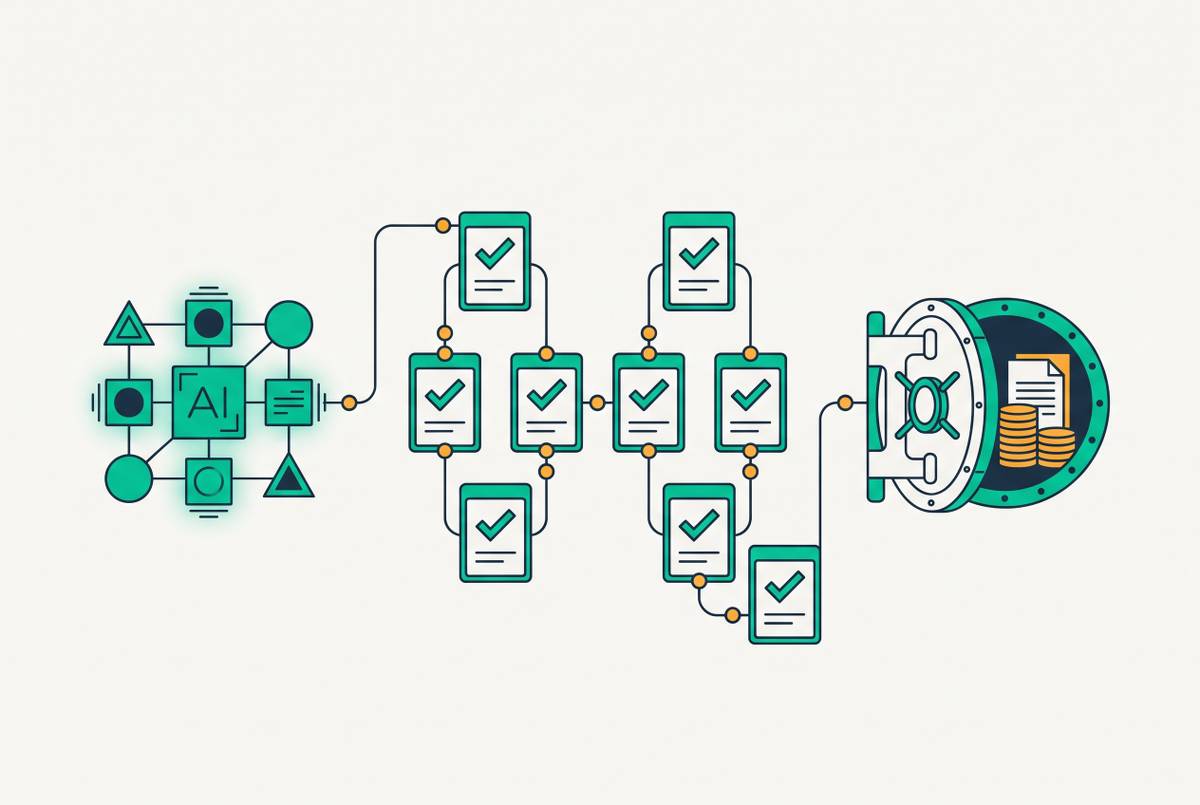
Transparency comes next: the institution must be able to explain, in plain language, how a specific model reached a specific decision, whether the audience is a regulator or the consumer sitting across the desk. Auditability follows close behind: every automated action needs to leave an immutable, contemporaneous record, generated at the moment the decision happened, not reconstructed afterward. Continuous validation closes the loop, testing models on an ongoing basis instead of treating a launch-day approval as good forever.
Architecture choices matter here too, and this is where a lot of institutions make the wrong call. Ripping out core infrastructure to bolt on new AI capability sounds bold, but it multiplies the surface area an examiner has to look at. Building on top of existing banking rails tends to be both the operationally sound move and the one that plays better with compliance. It keeps existing controls intact while extending what the system can do. FORUM Credit Union's AgentFlow integrated directly with the credit union's existing Temenos core rather than replacing it. That's not a small detail: integrating on top of a core system keeps the blast radius contained in a way rip-and-replace never does.
Voice and text interfaces turn out to be a quiet advantage here too. Every interaction through those channels throws off audio, transcripts, recordings, and structured data, all of which becomes exactly the audit evidence regulators want to see. Instead of reconstructing what happened after the fact, the evidence already exists in a form a compliance review can use directly.
The FS AI RMF's staged approach gives smaller institutions a proportionate path: start with the AI Adoption Stage Questionnaire, identify which of the 230 control objectives apply at the institution's current maturity level, and build documentation from there. Nobody is expected to tackle all 230 objectives on day one, least of all an institution still sitting at the Initial or Minimal stage.
The practical steps banks and credit unions should take before any AI system goes into production
Start before the vendor conversation even begins, not after. Map every proposed AI use case against existing obligations first: which FFIEC IT Handbook categories apply, which consumer protection laws (ECOA, FCRA, UDAAP) come into play, and which pieces of model risk guidance are relevant. Doing this after signing a vendor contract means retrofitting compliance onto a system that was never built with it in mind, and retrofitting always costs more than designing it in from the start.
Run the FS AI RMF's Adoption Stage Questionnaire early to get an honest read on current maturity. That result determines which of the 230 control objectives are actually in scope, and it becomes the documentation baseline an institution points to later if an examiner asks how the scope got decided.
Assign ownership before anything goes live, never after. Governance means one accountable person. Define explainability thresholds by use case tier well ahead of launch, so the institution knows in advance what it can say to a consumer or an examiner about how a specific credit decision, payment action, or risk flag actually got produced. Waiting until someone asks that question during an exam is the wrong time to start figuring out the answer.
The urgency here isn't theoretical. According to Cornerstone Advisors' Banking Outlook, 59% of credit unions have deployed generative AI, and 49% of banks have done the same https://www.statista.com/statistics/1652631/agentic-ai-adoption-financial-institutions-by-function/. The Financial Services AI Risk Management Framework itself was built in coordination with more than 100 financial institutions https://www.lowenstein.com/news-insights/publications/client-alerts/financial-services-ai-risk-management-framework-operationalizing-the-230-control-objectives-before-the-market-wakes-up-data-privacy. The scaffolding for doing this right already exists. What's missing at most institutions is the decision to use it before the system launches, rather than after an examiner asks why it wasn't there.
Sources
- U.S. Treasury Department Publishes AI Guidance for Financial Services
- Home | FFIEC
- Financial Services AI Risk Management Framework: Operationalizing the 230 Control Objectives Before the Market Wakes Up (Data Privacy) | Lowenstein Sandler LLP
- FFIEC IT Examination Handbook InfoBase - Home
- SR 26-2 & Agentic AI: Navigating the Fed Model Risk Guidance | Cutover
- cyberriskinstitute.org