Audit Trail Requirements for AI-Executed Banking Transactions
Banks must now log AI transaction decisions with seven fields across multiple regulatory frameworks.
Three regulatory events, all inside a seven-month window, moved audit trails for AI-executed banking transactions from a nice-to-have into an enforceable requirement. COSO published its guidance on internal control over generative AI in February 2026. The SEC intensified its SOX enforcement focus in early 2026, with AI-touched controls squarely in its path. And in August, the EU AI Act's transparency and general-purpose AI provisions reached their enforcement milestone, with high-risk system requirements phasing in on a longer timeline. None of this is on the horizon. It's already here, and banks running AI agents on live transaction rails are already subject to it.
The cost of getting this wrong isn't abstract either. Regulatory fines for AI governance failures reached substantial sums in 2024 and 2025, and that's before counting reputational fallout or the simple fact that a bank can't defend a decision in litigation if it can't reconstruct how that decision got made. On the other side of the ledger, banks with well-built audit architectures report meaningfully faster regulatory response cycles and fewer model risk exceptions. The gap between those two outcomes comes down almost entirely to whether the audit trail was designed in from day one or bolted on after the fact.
The specific frameworks banks must satisfy, and where their requirements conflict
Start with SR 26-2, the Federal Reserve's replacement for SR 11-7 and SR 21-8. It's the first full rewrite of model risk management guidance since 2011, and it hits hardest at banking organizations north of $30 billion in total assets, regulated by the Fed, the OCC, or the FDIC.
Here's the strange part. SR 26-2 explicitly carves generative AI and agentic AI out of traditional Model Risk Management controls. The rule calls these systems "novel and rapidly evolving" and, in effect, declines to govern them under the existing framework. That sounds like relief. It isn't. No parallel framework has stepped in to fill that space, which means every bank, regardless of size, is now getting asked by examiners how it governs the exact category of system the rule says it doesn't cover. The agencies have signaled a forthcoming request for information on bank use of generative and agentic AI, so the gap is likely to close. But it hasn't closed yet, and the exposure sits there in the meantime.
Then there's the EU AI Act. High-risk classification touches a lot of banking activity, though not as broadly as some compliance teams assume. Pure fraud detection is explicitly carved out of Annex III's high-risk list. AML systems land in a grayer zone and may not fall cleanly within or outside the high-risk categories. Where a system does qualify as high-risk, Article 12 requires it be built to automatically log its activity across its lifetime, with real requirements around traceability and input accuracy. Article 26 adds a floor: deployers keep at least six months of logs for high-risk systems.
DORA adds another layer for anything touching critical or important functions: external AI APIs supporting critical or important functions count as part of the bank's ICT risk surface, which pulls in incident classification, resilience testing, and third-party risk obligations.
Now stack the retention clocks side by side. SOX wants at least 366 days of operational logs and seven years for audit work papers. HIPAA wants six years. PCI DSS v4.0 wants twelve months, with three months immediately retrievable. The EU AI Act's floor is six months for high-risk systems. A bank operating across even three of these frameworks can't just pick a convenient number. It has to design to the longest applicable period, which in practice means seven years, not the easiest one to hit.
The 12-field minimum schema requirements, field by field
A common core appears across SOX, HIPAA, PCI DSS v4.0, and the EU AI Act. Call it the 12-field minimum, and gap assessments commonly find multiple fields missing or shallow.
Timestamp, NTP-synced, recorded in UTC using ISO 8601 format. Clock drift used to be a shrug. It isn't anymore.
Unique decision ID, immutable, linking backward to the source data and forward to whatever outcome followed.
Authenticated human user identity is the one that trips up nearly every enterprise AI deployment. Not a service account. Not an API key. A real, individual person. HIPAA's unique user identification rule (45 CFR §164.312(a)(2)(i)) paired with its audit controls standard (§164.312(b)), GDPR's accountability principle, and SOX's individual attribution requirement all converge on the same demand: a name, not a token.
AI system identity and version, the platform itself, tracked for change management.
Model identity and version means a specific version pin, not a family name. "GPT-4" doesn't cut it. The exact build does.
Inputs received, with source attribution, so the raw features feeding the decision carry provenance back to where they came from.
The specific policy, rule, or prompt invoked, the exact instruction the agent was acting under at that moment.
Reasoning, expressed in language a human can read. A high confidence score is not reasoning. It's a number. A regulator needs to understand why, in sentences, not in a probability output meant for a data scientist.
Output produced.
Action taken in downstream systems, so if the decision triggered a journal entry or fired off a payment, the trail connects the decision to that consequence directly.
Human review or approval, where one applies, tagged with the reviewer's identity.
Tamper-evident integrity proof, a cryptographic hash or something equivalent, so the record can't be quietly edited later.
Three failures occur over and over in early gap assessments: AI running under service accounts with no human tied to it, confidence scores standing in for actual reasoning, and retention windows shorter than the applicable floor. For SOX purposes, add one more layer: tag every AI touchpoint to the financial assertion it bears on, existence, completeness, valuation, rights and obligations, or presentation and disclosure. Of the twelve fields, individual user attribution is the one that gets underestimated most. Retention feels like the hard problem because it involves storage and cost. It isn't. Attribution is harder, because it means redesigning how the system authenticates a human.
Why agentic AI makes the audit trail problem structurally harder than traditional automation
Traditional automation follows fixed rules. Input goes in, a rule fires, output comes out. Logging that is almost mechanical. Agentic AI reasons, plans multi-step sequences, executes actions, and adjusts as it goes, which means the thing being logged isn't a single event anymore. It's a chain.
When an agentic system denies a loan or flags a transaction, the explanation might run through a dozen intermediate reasoning steps before landing on the final call. Each of those steps needs its own record: the triggering event, what inputs were visible at that moment, which model or orchestration version handled it, what threshold or prompt governed the step, and what output fed into the next stage. Skip logging any single link in that chain, and the whole reconstruction falls apart later, even if the final output was logged perfectly.
An agent should never be the one taking the action and the sole source of the record proving that action happened correctly. Put those two roles in the same system, and there's no independent way to check the system's own homework. Separate them, and the agent becomes something a regulator, an auditor, or a board can actually govern. This isn't a nice-to-have architectural preference. It's the difference between an audit trail that holds up and one that's really just the agent's own word.
The five transaction categories where incomplete audit trails create the greatest regulatory exposure
AML transaction monitoring and SAR filings. AI that flags suspicious activity without a reviewable evidence trail creates BSA exposure at every single filing. The alert itself isn't enough. Investigators need a full evidence chain ready to review, not just a red flag with no context behind it. U.S. financial institutions spend somewhere between $35 billion and $40 billion a year on AML operations, which gives some sense of the scale at stake if the documentation behind those investigations doesn't hold up.
Credit decisions and adverse action notices. ECOA and FCRA require that adverse action notices spell out the principal reasons for denial in terms a consumer can actually understand and push back on. An AI system can be accurate and still be a liability if it can't produce that plain-language explanation on demand. Fair lending exams specifically hunt for disparate impact that can't be explained at the level of one individual decision, not just in aggregate.
Payment execution and transfers. Every payment an agent initiates needs a clean line from the triggering instruction through authorization, execution, and settlement confirmation. This is where the separation principle matters most: the agent that sends the transfer cannot be the only system recording whether that transfer was authorized correctly.
KYC and customer due diligence. Identity verification, document checks, beneficial ownership review, PEP screening, risk scoring, each step needs its own timestamped, evidenced record. Given that AI already handles fraud detection at 58% of banks, this isn't a future obligation. It's a current one.
Model risk exceptions and override decisions, where a human overrules an AI recommendation, form a fifth category. That override needs its own full record too, reasoning, identity, and outcome, or the bank loses the ability to show why a human judgment call diverged from the machine's.
Architecture decisions that determine whether an audit trail is defensible or merely present
An audit log can have all twelve fields filled in and still fail in front of an examiner if it can be altered after the fact. That's why cryptographic integrity isn't a nice add-on. It's field twelve for a reason: without tamper evidence, a complete-looking log is legally worth about as much as an incomplete one.
The more common failure mode is retrofitting. A bank builds its AI system, ships it, and only later bolts on logging, at which point prompt versions are missing, source attribution is incomplete, and timestamps were recorded inconsistently across different services. That kind of trail falls apart exactly when it's needed most, under examination, months or years after the fact. Audit logging has to be a design decision made before the system goes live, not a compliance patch applied afterward.
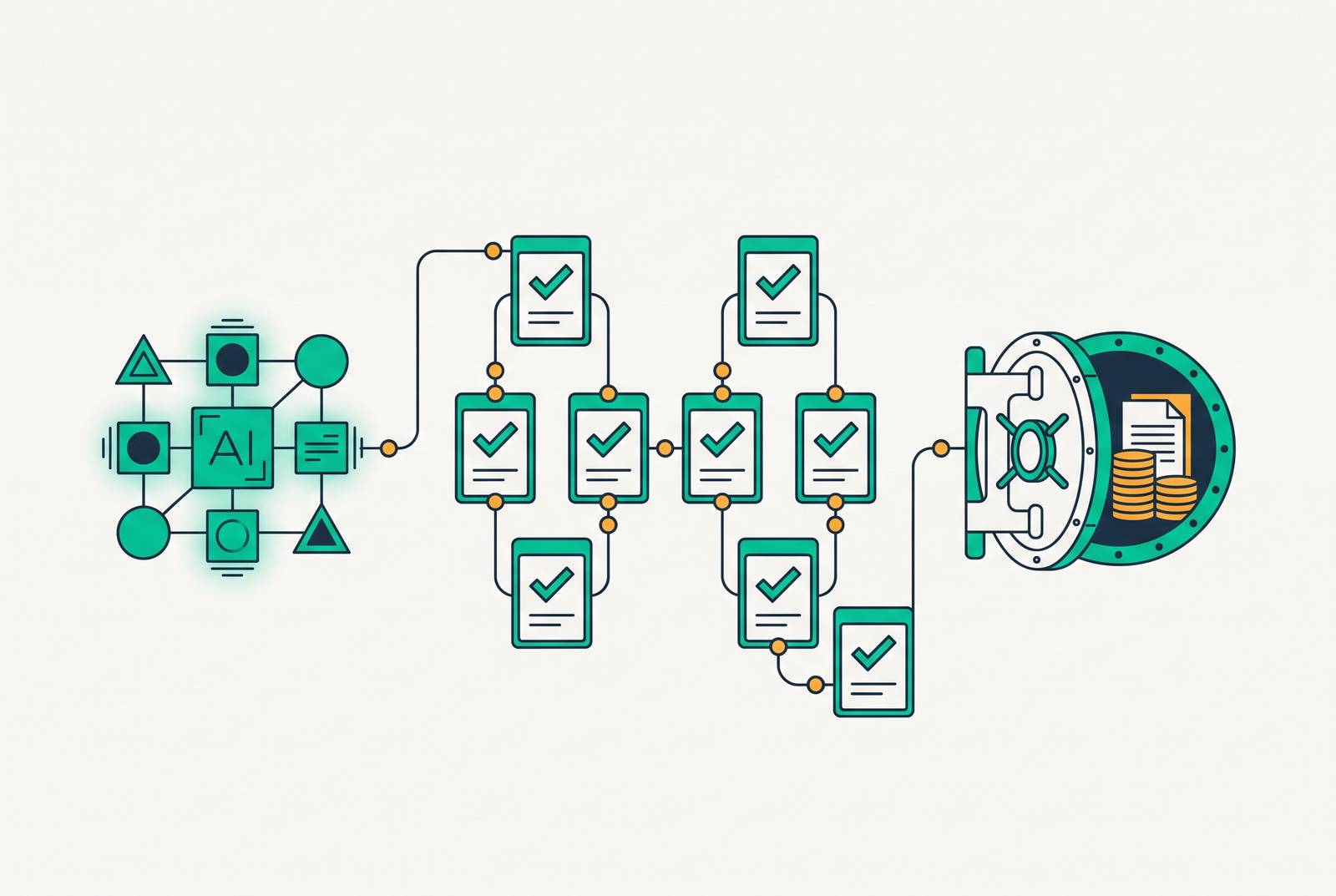
A workable architecture usually needs four things working together. Real-time event streaming, so decisions get captured the moment they happen instead of reconstructed from scraps later. Immutable storage, write-once and tamper-evident. Role-based governance, controlling who can view, query, or export logs, with a clean separation between whoever executes the transaction and whoever audits it. And fast examiner replay: an auditor should be able to pull up any specific flagged decision and walk through it without engineering having to build a custom tool on the spot.
Another point to make: ripping out core banking infrastructure to install a shiny new next-generation stack usually creates more risk than it solves. The stronger move is instrumenting the transaction flows that already exist, wiring the logging in around them rather than replacing the rails.
What a bank's audit trail must answer when an examiner arrives
Every AI decision touching a financial transaction needs to be reconstructible six years later with zero ambiguity about what the model saw, how it reasoned, and who signed off. Storage isn't the point of an audit trail. Answerability is.
So what does an examiner actually ask, staring at one flagged transaction? A handful of questions, every time, in some order:
What did the model see at the moment of decision, exactly, down to the raw inputs? Which version of the model and which version of the prompt or policy governed that decision? What reasoning, in plain language, led from those inputs to that output? Did a human review it, and if so, who, and what did they change or approve? What happened downstream, meaning what system executed the decision and when? And can the whole chain be reproduced today, without guesswork, without engineers reverse-engineering old code, and without any question about whether the record was altered after the fact?
A bank that can answer all six, cleanly, for any transaction an examiner points to, has built an audit trail that works. A bank that can answer four out of six has built documentation. Those are not the same thing, and the difference tends to become visible at the worst possible moment, mid-examination, with a regulator waiting on an answer that should have taken minutes to produce.
Sources
- AI Audit Trail Requirements: A 2026 Checklist for Finance, Healthcare, and Banking
- AI governance in banking: complete 2026 guide
- Audit Trails and Explainability for Compliance: Building the Transparency Layer Financial Services Cannot Ignore | by Lawrence Emenike | Medium
- Banking AI Explainability: From Concern to Compliance
- Best Practices for Auditing AI-Driven Transactions
- Audit trail requirements for AI-driven financial decisions | Ai For Finance Advanced Course | The Neural Base
- clarm.com
- backbase.com