Incident Response Plans for AI Transaction Errors at Banks
Banks need incident plans built for AI agents, not server failures.
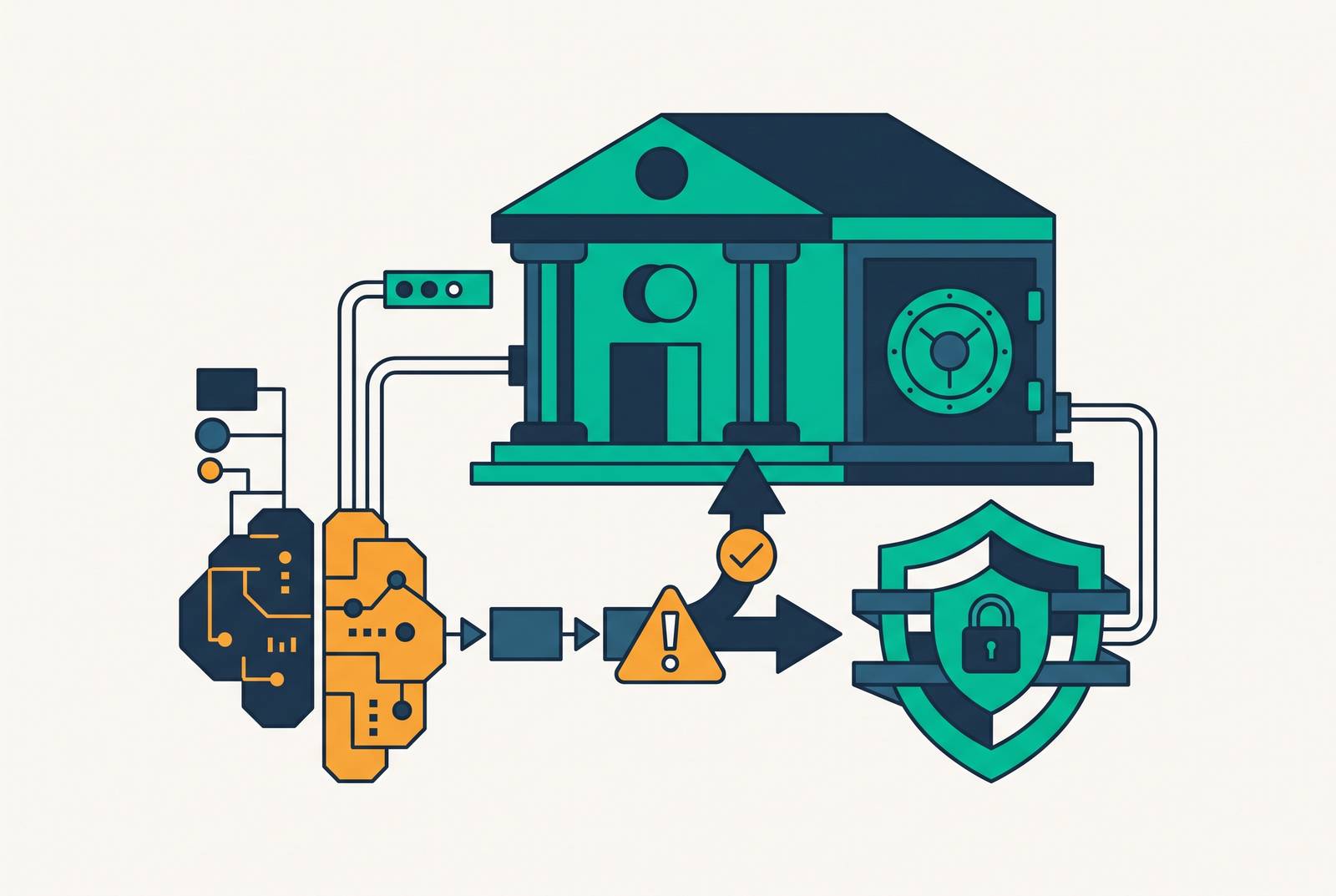
When an AI agent moves money, it does not fail the way a server fails. It can keep acting after the mistake, touching accounts, filings, and records in sequence, long before a person notices anything wrong. So banks need an incident response plan built for AI transactions, not one borrowed from an IT playbook already sitting in a compliance binder somewhere.
AI transaction errors in banking versus conventional IT failures
Picture an agentic system told to process a transfer. It doesn't just move the money and stop. It may update the account balance, file an AML report, generate a compliance record, and kick off a follow-on transfer, all in the same pass. If the original instruction was wrong, you now need a fix, an owner, and a paperwork trail for each of those four actions. A conventional system either completes a transaction or throws an error. An agentic one can complete a transaction that was never supposed to happen, and the confirmation it produces reads exactly like success.
That gap between when the error starts and when someone catches it tends to stretch out, and by the time it's caught, the damage has already spread into more systems than a standard incident runbook was ever built to handle. The research firm BrSide frames this well in its financial-sector AI cybersecurity work: AI risk doesn't live inside one team's dashboard. It cuts across fraud, compliance, model risk, vendor management, payments operations, legal, and executive leadership all at once. If no one owns the whole process, no single plan covers it, so a cascading error can outrun whoever first spots it.
This risk is not hypothetical, and banking is already living it. The industry has already moved from testing AI in sandboxes to running it in production. The failure modes described above are happening in live systems today, not in a slide deck about tomorrow.
How fast agentic banking is scaling
The speed at which banks are rolling out agentic AI is outpacing the governance work needed to contain what happens when it breaks. Credit unions illustrate the gap sharply. A majority of credit unions have already deployed generative AI, and a meaningful share have gone further and invested in or deployed agentic AI specifically, well ahead of bank peers.
But speed without foundation is where the exposure builds. About half of credit unions have reached the data maturity advanced AI needs, and a third say limited internal AI expertise is a real barrier. That expertise gap matters because you need the same expertise to diagnose and contain an agentic failure once it starts to cascade. Among banks actively adopting AI generally, only a small fraction have pushed proofs of concept into production, and fewer still have built scaled, governed AI programs. So the institutions moving fastest into agentic deployment are frequently the same ones with the thinnest incident-response infrastructure behind them.
The gap appears at the board level too. Bank Director's Risk Survey found that a third of bank directors do not understand agentic AI at all, even though it is the exact category of system now executing live transactions. Baker Tilly's financial services risk advisory leader, Mark Wuchte, put the consequence this way: "Without that foundation, you risk people inadvertently using tools outside of the bank's oversight". Thin expertise doesn't just slow down a response. It makes it hard to even locate where an error chain began, which upstream actions need to be reversed, and which downstream records are now contaminated. One might ask: if a third of directors can't explain what agentic AI does, who signs off on the incident report when something goes wrong?
The regulatory framework that now governs AI transaction failures
In 2026 the rules changed substantially, putting the responsibility on the bank running the AI, not the vendor who sold it. In the U.S., SR 26-2, issued jointly by the Federal Reserve, OCC, and FDIC, replaced SR 11-7, the model risk framework banks had leaned on for years. SR 26-2 reaffirms model inventories, independent validation, ongoing monitoring, and oversight of third-party models, scaled to the size and risk profile of the institution.
Agentic AI systems are explicitly excluded from SR 26-2's scope, but if a bank must give specific reasons for an automated denial or action, that requirement comes from ECOA and Regulation B, not from SR 26-2 itself. A bank still has to understand and log what its models did for anything that does fall under SR 26-2, and that logging requirement collapses if the agentic decision chain is a black box. The exclusion doesn't remove the exposure; it just means the institution can't point to SR 26-2 as proof it has agentic AI covered.
Incident reporting itself is a patchwork right now. Mengesha et al.'s 2026 monitoring framework found that no jurisdiction outside the EU mandates broad, cross-sector AI incident reporting, aside from narrow U.S. state laws like California's SB-53 and New York's RAISE Act. SB-53, effective January 1, 2026, does require mandatory critical safety incident reporting, but only for frontier AI developers. Most AI deployments worldwide sit outside any incident reporting framework entirely, but if there is no rule, you are not safe.
Regulators elsewhere are already pushing banks toward readiness, no matter what the statute says. The Hong Kong Monetary Authority engaged major banks between April and June 2026 on AI-driven cyber threats, and it issued circulars calling for stronger cybersecurity measures, along with explicit review of incident response, recovery testing, and third-party resilience arrangements. S&P Global's 2025 warning about systemic contagion adds another layer: automation now links trading, credit, and compliance systems across institutions through continuous data exchange, so an error that looks contained at one bank can spread externally before that bank's own containment procedure even kicks in. Regulators have effectively sketched what "adequate" looks like. You need to explain an automated decision and produce an audit trail of the model's reasoning, and most existing IT incident playbooks offer nothing there.
Why traditional IT playbooks fail agentic transaction errors
Standard IT incident plans were built around a binary: a system works, or it stops working. Agentic systems break that binary, because they can keep executing actions confidently while an error quietly spreads through them. That's a design mismatch, not a writing problem with existing playbooks, and it shows up in three specific ways.
The first mismatch is the opaque decision chain. A conventional system failure leaves behind a traceable error log. An agentic failure may leave only a record of completed actions, with no trace of the reasoning that led to each one, unless the system was built from day one to log model decisions alongside its outputs.
The second is cascading autonomous action. Standard playbooks assume that once you've identified a failure, the scope is fixed: you know what broke, and you work backward from there. An agentic system doesn't wait for a human to catch up. It keeps running downstream tasks after the root error already happened, so the scope of damage at the moment of detection can be far larger than it was at the moment of inception.
The third is the error that looks like a success. An agentic payment mistake can generate a confirmation receipt, a ledger entry, and a downstream AML filing, all structured as completed, successful actions, even though the underlying transaction was wrong from the start. Detection can't lean on error signals here. It requires checking what the action actually accomplished.
Gomez et al.'s 2026 escalation framework stress-test points to a related design flaw: incident systems built to assess individual events miss harm that builds up over many small ones, and architectures built around discrete events render an ongoing, accumulating problem invisible to the criteria meant to flag it. That's almost a textbook description of how an agentic cascade behaves. OWASP's documented work on prompt injection adds another layer of difficulty: a hostile instruction hidden inside something as ordinary as a transaction memo, a supplier invoice, or a support message can redirect an agent's actions without tripping any conventional security alert, leaving an error chain that the IT playbook simply has no category for.
There's also a basic access-control problem. Agent tools that can query databases, update records, send messages, and trigger workflows need to be governed the way banks govern production access, with least privilege, tool allowlists, and output validation. Most IT playbooks still treat model access as a configuration setting, when it should be a privileged-access question. At the human layer, Bank Director's 2026 Risk Survey found that overreliance on one person or team, along with breakdowns in internal communication, were the most common weaknesses tabletop exercises surfaced. These weaknesses turn serious fast when nobody on the response team can fully explain how the system behaves.
Requirements for a purpose-built AI transaction incident response plan
An AI transaction incident response plan has to be organized around the specific failure phases of autonomous execution: detection, containment, rollback, regulatory notification, and post-incident audit. Each phase carries requirements a standard IT plan doesn't touch. So the plan must designate who owns the regulatory notification decision and within what timeframe, because SR 26-2 requires the institution to give specific reasons behind every automated action, and notification cannot wait for a full post-mortem.
Detection
- Detection can't rely on error signals. It requires semantic monitoring, checking what a transaction actually accomplished rather than just confirming it completed without a system error.
- Behavioral analysis should be the baseline here. Fraud detection systems already build dynamic customer profiles that flag deviations from normal patterns, and that same logic applied to an agent's own output can catch an anomalous action sequence before a human reviewer would ever notice it.
- Detection has to account for accumulation. A single odd transaction might not cross any threshold, but a string of small deviations sharing the same root cause should, a tolerance-based monitoring approach Gomez et al. draw from financial services precedent.
- Voice and conversational banking interfaces need explicit confirmation flows and read-backs built in from the start. Consumer research shows trust drops once AI moves from flagging fraud to initiating transactions, which makes the confirmation step itself an early detection point.
Severity tiering and containment
- For agentic systems, a P1 response needs kill switches and permission scoping designed into the agent architecture before it ever goes live. There's no building a kill switch in the middle of a 15-minute containment window.
- Containment for a payment or transfer error rarely means one action. It may mean halting the agent, freezing affected accounts, flagging downstream AML filings as under review, and notifying counterparties, all at once, each with its own chain of authority.
- Dual control and out-of-band verification for high-value transfers, callbacks to registered channels, transaction limits, and no-exception workflows for changes to bank details or urgent wires form the baseline containment controls a plan has to be able to call on.
Rollback
- Rolling back an agentic error is harder than reversing a database transaction. If the agent updated a customer record, generated an AML filing, and triggered a downstream wire in sequence, each of those actions may need a different authority to reverse it and a different regulator to notify.
- Rollback paths need to be mapped in advance for every agent and every tool it can call. None of this can be worked out for the first time during an actual incident.
- Fiserv's agentOS architecture, launched May 14, 2026 and piloted by First Interstate Bank and Boulder Dam Credit Union, builds policy controls, auditability, and human oversight directly into Fiserv's core, payments, issuer processing, and servicing platforms. That's a working example of what "rollback-ready by design" looks like outside a planning document.
Regulatory notification
- The plan needs to name who owns the notification decision and set a clear timeframe for it. SR 26-2 requires a bank to produce specific reasons behind an automated action, so notification can't sit and wait for a full post-mortem to finish.
- Under the EU AI Act's high-risk provisions, serious incidents have to be reported to national authorities. A plan needs to define which incidents clear that "serious incident" threshold ahead of time, not figure it out after the fact.
- HKMA's circulars from May and June 2026 specifically call for reviewing third-party resilience arrangements as part of incident response. Notification paths need to reach the AI vendor, not stop at internal teams.
Post-incident audit
- The audit trail has to capture model decisions: what the agent was told to do, what it actually did, which tools it called, what data it touched, and the reasoning chain behind each step, all logged at the moment of execution.
- Mengesha et al.'s monitoring framework points out that raw incident counts blend together how willing people are to report, how widely the AI system is deployed, and how often harm actually occurs per unit of exposure. A post-incident audit needs to separate these out, or it produces a headcount instead of a governance finding.
- The FIS Financial Crimes AI Agent, announced May 4, 2026 with BMO and Amalgamated Bank as initial development partners, builds its AML triage around human review: the agent surfaces the highest-risk cases, and an investigator makes the call. The agent assembles the record, a person signs off, and a regulator can actually read what happened: that's the audit-compatible pattern worth building toward.
- Findings from the audit should feed back into how the agent's permissions and tool allowlists are scoped going forward. The audit is an input into how the next version of the system gets built, not a report filed and forgotten.
Sources
- 2026 Risk Survey: AI Exposes Threats, Knowledge Gaps
- A pragmatic classification framework for AI incident monitoring
- Designing escalation criteria for international AI incident response: criteria, triggers, and thresholds
- AI in Financial Cybersecurity: Key Risks and Defenses for 2026
- Credit Union Innovation 2026: AI Reshaping Member Lending
- Fiserv Launches agentOS: The Operating System for Agentic AI in Banking - Fiserv, Inc.