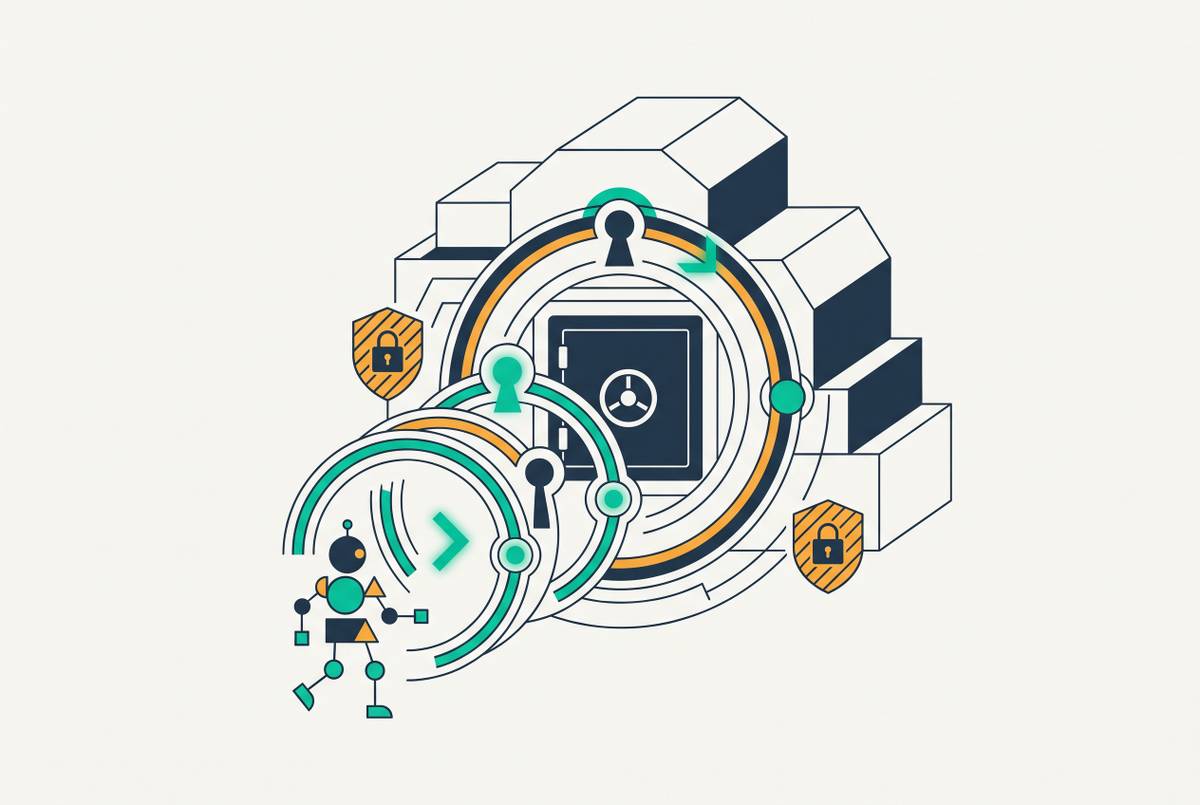
Real-Time Monitoring and Alerting for AI Banking Agent Activity
Banks must monitor AI agents in real time before they act, not after transactions complete.

A system that surfaces an insight tells a human what it noticed and waits. A system that executes a transaction moves money, flags a payment for release, or clears an account, often before any person looks at what it did. That difference is the whole argument here: agentic AI in banking has moved from experimentation into live production, and the monitoring built for the first kind of system cannot do the job the second kind now demands. Traditional transaction surveillance was built to review a completed, human-initiated event: a wire goes out, a rule checks it against a pattern, someone gets a case file the next morning. Agents don't work that way. They plan a sequence of steps, pick tools, judge their own confidence, and carry a task through to completion on their own. Reviewing the result after the fact is already too slow to catch the problem while it's still fixable.
What agentic banking activity looks like in production today
The agents already running in banks today orchestrate chains of steps across multiple systems, and each step in that chain is a place something can go wrong or quietly drift off course.
FIS and Anthropic announced a partnership on May 4, 2026, to bring agentic AI into banking, starting with a Financial Crimes AI Agent. According to the companies' own description, it combines Claude's reasoning with FIS's banking data and regulatory infrastructure, and it's designed to compress AML alert reviews and case investigations from a process that used to take days down to minutes. BMO and Amalgamated Bank are already developing with it, and FIS plans general availability in the second half of 2026. FIS describes the setup as an agent-first, governed environment: client data stays inside FIS-controlled infrastructure, and every decision the agent makes is meant to be traceable and auditable. That last part is the monitoring obligation hiding inside the convenience. When an agent turns days of investigator work into minutes, whatever watches it has to be able to pull apart the full chain of reasoning behind a decision, not just record whether the case was cleared or escalated.
Mastercard's Decision Intelligence works on a millisecond timescale. It evaluates transactions in milliseconds for fraud risk, weighing contextual signals at the moment a card is authorized. That's compliance screening running at the actual speed of a purchase, with no practical window for a human to look at any single decision before it takes effect.
One system reasons through a case over minutes and needs its logic preserved for later review. Another decides in milliseconds and needs rules baked in before the transaction happens, because there's no time to intervene after. A monitoring framework for agentic banking has to cover both ends of that range, along with everything in between, which is a much wider job than anything built for after-the-fact transaction review.
The five monitoring dimensions that traditional transaction surveillance does not cover
Five things need watching here that legacy transaction surveillance was never built to see: what the agent intends to do, the sequence of actions it takes to do it, how confident it actually is, what tools and permissions it's using, and how it coordinates with other agents.
Start with intent. An agent doesn't just execute a command, it pursues a goal, and it can land on a plausible but unauthorized reading of that goal without ever producing an obviously wrong output. Catching that kind of drift means checking the agent's interpreted objective against what it was actually authorized to do, before it acts, not after a bad transaction shows up in a report.
Then there's the sequence itself. A cross-border payment might move through routing optimization, a compliance check, and post-settlement monitoring, all handled by the same agent. If an early step gets something wrong, every step after it builds on a bad premise, and the risk compounds. Auditing this kind of workflow means capturing the whole sequence, not just the final transaction record that comes out the other end.
Confidence and hallucination risk determine who is liable when things go wrong. If a model invents a plausible-sounding reason to clear a suspicious transfer, the bank carries the fallout, not the vendor that built the model. Global fraud losses already run into the hundreds of billions each year by 2025 figures, and a hallucinated clearance adds a new way for that number to grow. Monitoring has to surface the agent's actual confidence and its reasoning, not only its final decision, so a reviewer can push back on an answer that looks right but rests on something the model made up.
Tool and permission scope is its own category. Accenture's Top Banking Trends for 2026 report calls for an agent identity framework, giving every agent its own authentication, authorization, and role-based permissions. Agents need defined identities and limited access to specific tools, and the monitoring layer needs to check, in real time, that an agent never reaches past what it's been given.
Finally, coordination between agents. BNY's Eliza system runs 13 specialized agents working together, and Accenture specifically names multiagent validation for sensitive tasks as something CIOs need to build in. When one agent hands a task to another, the monitoring system has to track that handoff: what context passed between them, and whether what got delegated matches what actually got done. A record of one agent's actions isn't enough once several agents are working together. The record has to stitch all of their interactions into something a human examiner can actually follow.
How the three-lines-of-defense model adapts to an AI agent as first line
Banks already have a structure for this kind of risk problem, built around three lines of defense, and that structure still holds. What changes is what each line actually does once an agent, not a person, is running the first-line workflow.
The first line is the agentic workflow itself, along with the controls built into it: thresholds, approval gates, escalation rules, confidence limits, tool permissions, and logs of every action taken. Those controls need to be set before the agent goes live, not added afterward once something has already gone wrong. Monitoring isn't a separate check bolted onto the system. Monitoring is a direct consequence of how the first line was designed.
The second line is independent risk oversight, and it needs more than the ability to flag a concern back to the first line. It needs the authority to pause or restrict the agent. Kill switches and override triggers have to be built and tested ahead of time, not improvised in the middle of an incident when it's already too late to think clearly about the right response.
The third line is internal audit, and its job widens. Instead of just reviewing transaction records, auditors now have to evaluate whether the controls, the logs, the incident responses, and the remediation steps around the agent are actually reliable. That means auditors need enough fluency in how these models work to push back on a model validation report, not just check whether the paperwork around it was filled out correctly.
An agent control room ties all three lines together. Picture a centralized interface that shows real-time agent activity, pending escalations, override triggers, and the current state of the audit trail, all in one place. It's the point where all three lines can actually see the same thing, at the same time, instead of working off separate and possibly contradictory pictures of what the agent is doing.
What configurable human override requires
A monitoring system with no override triggers tuned to the specific bank running it is a log with a dashboard attached, and it will fail exactly when it matters most: the moment something starts to go wrong.
There's a real difference between an alert and an override trigger. An alert tells someone something happened. An override trigger stops the agent's next action, pauses it, or reroutes it, while a human reviews what's going on. For an agent that executes transactions, the gap between an alert firing and the consequence landing can be a matter of milliseconds, so the override has to be wired directly into the workflow. It can't depend on a person seeing a notification in time to act on it.
Those triggers also need to be set by the bank itself, not handed down as generic defaults from whatever platform the agent runs on. A bank might require a transaction above a certain size to get mandatory human sign-off before it executes. It might route any decision where the agent's confidence drops below a set threshold to a human reviewer. It might pause cross-border payment orchestration automatically whenever a jurisdiction or counterparty hits a flag. It might cap how many steps an agent can take without a human checkpoint, so a long unsupervised sequence triggers escalation on its own. None of these are settings a vendor can reasonably choose on a bank's behalf, because they depend on the specific risks that bank is willing or unwilling to carry.
There's also an open legal question sitting underneath all of this. Regulation E requires demonstrable consent for authorizing transactions, and it's currently unresolved whether a consumer handing an AI agent access to their account or payment credentials actually satisfies that requirement. Until that gets settled, a human-in-the-loop checkpoint isn't just good practice for certain transaction types. It may be close to a legal necessity. Accenture's own recommendation lines up with this: build real-time telemetry tracking paired with multiagent validation for sensitive tasks, with the bank itself deciding what counts as sensitive, based on its own risk appetite, rather than inheriting that definition from a general-purpose AI platform's settings.
The Bank of America case shows what happens without any of this in place. The failure wasn't that the AI itself was somehow too capable. The failure was that no institutional workflow existed to govern what that capability was allowed to do, which is the comparison people mean when they call it a Formula 1 race car being serviced by local mechanics. Override triggers are what that governance actually looks like once it's built: specific, pre-configured, and tested before the agent ever touches a live transaction.
The regulatory floor that now applies, and the compliance gap it creates for banks without real-time monitoring
By the middle of 2026, any bank running agentic AI without real-time monitoring and a full audit trail sits inside a compliance gap, because the guidance that used to cover AI model risk doesn't reach agentic systems, and new requirements are arriving from several directions at once.
The clearest signal came on April 17, 2026, when the OCC, the Federal Reserve, and the FDIC issued revised interagency model risk management guidance, filed as OCC Bulletin 2026-13 and designated SR 26-2 by the Federal Reserve. That guidance formally replaced the long-standing SR 11-7 and explicitly placed generative and agentic AI outside its scope. In practice, that means the model risk playbook most banks have relied on for years no longer covers the systems they're now putting into production. The agencies were clear that this isn't a free pass: core principles like materiality, ongoing monitoring, and effective challenge still apply even to tools the formal guidance doesn't name. A request for information on AI-specific model risk is expected to follow, which signals that this regulatory floor is still being built.
Pressure is also building outside the domestic market. Under the EU AI Act, high-risk AI systems in the financial sector must meet specific requirements for transparency, traceability, and human oversight by August 2, 2026. Any bank operating across borders now faces explainability obligations that map almost directly onto the monitoring framework described throughout this piece: traceable decisions, human oversight points, and systems built to explain themselves.
Colorado adds another layer. Its AI Act, as amended by SB 26-189, takes effect January 1, 2027, after the amendment repealed the original law ahead of its earlier June 30, 2026 start date. It places obligations on developers of high-risk AI systems that have a material effect on financial services, covering public disclosures, consumer notification, impact assessments, and a standard of reasonable care meant to prevent algorithmic discrimination.
Different regulators, different jurisdictions, and different legal mechanisms all produce the same requirement. Real-time monitoring, full audit trails, and human oversight built into the system from the start are no longer features a bank can choose to add later. They're the baseline a bank needs just to operate an AI agent that touches real transactions and real customers.