Automated Reconciliations in Bank Payment Operations
Fixing broken payment data before matching reveals why most reconciliation fails.

Manual reconciliation in bank payment operations doesn't fail because staff are careless. It fails because the data hitting the reconciliation desk is broken before anyone opens a spreadsheet. The average online business runs on 7 or more payment platforms, per a Stripe report, and each one speaks its own dialect: different timing conventions, different reference schemas, different ideas of what a "memo" field is even for. Banks, ERPs, payment processors, and billing systems were never built to talk to each other, so memos come through garbled, payouts get bundled together, and reference IDs that started clean on one end arrive mangled on the other.
That's not a volume problem. Add more transactions to a well-normalized dataset and matching still works fine. The real issue sits one layer earlier: the data is incompatible before a single match attempt gets made. And once that incompatibility exists, it doesn't stay put. Small mismatches turn into reporting discrepancies that cross subsidiaries and currencies, and reconciliation timelines stretch further behind actual transaction volume. That's its own trap, since the backlog grows faster than the team assigned to clear it. Delayed reconciliation means decisions get made on data that's a week old, sometimes older, and accountants who trained for analysis spend their days doing manual lookups instead.
For years, the institutional answer was to throw more people or more engineering hours at the problem, or just accept a baseline level of revenue leakage as the cost of doing business. That approach has hit its ceiling. It doesn't scale with how fast and how large modern payment flows have gotten. This isn't a failure of effort on the part of banks. It's a mismatch between how payment data gets generated and how much of it a person can reasonably process by hand.
What automated reconciliation actually does to that input problem
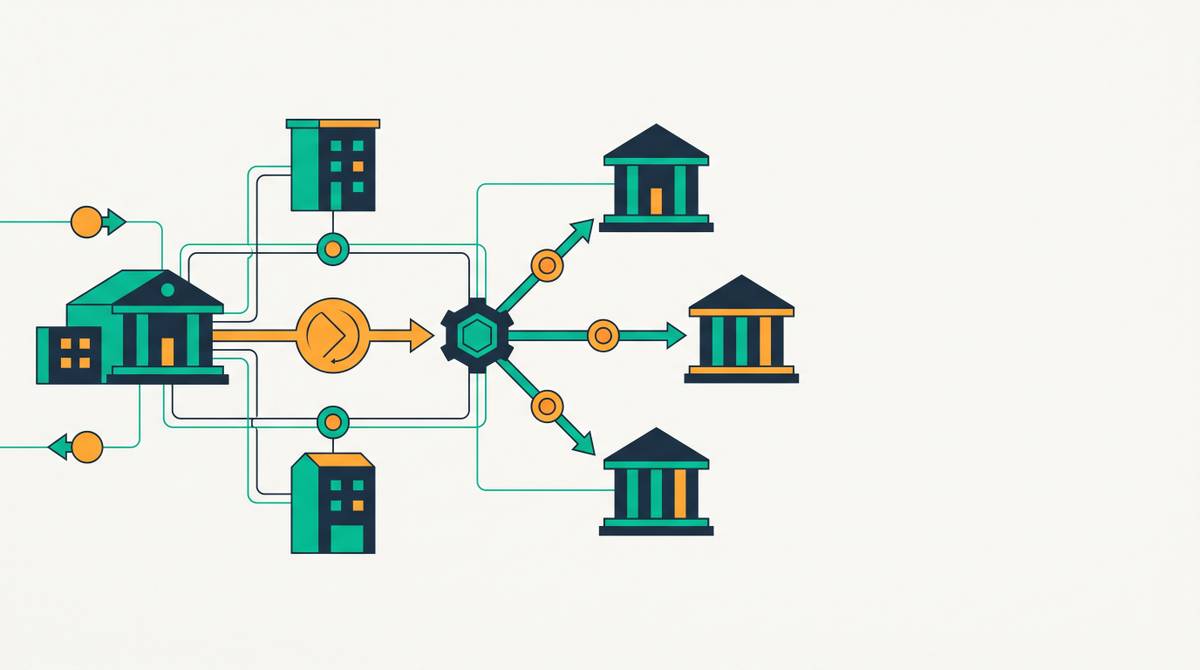
Before any matching happens, an automated reconciliation system has one job: take incompatible data and make it compatible. Ingestion and normalization come first, matching comes second, and skipping that order is where a lot of homegrown fixes go wrong.
Platforms built on large language models parse memo fields and free-text descriptions to pull out the financial identifiers buried inside them. They normalize field formats that differ across banks, processors, and internal systems, and map all of it into one shared schema. Nothing about the source data changes here. The AI layer sits on top of the raw files and adds the interpretation a person would otherwise have to supply by hand, so reconciliation moves forward without anyone cleaning files first.
What does that solve in practice? A wire memo written in shorthand can be parsed to figure out which invoices it's actually paying. A payer name that shows up differently in the bank feed than it does in the ERP, maybe because of a subsidiary name or an alias, gets resolved by looking at historical payment behavior and surrounding metadata. A payment with no invoice reference attached at all can still get matched, by pulling remittance advice sent separately through email or as an attachment.
Only after that normalization step does matching logic take over, and this is where AI earns its keep against anything rule-based. Partial payments, split payments, advances, the exception cases that never line up 1:1 against a structured record, these are exactly what rigid rule sets choke on. Worth drawing a clear line here between this and robotic process automation. RPA is genuinely good at validating, compiling, and running repetitive tasks according to fixed rules. But rule-based systems have no mechanism for handling cases outside those rules, which is precisely where reconciliation's hardest problems begin. Its usefulness runs out right where reconciliation's hardest problems start. A bank still betting its exception handling on RPA alone is solving last decade's version of this problem, not the one sitting in front of it.
How exception handling shifts from a backlog problem to a prioritization problem
Exceptions aren't going away. That's not the goal, and any vendor promising zero exceptions should raise an eyebrow. The real question is whether exceptions sit in a queue aging for weeks, or get surfaced and triaged the moment they show up.
AI confidence scoring is what changes that math. High-confidence matches move through automatically, without a person ever needing to look at them. Only the genuinely ambiguous cases get flagged for review, so human attention goes where it's actually needed instead of getting spread evenly across every transaction regardless of risk.
Human-in-the-loop design keeps control in the room. One-click adjustments let a reviewer modify, validate, or reject whatever match the AI proposed, and every one of those actions gets time-stamped and logged automatically. Then there's the learning loop: each correction a person makes feeds back into the system, so accuracy on future reconciliations keeps improving instead of holding flat.
Phacet's case study on Smartbox found that intelligent payment matching saved a full week of work per month and cut the error rate on data processing from 7% down to 2%. Day to day, that means finance staff stop manually chasing down discrepancies, a process that could eat weeks of a month, and start reviewing flagged items that already come with full context attached. That's the actual shift. Not fewer exceptions, but exceptions that cost a fraction of the attention they used to.
Continuous reconciliation versus batch reconciliation, and why the difference matters operationally
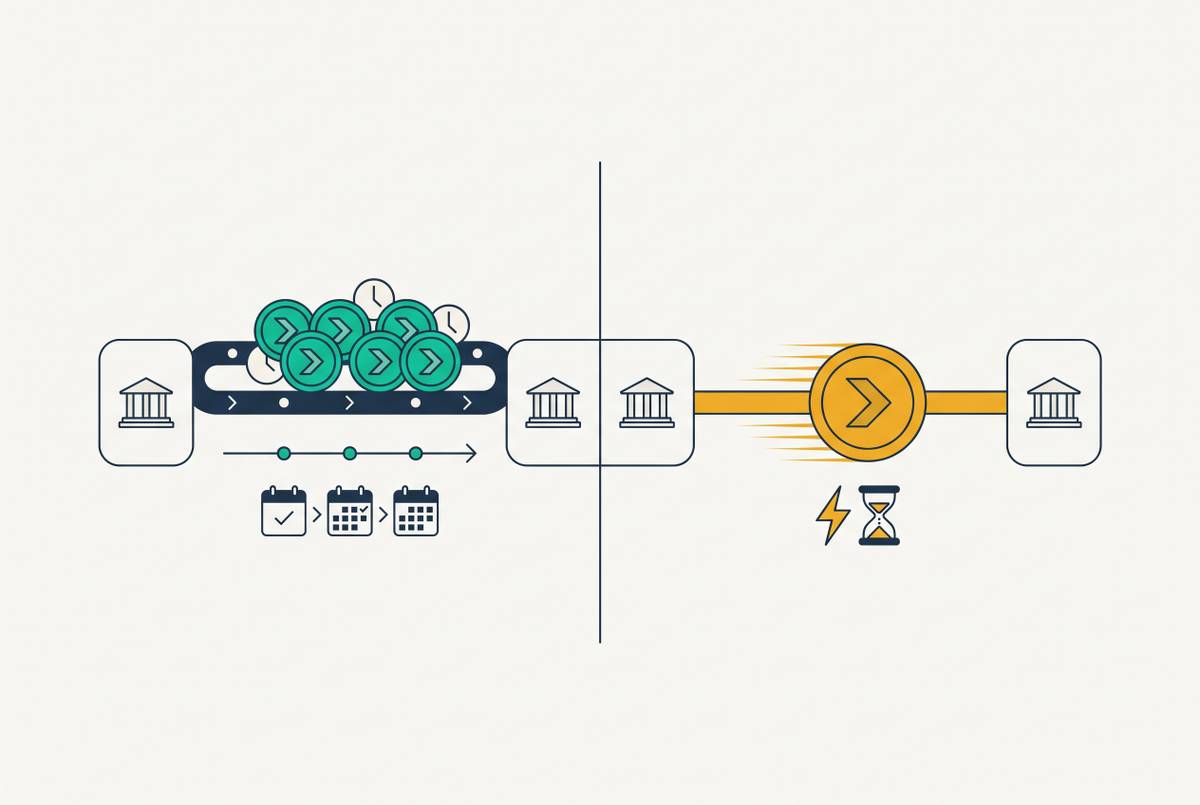
The traditional model exports files at period-end, reconciles everything in one bulk pass, and reports on numbers that might already be days or weeks stale by the time anyone acts on them. That's the batch model, and it's been the default for so long that a lot of finance teams don't think of it as a choice anymore. It should be one, because the alternative already exists and already works. Clinging to batch processing in 2026 is closer to habit than strategy, and it's worth naming that plainly instead of treating both models as equally defensible.
Continuous reconciliation is event-driven instead. Transactions get ingested and matched as they happen throughout the month, not stacked up and dumped on the close. Teams work off live data rather than a snapshot exported three weeks ago. Missing deposits, misapplied payments, inflow or outflow anomalies: all of it surfaces in real time, not after the fact. Open banking APIs increasingly build AI in to give institutions instant multi-bank cash positions, which opens the door to real-time forecasting and automated liquidity moves.
None of this would be technically possible without the ISO 20022 migration, which established richer, structured, machine-readable data across the payment lifecycle. That migration is the infrastructure piece that made event-driven reconciliation possible at scale, not just in theory. Batch data can't support continuous reconciliation, because by definition it's already behind by the time anyone looks at it.
The shift underneath all this is real: reconciliation stops being a monthly cleanup chore and becomes an ongoing control mechanism, one that feeds forecasting and liquidity management as events happen rather than weeks later.
What straight-through processing rates reveal about where reconciliation failures actually live
Straight-through processing, or STP, is the cleanest metric available for reconciliation health. It measures the share of transactions that go from initiation to settlement without a single manual touch.
Most banks top out around 60% STP. Everything past that point falls into operational whitespace: the space between systems where handoffs happen, exceptions pile up, and someone has to coordinate manually to close the gap.
J.P. Morgan is the benchmark worth knowing here. Moving more than $12 trillion across 60 million transactions a day, spanning over 200 countries and roughly 120 currencies, J.P. Morgan runs at a 99.5% STP rate. Don't mistake that gap for a technology gap, in the sense of fancier software on better servers. It's a data standardization and exception-handling gap, built on years of investment in AI and machine learning plus early adoption of ISO 20022's structured messaging standard. Which is precisely the terrain automated reconciliation is built to cover.
For community banks and credit unions, that 60% ceiling doubles as a diagnostic tool. Every transaction that falls outside STP is a manual reconciliation touch, a potential exception, and an audit event that has to get tracked somewhere. Closing even part of that gap, through normalization, AI matching, and human-in-the-loop exception handling, compounds over time into real reductions in operational cost and settlement risk. Smaller institutions don't need to hit 99.5% to see the benefit. Closing even part of that gap produces workload reductions that staff notice meaningfully over time.
Audit trails and compliance output as a first-class product of automated reconciliation, not an afterthought
Every match, every edit, every exception classification, every human override inside an automated system gets time-stamped, traced, and made export-ready by design. Nobody has to build that record after the fact, which is exactly where manual reconciliation falls apart under scrutiny.
An audit trail generated by an automated system contains four things a spreadsheet-and-email process almost never can:
- Source data provenance: where each transaction came from and how it got normalized
- Match logic: what rule or AI inference produced each match, and how confident the system was
- A full human intervention log: every human-in-the-loop action, who took it, and when
- The disposition of every exception: how it was classified, routed, and eventually resolved
Compare that to the manual version, reconstructed after the fact out of old spreadsheets and email threads, assuming anyone remembers which version of the spreadsheet was actually final.
Regulation is catching up to this reality, not the other way around. Regulatory frameworks such as the EU AI Act and DORA have established obligations around transparency and ICT risk management that assume the kind of logged, attributable decision record that automated reconciliation produces natively, as a byproduct of how it works rather than as a compliance bolt-on.
Regulators have made the framing increasingly explicit: AI in financial operations is an ICT risk management issue, not merely an innovation topic or an ethics debate. Regulators expect AI-driven financial processes to produce auditable output as a baseline requirement, not as something a vendor gets to advertise as a bonus feature. The practical payoff shows up when internal audit, external examiners, or compliance staff need to review a reconciliation decision: they look at the record directly, instead of reconstructing the whole process from raw files after the fact.
The governance gap most institutions deploying reconciliation automation haven't closed
Deployment and readiness are not the same thing, and most institutions are further apart on these two than they'd probably admit. Wolters Kluwer's Q1 2026 Banking Compliance AI Trend Report, surveying 148 financial institutions, found that about 31.8% have moved AI or machine learning into production. Only 12.2% describe their AI/ML strategy as well-defined and properly resourced. Read those two numbers side by side and the gap becomes obvious: a lot of institutions are running systems they haven't finished building the governance around.
Data infrastructure is the most concrete part of the problem. Only 9.5% of respondents said they felt very prepared to support AI on their existing data infrastructure, while 48% called themselves somewhat prepared, which is a polite way of saying not really, but managing.
AI brings risks that traditional control environments weren't built to catch. Model drift is one: matching logic that performed well at deployment can degrade quietly as transaction patterns shift underneath it. Bias accumulation is another, where systematic mismatches build up silently over months without triggering any alarm. Automation bias might be the most human of the three, where reviewers start deferring to whatever the AI recommends without actually scrutinizing it.
That last one deserves the most attention, not the least, because it's the failure mode that looks like everything is working right up until it isn't. Industry surveys consistently identify automation bias as one of the greatest risks to AI safety frameworks in financial institutions. A significant share of the industry already sees this coming. Treating it as a footnote instead of a design constraint is the mistake most institutions will make anyway, and it's worth calling that out directly rather than softening it.
Static software runs on fixed rules and stays put until someone changes the code. AI models learn from new data and shift their own behavior over time, so one-time validation at launch isn't enough. It never was going to be. Real governance means clear standards for model validation and residual risk assessment, ongoing monitoring for drift in matching behavior, defined roles spanning business, risk and compliance, technology, legal, and internal audit, and alignment with the institution's actual documented risk appetite. Skip any of those, and the system doesn't fail loudly. It degrades quietly, and most institutions without dedicated monitoring in place won't catch that until an audit finds it for them.
What responsible deployment of automated reconciliation looks like in a regulated banking environment
Automation and accountability get treated as if they're in tension. In reconciliation specifically, they're not. The audit trail, the human-in-the-loop controls, the confidence scoring, the exception routing: these are all governance, just expressed as workflow instead of policy memo.
Deploying on top of existing banking rails, connecting into the bank's current ERP, core banking system, and payment infrastructure through APIs, beats ripping out core systems and starting over. It keeps institutional knowledge intact and keeps integration risk contained to something manageable. CGI's banking predictions for 2026 point to a broader shift from generative AI experimentation toward agentic AI embedded directly in core banking infrastructure, and automated reconciliation is one of the most mature, highest-value places to make that transition. Okpala et al. (2025) describe this kind of architecture as "agentic crews": adaptive, semi-autonomous systems that plan, normalize, match, classify exceptions, and route for human review, all while staying under human oversight rather than replacing it.
What should an institution actually require before signing off on any of this? Start with SOC 2 certification or an equivalent standard, as a baseline for anything touching real financial transaction data. Add configurable controls too: matching thresholds, exception routing rules, and approval workflows that a business user can adjust without waiting on an engineering ticket. Require complete, immutable audit logs generated natively at every decision point, not reconstructed after the fact. Insist on human override at every stage, with no fully autonomous posting to the general ledger absent a governed approval path. And set a defined cadence for model monitoring, covering match accuracy, exception rates, and drift indicators, on a schedule someone actually owns.
Banker skepticism about AI in financial operations is fair, and it shouldn't get waved away. But dismissing automated reconciliation on principle is the wrong call, and bolting it on without the governance work described above is just as wrong, maybe worse, since it looks like progress while quietly building the next audit finding. The path that actually holds up runs through the audit trail and the override logs, showing that the controls built into a responsible deployment are more rigorous and more traceable than the manual process they're replacing. Institutions that get this right don't just close their books faster. They end up with a financial operations record that holds up better under an auditor's questions, reads clearer to a regulator, and does more for the organization than any spreadsheet ever could.