Invoicing Workflows in Bank-Facilitated Payment Automation
Bank ownership of the full workflow, not just speed, unlocks fraud control and scale.

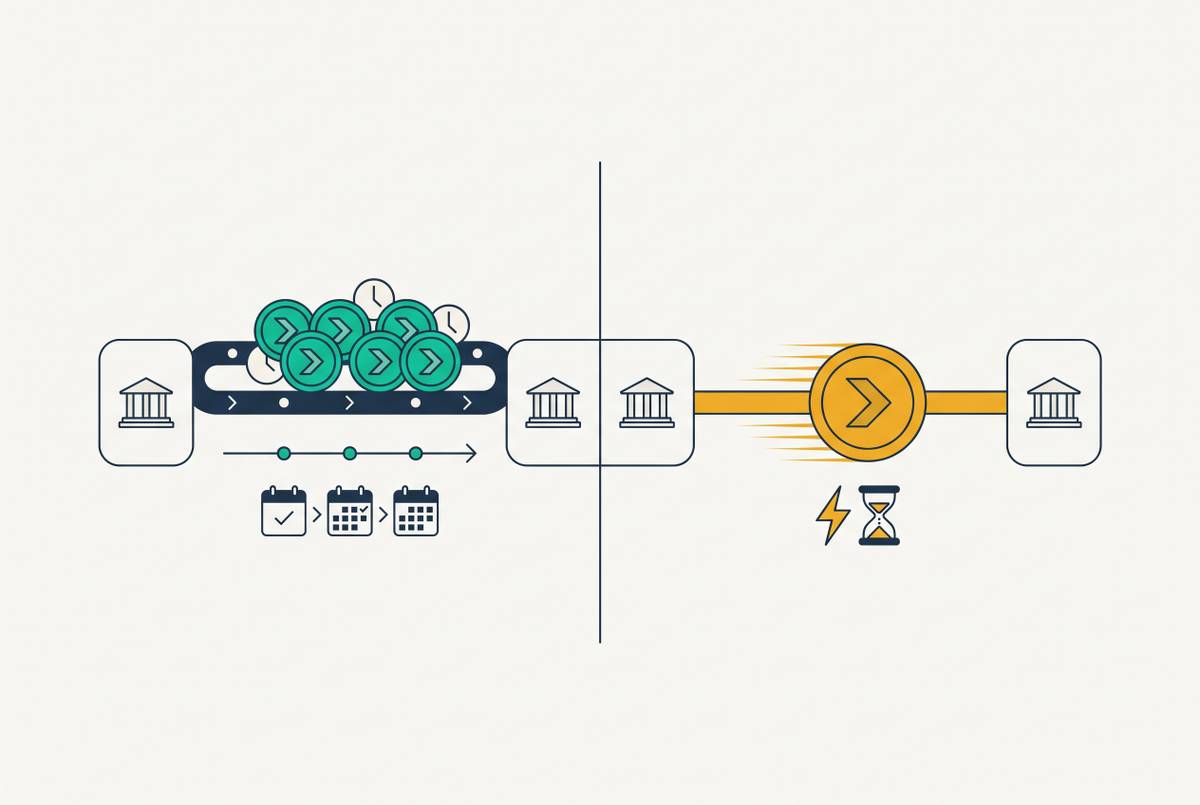
Bank-facilitated payment automation doesn't just speed up how fast an invoice gets paid. It changes what the invoice workflow actually is: a chain of manual handoffs becomes a single governed process running on the bank's own rails, start to finish. Most institutions still treat this as a speed upgrade. That's the wrong frame, and it's costing them the harder, more valuable win.
Most accounts payable teams still key invoices into their ERP by hand. Manual entry remains common across organizations, not the exception. For a mid-market company processing a few thousand invoices a month, that means roughly one full-time employee is tied up just opening, checking, entering, and routing paperwork. Multiply that across a bank's whole portfolio of business clients, and the problem gets a lot bigger fast.
The numbers back this up. Ardent Partners' State of ePayables 2025 puts the average cost per invoice at $10.89, against $2.78 for best-in-class teams, a gap of roughly $8 per invoice. Processing time tells a similar story: 10.9 days on average versus 3.1 days at the top. None of that counts fraud. The 2025 AFP Payments Fraud and Control Survey found most organizations reported attempted or actual payments fraud in the prior year, with manual processes widely cited as a key vulnerability in payments fraud. Every time a person retypes a number or forwards a PDF for approval, that's a moment where data drifts, timing slips, or someone impersonates a vendor. The workflow itself is the attack surface. It's not some outside threat bolted on top of it.
What changes when a bank owns the full invoice-to-payment workflow
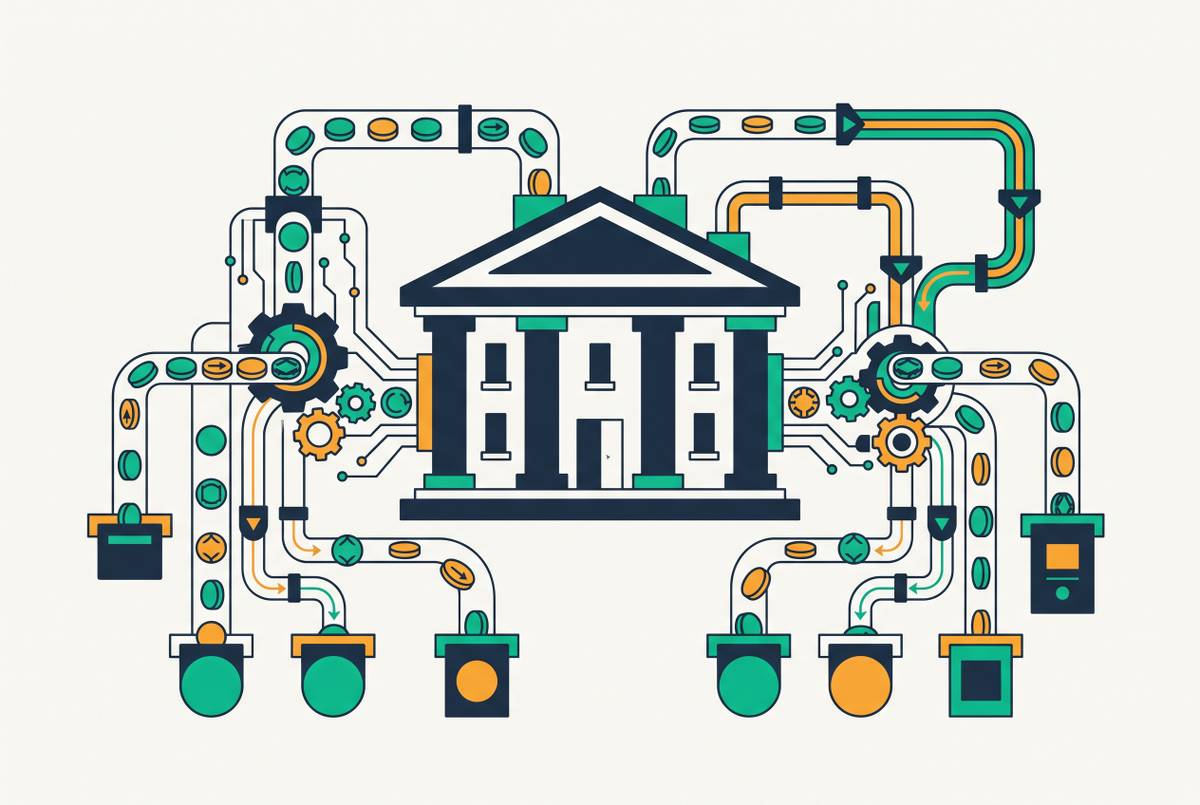
Draw a clear line here: bank-facilitated automation means the institution executing the payment also governs the workflow that triggers it. That's different from a fintech layer sitting on top of a bank, passing instructions through like a messenger service. When the bank owns both ends, there's no handoff between the system that decided and the system that paid. Most vendor pitches skip right past this distinction. It's the one that actually matters, and the one that's hardest to fake.
Agentic AI raises the stakes on getting this right. Per an IMF Notes paper from Davidovic and Tourpe (Volume 2026, Issue 004, April 2026), agentic systems interpret a goal, plan out several steps to get there, and act on banking infrastructure with limited human input at each step. That's a real shift away from a person typing explicit instructions for every transaction. The IMF frames this as a meaningful shift in how authorization, control, and settlement interact across the payment chain. A bank running its own agentic workflow governs all three layers, not just the moment money moves, but the reasoning that led to it.
Older rule-based automation could only follow paths someone coded into it. Feed it an invoice format it hadn't seen, and it broke, or bounced the document to a person. Agentic systems work differently: they adapt to a new vendor template, a policy change, or an unfamiliar invoice layout without anyone rewriting the rules. Call it judgment instead of template matching.
None of this works if a bank has to rip out its core payment infrastructure to get there. The AI layer has to sit on top of rails the bank already runs, full stop. Finzly's Agentic Galaxy, announced October 22, 2025, is built on the same ISO 20022-native framework that already powers its Galaxy payment products, so the bank isn't swapping in new plumbing. It's adding a layer of judgment to plumbing that's already there. And because every agent decision moves through that same governed infrastructure, there's no gap between the record of why a decision got made and the record of the transaction itself. That single detail is what makes an audit trail possible later.
How each stage of the invoice workflow is restructured under automation
Break the workflow into its five stages and the changes get concrete fast.
Ingestion and capture. Invoices show up everywhere: email inboxes, supplier portals, EDI feeds, scanned paper somebody dropped on a desk. Agentic systems pull from all of it and turn whatever they find into structured data, without needing a separate template for every format. A new invoice layout, a different language, a credit memo instead of a standard bill: none of that requires retraining. The system reads the document type and adapts on its own.
Data extraction and validation. Line items, tax amounts, payment terms: the system pulls all of it out no matter how the document is laid out, then checks it against the purchase order, the contract, vendor master records, and past transaction history before the invoice moves forward. GL coding gets applied line by line, automatically. If something's missing, the system checks the vendor's billing history first, rather than dumping the invoice into a person's queue by default.
Three-way matching and confidence scoring. This is where the invoice, the purchase order, and the goods-receipt record get compared. If everything lines up, a human reviewer never sees it. Confidence scoring decides what counts as "lines up": each extracted field gets a score, and thresholds determine whether the invoice sails through or gets flagged. A header total below a set confidence threshold triggers mandatory review. A missing PO on a vendor that requires one routes straight to procurement. Vendor case studies report no-touch rates as high as 85% for PO-backed processes once the deployment matures, which says something about how much of this work never needed a person in the first place.
Approval routing. Here the system feeds a reviewer context, not just a raw PDF: prior payment history, contract terms, remaining budget, whether an early payment discount window is closing. Approval hierarchies get set by the institution, and potential fraud gets flagged before it ever reaches someone's inbox. Some deployments allow approvals through voice or text, right inside the bank's existing interface, so a manager isn't logging into a separate AP portal just to click approve.
Payment execution and rail selection. The system picks a rail (FedNow, Real-Time Payments, ACH) based on cost, speed, liquidity position, and fraud risk, then fires the payment on its own. The Atlanta Fed's December 2025 analysis notes that agentic AI can trigger recurring settlements automatically once liquidity thresholds are met, cutting out manual batch scheduling entirely. The broader pattern points toward agents managing liquidity and prioritizing payments inside settlement systems, essentially doing by machine what banks already did by hand. The same logic extends to more complex payment flows, where a single coordinated workflow can replace multiple disconnected systems passing instructions along like a relay baton.
What straight-through processing rates actually reveal about workflow maturity
Straight-through processing, or STP, is the invoice that moves from arrival to payment without anyone touching it. It's the cleanest single number for judging how mature a workflow really is.
Industry data suggests STP rates vary widely across organizations, with average performers clearing a minority of invoices without a touch and top-performing teams achieving substantially higher rates, with some approaching half their invoices processed without human intervention under mature, well-governed deployments.
That gap between average and best-in-class isn't about who bought better software. It's a workflow design problem and a data quality problem, plain and simple. STP rates climb as PO coverage goes up, as vendor master data gets cleaned, and as confidence thresholds get tuned to the institution's actual invoice mix. An institution can use its own STP rate as a diagnostic: check it against the Ardent Partners numbers, and the shortfall points straight to where the bottleneck lives. Low STP from format chaos at ingestion looks nothing like low STP from weak PO discipline, and both look different again from an approval routing setup that's just too cautious.
One sub-metric worth watching closely: duplicate invoice detection. AI-assisted systems are widely reported to catch duplicate invoices at rates well above what manual review typically achieves. That single improvement changes the fraud-loss math on its own.
But what the STP rate doesn't show matters more than what it does. It measures volume cleared without a touch, not how well the remaining 15% to 50% gets handled when something's actually wrong. That's where the risk piles up, and it's exactly why governance matters more than the headline percentage. Chasing a higher STP number without fixing what happens on the exception path is optimizing for the wrong thing entirely.
The governance layer that makes automated payment execution safe to deploy
AI brings risks a bank's existing control environment wasn't built to catch: model drift, bias that builds up slowly, answers that sound confident but are wrong, systems that keep changing even when nobody touched the code. A rule-based system breaks in predictable ways. An AI system can fail quietly, and that's the harder problem to catch.
A 2026 Wolters Kluwer survey of 230 US banking professionals found risk mitigation was the top driver of safe AI adoption, at 36.52%, ahead of regulatory compliance at 30%. The same survey flagged automation bias (34.21%) and misaligned incentives (27.19%) as the biggest threats to AI safety frameworks. Read together, those numbers say something plain: bankers worry more about the system quietly doing the wrong thing than about a regulator catching them at it.
Explainability sits at the center of all this. If an institution can't say why an AI system approved a payment, declined one, or flagged an invoice as fraudulent, that decision turns into a liability the moment anyone asks about it. Audit trails have to get built as the agent works, timestamped and tied to a specific decision, not stitched together afterward from logs.
Human oversight isn't an on-off switch either. Tiered models let routine, low-risk invoices go straight through while anything high-value, unusual, or policy-flagged gets kicked to a person, with the institution setting where those lines sit. Finzly's Agentic Galaxy keeps a human-in-the-loop model built into its governance structure, framed less as a limitation and more as the reason a bank can trust the system enough to deploy it in the first place. The IMF's Davidovic and Tourpe paper lists the emerging mitigation toolkit: authorization tied to a specific mandate, architectural separation between the system that decides and the system that executes, agent identity frameworks, programmable payment controls, audit trails, and tiered human oversight. Standard security certifications matter, but they address only part of what governed agentic deployment requires, and that's worth remembering the next time a sales deck leads with them.
How the regulatory environment now shapes what governed invoice automation must include
Several regulatory frameworks now apply at once to any bank running AI inside a payment workflow, and none of them are waiting on the others to move first.
The EU AI Act's Chapter V obligations for general-purpose AI models, including Articles 53 and 55, became applicable August 2, 2025. Article 50's transparency requirements follow on August 2, 2026. In Germany, BaFin published guidance in December 2025 that treats AI explicitly as an ICT risk management issue under DORA, not a side conversation about ethics or innovation. In the US, the OCC's Fall 2025 Semiannual Risk Perspective identifies AI deployment as a source of heightened operational and compliance risk for banks. The Bank of Thailand's 2025 AI risk-management policy requires human oversight anywhere AI touches a strategic decision, loan approval or account opening among them, and demands controls across the whole model lifecycle: data quality, explainability, AI-specific cyber defense. NIST launched an initiative in February 2026 targeting security, identity, and interoperability standards specifically for agentic systems.
The pattern across all of these holds steady. No regulator is telling banks to stop using agentic execution. Every one of them is asking the institution to prove traceability, show its oversight structure, and explain its decisions when an examiner asks. That's a SOX question too, not just a compliance checkbox: strong access governance, clear ownership of controls, and a complete audit trail are required under Sarbanes-Oxley regardless of AI, and any AI-generated insight in that chain needs to be transparent and backed by evidence. The invoice workflow's audit record is a SOX artifact now, whether or not anyone originally designed it that way.
Worth sitting with, too, is where industry and regulators actually agree, and where they don't. The CCAF's 2026 report found data privacy exposure and AI hallucination or unreliable output are top concerns for the large majority of firms integrating AI into core systems. Lack of explainability, though, shows up as a top concern mainly among regulators, at 56%, rather than as a majority concern inside the industry itself. That gap says something plain: the rulemakers are responding to a risk the firms themselves haven't fully faced up to yet. A report from the World Economic Forum, released at the 2026 Annual Meeting of the New Champions, put it plainly: financial institutions are moving from experimenting with AI to actually deploying it at scale, and trust, governance, and human oversight now sit at the center of that shift. Regulatory convergence and institutional readiness are landing at roughly the same moment. Call that good timing, or call it no coincidence at all.
What credit unions reveal about deploying invoice automation on constrained infrastructure
Credit unions process thousands of vendor invoices a month across branches, departments, and cost centers, and most of that is still handled by hand. AP staff spend a real chunk of the week chasing down approvals, fixing data entry mistakes, and reconciling invoices against POs that don't quite match. That's not a smaller version of the same problem banks have. It's the identical problem, running on a fraction of the budget.
Which makes one number stand out. Industry research has noted that credit unions are showing notable interest in agentic AI investment. The adoption gap is closing faster than the size difference between the two sectors would predict, and that alone should reset expectations about who actually moves first on this technology. The instinct is to assume the bigger institution with the bigger budget leads. The data says otherwise, and it's worth sitting with why: smaller institutions have less legacy infrastructure to work around, not more resources to throw at the problem.
Clearview Federal Credit Union, based in Moon Township, Pennsylvania, offers a useful pattern for how that adoption actually happens. CIO Raymond George rolled AI into individual workflows one at a time rather than all at once: Zelle fraud monitoring first, then automated underwriting through Zest AI, then internal productivity tools, with boot-camp-style prompt training for managers ahead of each broader rollout. That staged approach maps almost exactly onto how invoice automation should get deployed too. Start with ingestion and extraction, the lowest-risk, highest-volume piece. Add matching and confidence scoring once ingestion is solid. Configure approval routing next. Only then turn on autonomous payment execution.
The regulatory ground under credit unions has also gotten more solid. Regulators including the NCUA have taken steps to address AI governance as adoption among credit unions grows, then pulled its AI Resource Hub together in December 2025, giving credit unions one place to check due diligence expectations for any third-party AI vendor. That's a regulatory runway clearly marked, rather than something a credit union has to piece together case by case.
Demand from small businesses backs this up. A June/July 2026 Credit Union Tracker Series report, from PYMNTS Intelligence working with Velera, found roughly three-quarters of small and medium-sized businesses say they'd use at least one AI feature from their financial institution within two years, with adoption interest particularly notable among larger business customers. But the demand is for speed and accuracy, not for an agent acting with no person anywhere in the loop. Businesses want faster and more accurate. They aren't asking to get cut out of the process, and any credit union reading this as a mandate for full autonomy is misreading its own customers.
The decision framework for financial institutions evaluating where to begin
Start with a diagnostic, not a purchase. Measure current STP rate, cost per invoice, and fraud loss rate, then hold those numbers against the Ardent Partners benchmarks. The size of the gap tells an institution where transformation pays off fastest. Buying the platform before knowing what problem it's actually solving is the single most common mistake in the whole process, and it's an expensive one to walk back.
Infrastructure comes before features. Confirm the AI system runs on the bank's existing payment rails rather than requiring a core system replacement, because governance continuity depends on getting that architecture choice right up front. If a vendor's product means ripping out infrastructure that already works, that's worth questioning before evaluating anything else it offers.
Governance can't be a phase-two decision. Audit trail generation, confidence-threshold configuration, human-in-the-loop escalation rules, and explainability logging all need to run before autonomous payment execution goes live, not get bolted on once something goes wrong. Retrofitting governance after the fact is how institutions end up trying to explain a decision they can't actually reconstruct, and by then it's too late to matter.
Rail selection is a decent proxy for how mature a system really is. If it can weigh cost, speed, and liquidity and route dynamically between FedNow, RTP, and ACH on its own, that's a genuinely agentic payment system. If it just processes a fixed batch faster than before, that's automation, plain and simple. Not agentic anything, no matter what the marketing calls it.
Compliance readiness closes the loop: SOC 2 certification, documented model explainability, a complete audit trail, and alignment with the OCC's Fall 2025 Risk Perspective and emerging NIST standards for agentic systems. None of those are optional extras bolted onto a good product. They're what separates a governed workflow from a fast one that's quietly out of control.