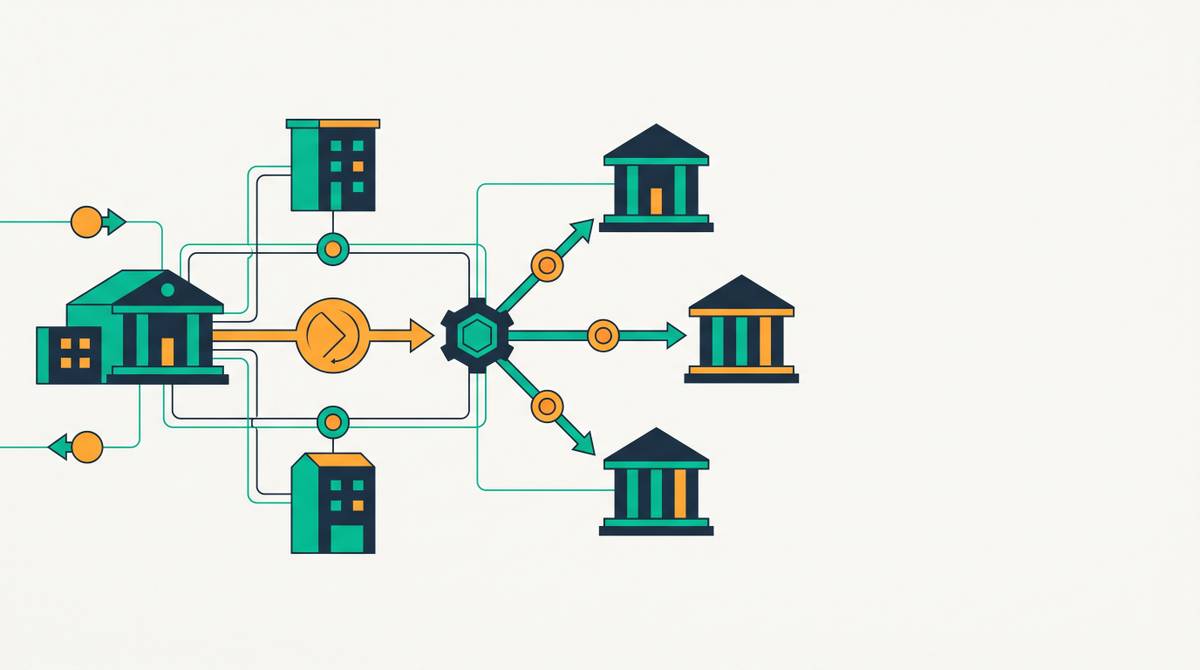
Employee Reimbursements Automation for Banks and Credit Unions
Agentic AI automates end-to-end reimbursement processing that older tools cannot handle.

Employee reimbursement processing is one of the most automatable workflows sitting untouched in bank and credit union back offices. The reason comes down to its shape: repetitive, rules-bound, multi-step, and audit-sensitive, which is exactly the combination agentic AI handles better than either a human processor or an older automation tool.
Employee reimbursements as a high-value automation target in banking
Look at what a single reimbursement actually requires. A receipt comes in. Someone checks it against policy. The expense gets classified. It routes for approval. Money moves. Every one of those steps follows a sequence that does not change from submission to submission. The decision logic stays fixed even when the receipt, the employee, or the dollar amount changes. That consistency is precisely what makes the process brittle in human hands and tractable for a machine. A person processing the two-hundredth reimbursement of the week is bored, tired, and prone to missing a duplicate submission or a policy threshold. An agent processing the two-hundredth reimbursement applies the same rule with the same attention it applied to the first.
That predictability is also what drives up the cost of manual handling. Manual reimbursement handling draws on front-line staff hours spent on routine intents, operations staff hours spent chasing missing documents and redoing errors, and a recurring annual cost for reconciliation and regulatory reporting prep. None of that labor is specialized. All of it is recoverable. At a mid-sized institution, that total is typically a seven-figure annual number.
Credit unions feel this pressure in a sharper way than larger banks do. They carry the same compliance obligations and the same operational demands as a bank many times their size, but with a fraction of the staff to absorb it. Cornerstone Advisors' What's Going On in Banking 2026 report found that 59% of credit unions have already deployed generative AI in some form. That number says less about enterprise strategy and more about appetite: credit unions are already comfortable putting AI into operational work, even without a formal roadmap guiding the rollout. Reimbursements fit into the same category of work that credit union AI agents are already handling, alongside dispute intake, fraud monitoring, and regulatory workflow automation. The infrastructure and the institutional comfort level are both already in place. What's missing, in most cases, is simply the decision to point them at reimbursements.
What agentic AI does that older automation could not
Older automation tools hit a ceiling in this workflow, so it helps to see exactly where that ceiling sits before crediting what comes next. Chatbots work fine when a submission follows the script. The moment something goes sideways, an unusual expense category, a missing receipt, a borderline policy exception, the chatbot has nowhere to go. Robotic process automation runs into a similar wall from a different direction: it breaks the instant a document format changes, or the instant a step calls for a judgment call, like whether an ambiguous expense actually qualifies under policy. Reimbursement queues generate exceptions like this constantly, and neither tool was ever built to handle them.
The underlying technology changed, not the surrounding tooling. The shift from rule-based RPA to agents that reason is what actually makes end-to-end reimbursement automation possible now. An agent can plan a sequence of actions, reason through an ambiguous case, handle an exception without stalling, and adjust as conditions shift. That difference in kind lets a system own a reimbursement from start to finish. An agent can take a receipt, check it against the policy document, classify the expense, route it for approval, and start the payment transfer without anyone touching the queue. When something unusual shows up, a duplicate claim, an amount above the policy ceiling, a document that never arrived, the agent escalates it with the context already gathered, instead of silently dropping the task or flagging a false positive that wastes a reviewer's time.
That capability reflects a larger shift happening across financial services: AI is moving from producing predictions to actually running coordinated, multi-step work. Early agentic deployments are already cutting manual workload by meaningful margins in operations, with the biggest gains appearing in workflows with many steps and frequent exceptions, a combination reimbursement processing matches almost exactly. Jack Henry expanded with Google Cloud in June 2026 to deliver AI-driven security and operational capabilities to its community bank and credit union clients, and early adopters reported time savings of up to 70% on routine administrative tasks, so reimbursements belong to that same category of work.
The end-to-end reimbursement workflow an agent handles
A properly configured agent can carry the full reimbursement lifecycle from the moment an employee submits a request to the moment the payment settles, with people stepping in only for real exceptions and oversight checkpoints.
The cycle starts with submission intake. An employee describes an expense or uploads a receipt through a voice or text interface, and the agent ingests it, pulling out structured data like amount, vendor, date, and category, then checking whether anything is missing. If a field is incomplete, the agent asks for it specifically, right away, instead of letting the request sit in a queue waiting for someone to notice.
From there the agent moves into policy cross-reference and classification. It checks the extracted data against the institution's current expense policy, sorts the expense into the right category, flags anything that approaches or crosses a policy threshold, and applies whatever eligibility rules attach to the employee's role. Duplicate detection also runs automatically at this stage, checked against existing records before anything moves forward.
Next comes approval routing. A compliant submission goes to the right approver with everything already assembled: the expense details, the relevant policy language, the reasoning behind the classification. Anything that actually requires judgment, a policy exception, an ambiguous category, an amount over the threshold, goes to a human reviewer as a structured summary rather than a pile of raw documents. Every approver action gets logged with a timestamp the moment it happens.
Once approval clears, the agent moves to payment execution, and it runs this stage on the institution's existing payment infrastructure. No new rails, no new systems to stand up. The agent starts the transfer, watches for settlement, and flags anything that goes wrong, a failed transfer, a routing error, for a person to handle. Running this on infrastructure the institution already operates avoids the cost and the risk that comes with ripping out core systems just to add automation.
The final stage is reconciliation and reporting. Every action across all five stages lands in a structured, queryable audit trail, and reconciliation reports generate on their own, removing the manual prep work that normally sits at the tail end of the reimbursement process.
Forum Credit Union, based in Fishers, Indiana, reported a 70% jump in loan processing volume after deploying AI to help with a similarly structured, multi-step document and decision workflow. Loan processing and reimbursement processing aren't the same task, but they share the same bones: documents in, rules applied, decisions routed, actions logged. So a comparably sized credit union that points that same approach at reimbursements can expect a similar order of improvement.
The governance stakes raised by the irreversibility of payment execution
Every stage described above builds toward one moment: the agent moves real money. That single fact changes what a mistake costs. A reimbursement agent does not just make a recommendation that a person reviews before acting. It executes a transfer. So when something goes wrong, hallucination risk and governance gaps become financial and regulatory problems that reach beyond a bad user experience.
Generative models, even sophisticated ones, still produce answers that sound confident and turn out to be wrong. In an agentic system, that wrong answer doesn't stay a suggestion. It becomes an instruction the system acts on. If a model hallucinates a policy threshold, misclassifies an expense, or miscalculates what someone is owed, it can trigger a payment the institution never actually approved. In a reimbursement workflow, that is not a glitch to patch in the next release. Money has already left the building, and the error registers as an operational loss.
Regulators have already drawn the line connecting this kind of error to legal exposure. The CFPB has established that if a system gives incorrect information, including information generated by AI, that can constitute a UDAAP violation. That standard was built with customer-facing interactions in mind, but the same logic reaches internal reimbursements: a hallucinated policy interpretation that fires off an unauthorized transfer creates legal and regulatory exposure, not simply a journal entry to correct later. Controlling for hallucination is a compliance requirement for a reimbursement agent, not a nice-to-have feature.
Most banking executives already name governance, risk, and compliance as their single biggest challenge when they deploy AI. Reimbursement automation concentrates that challenge precisely because the payment step cannot be undone once it fires. A skeptical banker raising this objection is raising a fair one. Designing the governance architecture into the deployment from day one, rather than bolting it on after something goes wrong, addresses that fairly.
That design work has gotten more urgent, not less, because of a regulatory shift. In April 2026, interagency regulators replaced SR 11-7 with SR 26-2, and the new guidance explicitly leaves generative and agentic AI out of scope. That creates a near-term vacuum: the old model risk rulebook no longer covers the systems banks are now deploying, and each institution has to build its own equivalent framework to fill the gap. The design choices covered in the next section matter more because of that gap, not less.
The governance architecture that makes reimbursement agents safe to deploy
The controls needed to deploy a reimbursement agent safely are well understood, and production systems already apply them. The open question for any given institution is whether its deployment is built with those controls from the start, or added after the fact.
The 2026 Singapore Consensus on Global AI Safety lays out ten foundational principles for managing agentic risk, and several map directly onto what a reimbursement deployment needs. Least privilege means the agent only touches the systems and data its reimbursement role actually requires. Traceable identity means every action the agent takes can be tied back to a specific agent instance and the person who triggered it. Auditability means each step in the workflow lands in a queryable, immutable log. Interruptibility means a kill switch or a human checkpoint can stop the agent at any point before a payment goes out. Human oversight means a person signs off at defined thresholds because the process requires it.
These principles appear in deployed systems already. Fiserv's agentOS, launched May 14, 2026, builds in kill switches, human-in-the-loop checkpoints, permission scoping, and audit logging as core features rather than add-ons, and it was built using OpenAI and AWS Bedrock AgentCore. First Interstate Bank and Boulder Dam Credit Union are running pilots on the platform, while Salem Five, City National Bank, Bank OZK, and SouthState are co-developing it. agentOS launched with four first-party agents, including Daily Operational Analysis and Reporting and Agentic AML Triage Analysis, and those agent types rely on the same governance architecture a reimbursement agent would need.
Backbase's AI-native Banking OS, launched in April 2026, offers a different angle on the same governance challenge. Its Sentinel layer checks every action any actor takes against bank policy before that action executes, and it logs it, which fits what payment execution in a reimbursement workflow calls for. Backbase pairs this with a shared semantic layer called Nexus, so every agent and every employee reads from the same current customer, account, and case record, and Sentinel enforces policy checks before anything happens. That shared record prevents one system from working off stale policy data and producing a hallucinated interpretation as a result.
The institutional side of governance matters as much as the technical side. BCU, a $6.1 billion credit union based in Vernon Hills, has approved dozens of efficiency-generating features spanning HR, marketing, and software development, enabled through a formalized AI governance framework and fast-track approval process for business teams seeking to use AI-based features. That makes BCU one of the few confirmed cases of a credit union building the organizational governance layer alongside the technical one, which is the piece many institutions skip. HSBC's approach offers a model for what that organizational layer can look like: a detailed inventory of AI systems, use cases prioritized by clear business value, shared technology platforms, strong data quality and access controls, and a standing commitment to human-AI collaboration rather than outright replacement. Financial services platforms built from the ground up for this environment tend to combine audit logging, role-based access control, configurable guardrails, and explainability, with the strongest among them covering SOC 2, PCI-DSS, AML, and KYC obligations as native features rather than afterthoughts.
Regulatory requirements for a reimbursement automation deployment
A reimbursement deployment inside a regulated institution has to satisfy several overlapping regulatory expectations at once, and together they set a compliance floor no deployment can skip.
SR 11-7 used to require rigorous development documentation, independent validation, and ongoing monitoring for any model you had in use. It was rescinded and replaced by SR 26-2 in April 2026, and the replacement explicitly leaves generative and agentic AI out of scope. That does not mean the underlying expectation, documented, validated, continuously monitored AI behavior, has disappeared. It means the obligation to build that documentation and validation now falls on each institution rather than on a standard examiners already apply.
NYDFS Part 500 never names AI systems directly, but an October 2024 industry guidance letter clarified that the existing framework, including risk assessments, access controls, and audit trails, already reaches AI systems that touch nonpublic information. A reimbursement agent handling employee financial data sits inside that scope. The controls Part 500 already demands, risk assessment, access control, audit trail, are the same controls a reimbursement deployment needs regardless of what the regulation calls them.
Credit unions face a parallel structure through the NCUA. The agency has appointed Amber Gravius as Chief Artificial Intelligence Officer, and it built an AI Compliance Plan aligned with OMB Memorandum M-25-21 and the AI in Government Act of 2020. The NIST AI Risk Management Framework shows up in NCUA's broader credit union guidance rather than in the Compliance Plan itself, but it still gives credit unions deploying reimbursement agents a practical starting point for building toward examination readiness. None of these frameworks were written with reimbursement automation specifically in mind. Their requirements, documented behavior, access control, audit trails, independent oversight, describe what a well-built reimbursement agent already produces as a byproduct of doing its job correctly.