Overcoming AI Skepticism Among Bank Executives and Examiners
Bankers doubt AI's accountability, not its capability, and audit trails are the fix.

Bank executives and examiners doubt something specific: whether AI can operate inside the accountability structures banking demands. The doubt has little to do with whether AI can improve a workflow or cut processing time. Most leaders in the industry already believe it can. What stops them is a narrower question: can a system that reasons on its own still produce a trail someone can defend to a regulator?
That distinction changes what kind of fix actually works. Treat the skepticism as fear of new technology, and the response becomes more demos, more efficiency numbers, more slides showing cost savings. None of that touches the real concern. A substantial majority of banking leaders say they are not fully confident in their AI controls, and governance, not capability, ranks as the top barrier to AI performance. The gap sits between what a system can do and what an institution can prove about what it did. Closing that gap takes audit trails and controls, not better pitches.
How the governance gap became the central barrier
The governance gap did not appear overnight. It built up through a cycle that repeats across the industry: an early AI pilot launches without real controls, it underdelivers or raises a flag during review, and the executives who approved it become harder to convince the next time someone asks for budget. Each round of disappointment raises the bar for the next proposal, and the bar keeps rising faster than the pilots can clear it.
Deloitte's 2026 Banking & Capital Markets Outlook describes the resulting pattern directly: AI work in banks is often "throttled by brittle and fragmented data foundations, mounting compliance demands, outdated legacy systems, and internal resistance to change. Projects get stuck as isolated proofs of concept, duplicated across departments and governed unevenly. A majority of community banks cite worries about security and data leakage. Banking leaders report concerns about third-party vendor risk and thin internal expertise across the industry. None of these three problems comes down to whether the underlying model works. Each one is about who controls it, who is accountable for it, and what happens when it fails. Institutions that push forward without closing that gap risk examiner scrutiny. Those that wait let competitors build real experience while their own risk exposure quietly grows. Either path carries a cost, and the standing-still option is not actually free.
What the April 2026 regulatory shift changed for institutions
In April 2026, the Federal Reserve, the OCC, and the FDIC jointly issued SR 26-2, replacing the long-standing SR 11-7 framework that had governed model risk for well over a decade. SR 26-2 keeps the core expectations in place: model inventories, independent validation, ongoing monitoring, and oversight of third-party models, all scaled to the size and risk profile of the institution. For traditional statistical and machine-learning models, the rules of the road are clearer than they were before.
Generative and agentic AI sit outside that clarity. The guidance says so directly, excluding these systems from its scope because regulators consider them too novel and too fast-moving to pin down with fixed rules. Institutions are still expected to apply sound governance and risk management to any AI system they run, generative or agentic included. The expectation exists without a prescribed method for meeting it. No regulator has specified the exact controls an agentic AI deployment needs, but examiners are already asking about them during routine exams, and institutions without answers are the ones left exposed. The Bank Policy Institute has pushed supervisors toward a framework that "acknowledges the risk to the banking system from inaction," a reminder that regulatory caution now cuts in two directions. Moving too fast without controls draws scrutiny. Refusing to move at all carries its own version of risk: a competitive and operational gap that appears later.
Agentic AI and the higher accountability stakes it raises
Agentic AI differs from the chatbots and recommendation engines banks have already absorbed into daily operations. An agentic system plans a sequence of steps, executes them, and adapts as conditions change, often without a person approving each move along the way. A single workflow might pull a customer file, price a risk, and issue credit terms. Another might triage an anti-money-laundering alert from start to resolution. In both cases, the system takes the action itself rather than suggesting one for someone else to take, and the institution has to be ready to explain that action after the fact.
That shift matters because it changes who bears responsibility for the outcome. A recommendation engine leaves the decision, and the accountability for it, with a human reviewer. An agentic system collapses that distance. The bank becomes responsible for outcomes nobody individually signed off on in the moment, which is exactly the scenario SR 26-2's carve-out leaves unresolved. Platforms built with audit logging, role-based access, configurable guardrails, and explainability from day one are the ones gaining traction, because they treat this problem as a design requirement from the start. Adoption is already uneven across the industry. Credit unions, according to Cornerstone Advisors, have moved faster than community banks on agentic AI investment and deployment. In both groups, the share of institutions with complete governance frameworks in place still trails well behind the share simply experimenting, which is the real measure of how much work remains.
The four elements of demonstrable governance
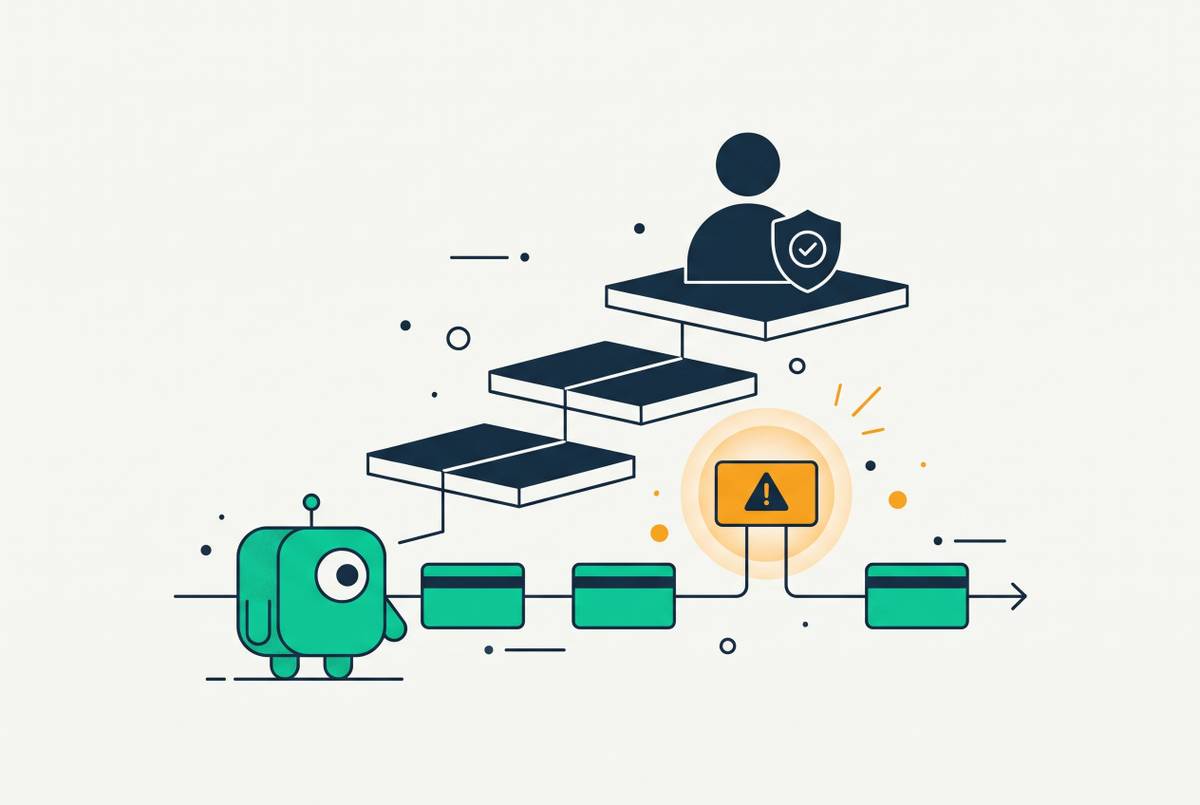
Closing the accountability gap for agentic AI comes down to four things an institution has to be able to show, not just describe. The first is a complete audit trail: every action, every data point touched, every tool call, every step in the system's reasoning, logged in a form that holds up under a regulator's or an internal risk team's review. An agent that cannot show its work cannot be defended, no matter how well it performed.
The second is configurable control: permission scoping that defines exactly what an agent can and cannot touch, kill switches that stop an agent mid-task, and role-based access that limits which workflows a given agent can start. This is the physical architecture of accountability, built into the system itself. Fiserv's agentOS, launched May 14, 2026, shows what this looks like in production. It embeds kill switches, human checkpoints, permission scoping, and auditability from the ground up, running on AWS Bedrock AgentCore with OpenAI collaborating on select first-party agents. First Interstate Bank and Boulder Dam Credit Union are piloting it; Salem Five, City National Bank, Bank OZK, and SouthState are helping build it.
The third element is the human-in-the-loop checkpoint. These are how an institution keeps hold of decisions that matter, routing exceptions to a person rather than letting an agent push through uncertainty on its own. Regulators expect this kind of oversight, and systems built to hand off cleanly to a human reviewer tend to earn more trust, not less. The fourth is governance over third parties: oversight of vendors, visibility into subcontractor exposure, and a documented plan for what happens if an AI system fails. These are the exact questions examiners are asking right now, and an institution that has not worked through them in advance has nothing to say when asked. A basic requirement drives all four, one infosec and compliance teams already enforce for any system touching customer data: SOC 2 certification. It is the minimum bar a system must clear before it goes near a transaction.
Deploying on existing banking rails makes governance tractable
Much of the resistance to agentic AI rests on the assumption that using it well means tearing out core banking systems and starting over. That assumption is mostly wrong. The pattern gaining ground across the industry is an orchestration layer sitting above the existing core, not a replacement for it, and this approach now runs production workloads reliably enough to trust.
Agents reach into bank systems through APIs, through MCP connections, and through the same software interfaces employees already use every day. None of that requires migrating years of data or rewriting the code the bank already depends on. The move from traditional APIs to MCP-based connections matters here in a concrete way. A traditional API needs custom development for every single connection, one build per system, per workflow, per vendor. MCP replaces that pile of one-off integrations with a single standard interface that any MCP-enabled agent can use without new engineering for each connection. That difference alone saves months of work.
This overlay approach also solves a second problem: data readiness. Because agents work with the outputs a system already produces rather than demanding a full data migration first, institutions that are only partway through modernizing their data can still deploy governed workflows in specific, well-defined areas. And the overlay design is itself a governance tool. Keeping read and write permissions separate at the infrastructure level limits how far a single agent's actions can reach, enforces the principle that an agent should only touch what it strictly needs, and makes the audit trail easier to build because every action an agent takes is already bounded by what the integration layer allows. Banking AI platforms built specifically for this setting, with native core integrations and compliance configuration built in, cut the distance between an AI strategy and a working, production-grade system down to weeks, compared with the 12 to 18 months a full infrastructure overhaul would take.
AML and payments automation clearing the examiner bar
Two domains already show that agentic AI can meet banking's accountability standard in practice: anti-money-laundering investigation and payments automation. The governance lessons from these deployments carry over directly to other parts of the bank.
Financial crime investigation makes a natural starting point for skeptics precisely because the stakes are so explicit. Every alert disposition has to hold up to an examiner. Every suspicious activity report narrative has to be backed by evidence. A missed case carries real regulatory consequences, not just an internal correction. FIS's Financial Crimes AI Agent, announced May 4, 2026 and built with Anthropic, compresses AML investigations that used to take days down to minutes, pulling evidence from across core systems, checking activity against known typologies, and drafting the SAR narrative itself. The agent hands back an evidence chain, a documented reasoning path an investigator or examiner can follow, which is what makes that output defensible.
That is the governance lesson worth carrying into every other workflow under consideration. Consequential automation earns trust when it produces a chain of evidence someone can review, and when the system routes anything outside its configured boundaries to a human. Once an institution proves that pattern in one domain, extending it to adjacent workflows becomes a matter of configuration, not a fresh argument from scratch.
How institutions moved from pilot to production
The institutions that got agentic AI past the pilot stage did not win the internal argument by debating AI's potential. They won it by building something concrete enough for skeptical colleagues to see working, with the governance visible inside it.
BNY took on internal skepticism directly with a 40-hour AI bootcamp that required participants to build a working prototype solving an actual problem from their own part of the bank. That approach produced something no slide deck can: proof that the thing works, in context, built by someone the skeptics already know and trust. A working prototype tends to move a doubtful executive further than any projection of future savings.
A second pattern appears across institutions that made it past the pilot stage. They picked entry points where accountability requirements were already spelled out, like AML, fraud triage, and payments, proved the governance worked there first, and expanded only after that proof existed. None of them rolled a system out broadly and tried to bolt controls on afterward. Fiserv's agentOS co-development model, built together with Salem Five, City National Bank, Bank OZK, and SouthState, offers a related path to the same credibility. Institutions that helped shape the governance architecture of the platform they would eventually run could speak to examiners with detailed, first-hand knowledge of how the system actually worked, rather than describing a vendor's black box from the outside. And the common objection that agentic AI requires gutting legacy infrastructure gets answered not through argument but through choice: picking an overlay deployment that already performs at production grade on the rails a bank already has. K2, a finalist in Callahan & Associates' 2026 Innovation Series, makes that case for credit unions concretely. By connecting directly to core, digital banking, and servicing systems through existing Kinective connectivity, it delivers measurable results in weeks rather than the 12 to 18 months a bigger overhaul would take, with governance and compliance guardrails already built into the deployment. That shortens the window where a skeptic can reasonably argue the pilot isn't ready for an examiner to look at.
What to demand from an agentic AI vendor before a pilot
The question to ask an agentic AI vendor is not what the system can do but what the institution could show an examiner about what the system did and who authorized it, and starting there is what separates leaders who filter out the pilots likely to stall from those who discover the problem only after signing a contract.
A vendor should be able to demonstrate a complete audit trail in a sandbox environment before any contract is signed, logging every action, data point, tool call, and reasoning step as it happens rather than reconstructing it after a problem surfaces. If that trail cannot be shown before deployment, it will not exist in a form an examiner can use afterward. Controls need to be configurable at the workflow level: permission scoping that limits exactly what an agent can start, kill switches that halt an agent without requiring a code change from an engineer, and role-based access that maps onto the governance structure the institution already runs. Human-in-the-loop checkpoints need to be a default part of the architecture, with the rules for when an exception gets routed to a human set by the institution. Leaders should also ask who the vendor's AI model sub-processors are, what the data retention terms look like, and what happens if a model provider changes its terms or shuts down, since these are the same questions examiners are already raising in routine exams. SOC 2 certification should be treated as a condition of doing business, not an item on a roadmap for next year. A vendor without it is not ready for a regulated environment, no matter how capable the underlying model is.
Last, confirm that the deployment runs on the bank's existing rails, through APIs or MCP, without requiring the core to be replaced. That matters for more than convenience. An overlay architecture is more governable because the integration layer itself enforces the permission boundaries the institution sets, not the vendor. Purpose-built banking AI platforms, with pre-built banking agents, native core integrations, and governance built in from the start, cut the distance between an AI strategy and a production-grade, examiner-ready workflow down from months to weeks. That gap, between a platform built for this environment and a general-purpose tool adapted to fit it, is the same gap between a pilot that clears compliance review and one that quietly stalls. Winning over a skeptical examiner or a skeptical board was never going to come from a faster demo or a bigger efficiency number. It comes from showing, in detail, exactly who is accountable for what an agent does, and proving it before anyone has to ask.