SOC 2 Compliance Requirements for AI Payment Systems
Auditors still use the old criteria, but test AI payment agents harder.
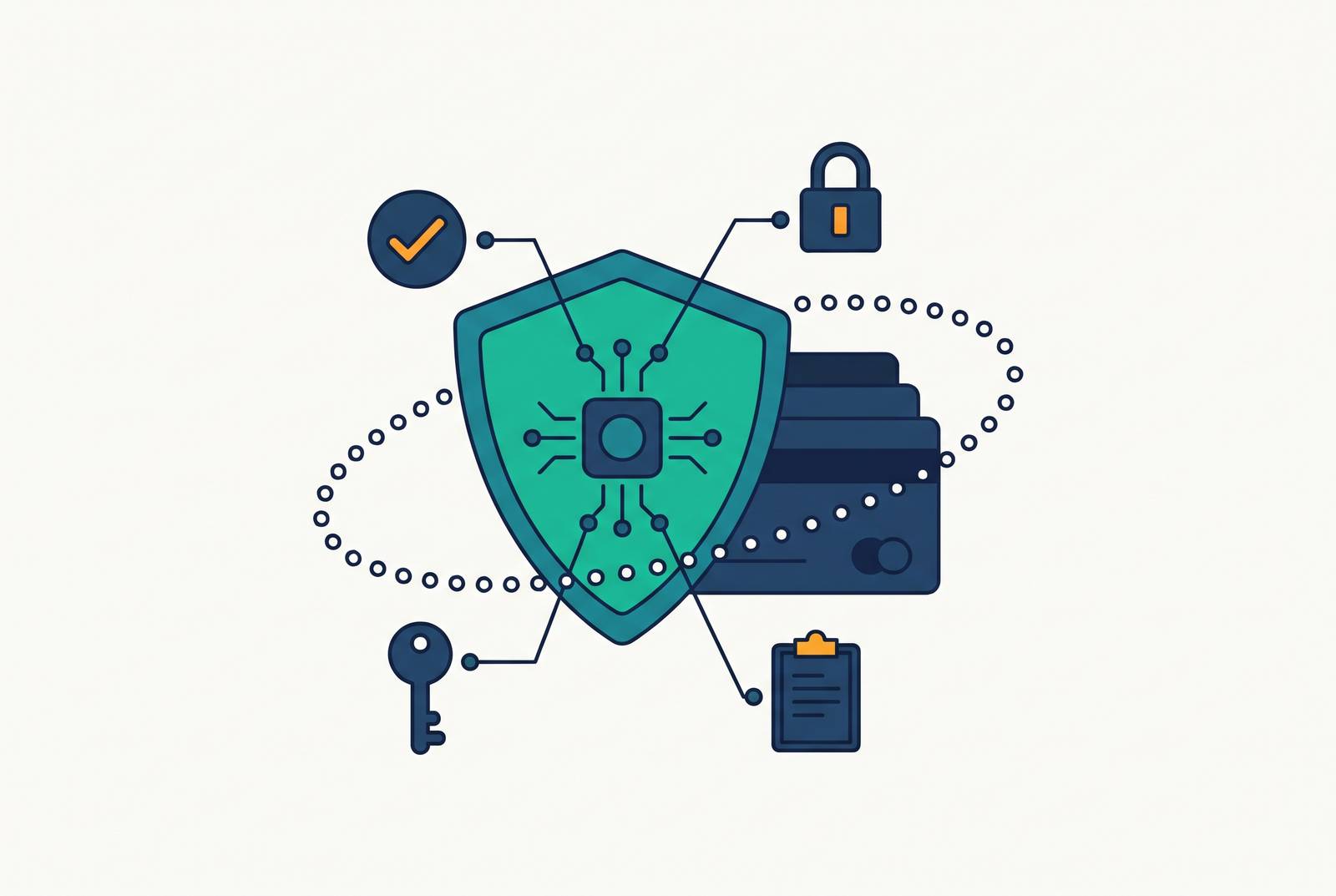
SOC 2 compliance for AI payment systems uses the existing five Trust Services Criteria. The harder task is proving that controls work when an agent can initiate a transfer. For banks and fintechs, the central obligation is to make autonomous payment execution accountable, traceable, and auditable across the full examination period.
Why SOC 2 auditors are scrutinizing AI payment systems more heavily in 2026
Banks and fintechs expecting a new AI rulebook are looking for the wrong change. The operative standard in 2026 remains the 2017 Trust Services Criteria, with revised Points of Focus published in fall 2022 and made available for download in September 2023. No AI-specific criteria have replaced that framework. What has changed is how closely auditors examine AI risks under its existing principles.
Autonomous payment execution explains the sharper scrutiny. An agent that writes to a database or initiates a transfer takes a privileged action that must be attributable to an accountable party. Traditional SaaS controls were not designed to answer that question across models, tools, and agent handoffs. AICPA TQA Section 9561, listed on 11 September 2026, provides nonauthoritative guidance on how AI use affects SOC 1 and SOC 2 examinations. Organizations therefore face a harder examination without a rewritten standard, particularly where their evidence says little about AI tools, model vendors, or autonomous action chains.
How to scope a SOC 2 engagement when AI is executing payments, not just supporting them
Does it support internal work, or execute transactions for customers? TQA 9561 distinguishes AI used in services delivered to user entities from AI used only in internal processes. The former affects scope, while the latter may not. Security is mandatory in every engagement, while the other four criteria depend on the service and its commitments.
Three roles help make that distinction concrete. A User consumes AI outputs internally, while a Provider operates third-party AI inside a product or service. A bank deploying an agent that initiates transfers on existing rails is therefore a Provider. A Producer builds or fine-tunes models. If the institution fine-tunes a model for fraud detection, it takes on model governance obligations in addition to its Provider responsibilities.
If the transfer agent calls a hosted LLM to make authorization decisions, that provider becomes a subservice organization requiring inclusive or carve-out treatment. Discovering this dependency during testing can leave scope, controls, and evidence unresolved after fieldwork has begun. The first step should therefore be a written risk assessment documenting how AI enters the service, which roles the organization occupies, which criteria are implicated, and which controls address the risks. That assessment gives the examination a defensible boundary.
Where the Security criterion (CC6) bites hardest for AI payment agents
For Providers and Producers, CC6 raises a question beyond whether an account has permission to act. Was this combination of permissions authorized for this transaction? An agent making dynamic access decisions can combine permissions in ways no human approved for the particular context. Static role-based controls alone cannot resolve that problem. Auditors need evidence connecting access rights to oversight of what the agent can actually do.
That evidence begins with an inventory of every AI tool and service account in scope. LLM API keys are credentials, so they need the same discipline as database credentials, including storage in a secrets manager, documented rotation, and revocation on offboarding. A vendor’s terms of service cannot substitute for that control record. A policy against shadow AI also does not show that it can be detected. Auditors are testing network- or endpoint-level capability to detect engineers sending customer payment data into unsanctioned tools, creating vendor relationships outside the approval process.
A ledger write or transfer must be traceable through the models, tools, and inter-agent handoffs that produced it. Containment addresses a different part of the risk. MicroVM-based sandbox isolation uses hardware virtualization to create execution boundaries for each agent invocation, limiting the reach of malicious instructions. That boundary addresses the blast radius, while attribution establishes responsibility for the action itself.
Why Processing Integrity is the criterion most directly reshaped by autonomous payment execution
Processing Integrity moves the examination from who may act to whether processing is complete, valid, accurate, and timely. AI’s emergent behavior challenges the assumption that a system will continue to operate as intended after conventional change approval. Model drift makes this harder because a model that passed validation at deployment may behave differently weeks later without a change ticket to explain it.
Auditors therefore test model lineage. For a production model, the evidence includes its training or fine-tuning dataset, approval chain, pre-production testing, and a documented, tested rollback procedure. A model registry is the minimum evidence structure for connecting versions, inputs, and approvals. Informal updates between sprints leave holes in that record. When fieldwork begins, a team may be able to identify what is running but not demonstrate how it became authorized for production.
Payment execution also requires a distinction between explainability and reproducibility. Explainability establishes why an action occurred, while reproducibility establishes whether its decision process can be reconstructed. Distributed agent workflows put both at risk. For a bank integrating with a 20-year-old core, timing creates a particularly concrete test, because batch-cycle balances may be hours old when the model acts. The error may remain invisible until reconciliation, so the audit trail must establish which data informed the decision and when that data was available.
How vendor oversight of LLM providers maps onto CC9 and why it catches payment-AI vendors off guard
TQA 9561 makes the hosted-model dependency a scoping obligation. An LLM provider used in a payment workflow must be handled as a subservice organization through the inclusive or carve-out method, with proportionate oversight evidence. Calling an API does not remove that responsibility. The organization must account for the third party’s role in delivering the service, even though it does not operate the model itself.
Under CC9, that requires AI-specific vendor questions. The contractual evidence must address whether customer payment data can be used to train the provider’s models, with no such use unless the organization explicitly opts in. An actual Data Processing Agreement is needed. A data flow map must also identify which personal and financial fields reach the LLM, in what form, and under which retention terms. The vendor risk assessment then records why the provider was selected and what residual risk was accepted.
Retention deserves particular attention in payment workflows. Written zero-retention commitments are more often expected when account numbers, transaction histories, or customer identity fields reach the model. This makes vendor oversight inseparable from decisions about which data the service exposes. The proposed 2027 criteria would add points of focus on evaluating third-party AI models and APIs. That nonbinding proposal signals more explicit attention to a dependency auditors already examine.
What Availability and Confidentiality require when an AI agent is the payment execution layer
An agent may misclassify a system state or fail to halt an anomalous payment, creating an availability gap without a single broken component to identify. The execution layer changes the failure pattern. On always-on instant payment rails, the risk window is so short that monitoring must be continuous. Audit evidence must show that monitoring operated throughout the observation period.
Confidentiality shifts attention from the agent’s output to its input. Transaction histories, account balances, and customer identity fields supplied to a model are part of the data exposure under examination, even if its answer reveals none of them. A clean response is not sufficient evidence. The data flow into the model must be within the control picture, which makes records of what the model received essential to assessing confidentiality risks.
Privacy adds a related but distinct obligation when it is scoped in. The evidence must document how personal data is collected, used, retained, and disposed of across the full AI pipeline, including the provider’s retention practices. For Availability and Confidentiality, static screenshots are increasingly challenged because they establish little about operation between testing points. Timestamped continuous-monitoring exports show what happened across the full audit window. This connects the control design to a harder question about whether it kept working.
The new joint SOC 2 + AIUC-1 offering and what it means for AI payment vendors preparing for 2027
The AICPA and the Artificial Intelligence Underwriting Company announced the joint SOC 2 + AIUC-1 offering on 19 October 2026. It uses one CPA-led engagement that ends in a single report with both SOC 2 reporting and AIUC-1 certification of named AI agents. The addition is testing of the agent itself, including its behavior under adversarial inputs. It does not change the Trust Services Criteria governing the SOC 2 portion. Several CPA firms already offer it, and the full launch is expected in early 2027.
For payment-AI vendors, that creates a structured way to address enterprise questions about agent behavior under attack or in edge-case payment scenarios. Those questions are separate from whether the surrounding controls worked as they should. The combined offering brings both into one auditor-issued report. Its availability should not, however, be confused with a replacement of the current SOC 2 standard.
The AICPA put out its proposed 2027 Trust Services Criteria exposure draft on 26 October 2026. The draft adds AI points of focus to the existing criteria, including how to monitor AI components, defend against attacks such as prompt injection, and assess third-party models and APIs. It introduces no separate AI-specific criteria. Prompt injection can target payment agents that accept natural-language or voice instructions through an attack surface that traditional payment automation does not have. Comments are requested by 15 January 2027, and, if finalized, the draft would apply to engagements beginning on or after 31 December 2027, with early implementation permitted.
Present examinations still use the 2017 criteria. Organizations preparing for a 2026 or early-2027 examination should ask their CPA firm which criteria version the engagement will use and record the answer. That decision affects evidence requirements. Planning for the draft cannot substitute for demonstrating controls against the standard governing the engagement.
Building an evidence programme that holds up when auditors apply all five criteria to autonomous payment execution
The practical response is an evidence programme driven by the risk assessment. Credit unions face an especially wide gap between what compliance requires and what their own staff know. The NCUA’s existing technology-neutral regulations already apply, with supervisory expectations for risk assessment, vendor due diligence, and a board oversight record. Those expectations still apply when staff have little AI expertise. It makes a clear connection between identified risks, control owners, and supporting records especially important.
The model registry records which version is in production, while the AI tool and API key inventory should name the human owners and be used in regular access reviews. Subservice documentation should include the actual DPAs, zero-retention terms, data flow maps, and vendor risk assessments. Continuous-monitoring exports establish operation over time. Action-attribution logs should link each agent-initiated payment to the model version, input state, and approval chain that produced it, so the model record and transaction record are linked.
Existing banking rails provide a useful starting point. Their access logs, transaction records, and reconciliation controls are already built and auditable, so the additional SOC 2 work can concentrate on the AI layer. The task is to connect those records to autonomous decisions without leaving an unexplained handoff. For the programme to hold up, it must keep evidence that controls worked throughout the observation period. Otherwise, an agent that drifts between examinations can leave the organization with a documented control design but no consistent proof that it worked.