Vendor Due Diligence Checklist for AI Banking Agent Procurement
A governance-first checklist for buying AI agents that move money.
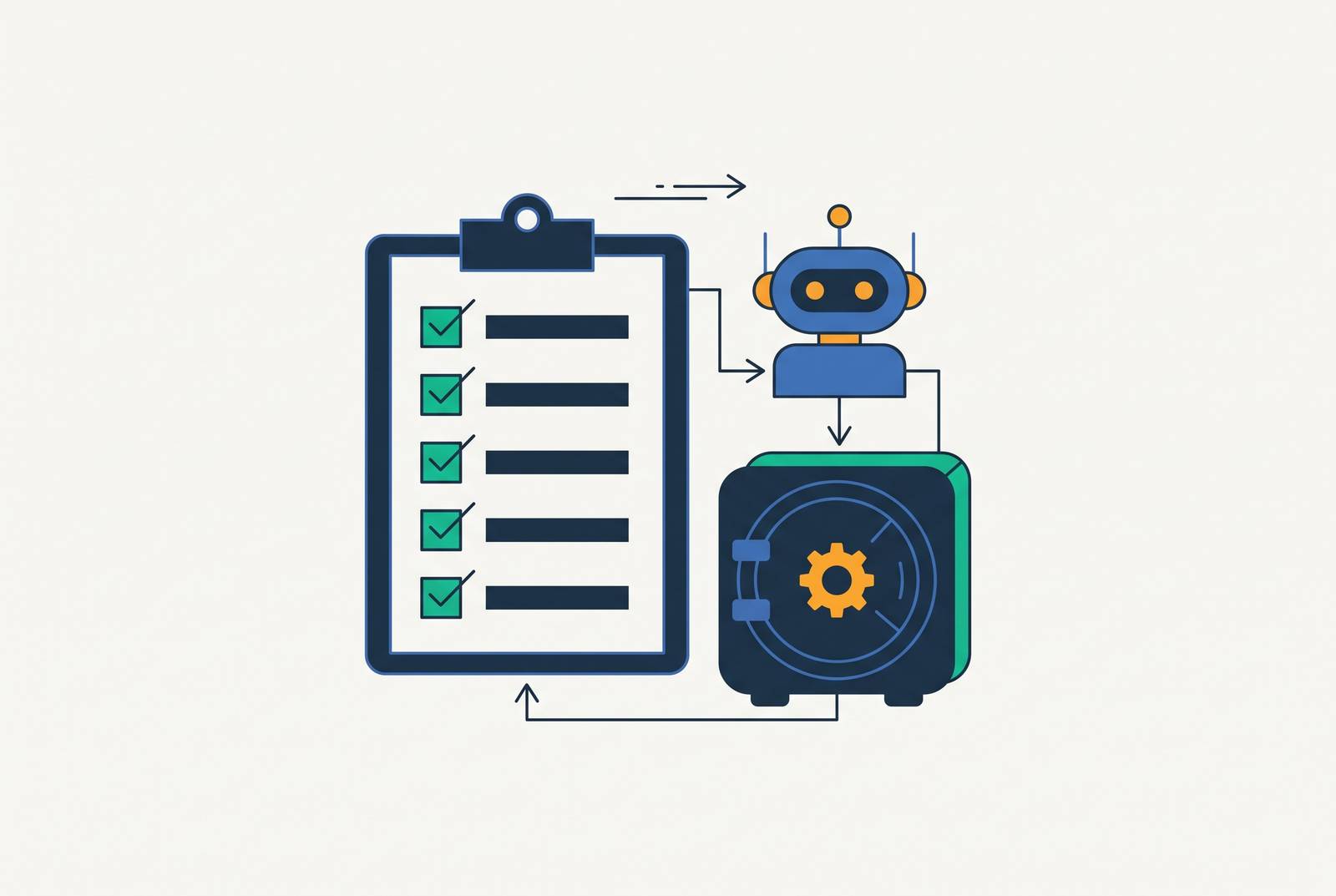
A banking AI agent doesn't answer questions. It logs into core systems, updates records, moves money, and resolves issues end-to-end with no person in the loop. That changes what you're buying, and it changes what you're accountable for before you sign anything.
The procurement decision isn't really about capability. It's about whether the vendor's control architecture can satisfy a regulator, an auditor, and a board. If you buy the tool first, you'll spend the next year retrofitting governance around it. Build the governance framework first and you'll produce a procurement record an examiner can actually defend.
That distinction matters because the failure path is well documented. The Thunai 2026 buyer's guide flags a pattern many credit unions have already lived: they buy a tool, then scramble to build a due-diligence process around it. The scramble is expensive, and it rarely works. A governance-first sequence costs less and holds up better.
Early banking implementations of agentic AI indicate savings of over $3 million annually. That's real money, and it's exactly why the pressure to move fast is intense. But speed without a control framework is how institutions end up explaining themselves to examiners months after the fact, reconstructing decisions they can't fully document.
The regulatory gap that puts accountability on the institution, not the vendor
Federal guidance hasn't caught up to agentic systems. SR 26-2, the April 2026 interagency model risk guidance that replaced SR 11-7, explicitly places generative and agentic AI outside its scope. It calls these systems novel and rapidly evolving, and tells banks to use the risk-management principles they already have while the Federal Reserve gathers input. That's not a roadmap. It's a placeholder.
The same gap shows up in NCUA's six 2026 supervisory priorities: lending and credit risk, interest rate and liquidity risk, earnings and capital adequacy, payment systems, fraud prevention, and BSA/AML/CFT compliance under Compliance Risk Management. Every one of these is touched by AI agents. An agent that decisions loans becomes a fair-lending issue. One that moves money falls under the payment systems priority. One that screens transactions triggers BSA requirements.
Yet NCUA has no authority to examine the vendors that supply most credit union AI. The institution owns the compliance exposure, regardless of what the vendor promises. No certification substitutes for your own documented due diligence. The checklist that follows exists because that burden lands entirely on you.
Why agentic payment and transfer execution creates a unique category of procurement risk
Core payment infrastructure is built on deterministic logic. Every step of the transaction lifecycle requires predictability, auditability, and legal enforceability. Agentic AI reasons probabilistically, so it can yield different outcomes under similar conditions. That structural tension is what procurement must address, and it's not a minor technical detail.
An IMF note on agentic payments identifies the specific failure modes that matter: authorization traceability, opacity, correlated agent behavior, cybersecurity exposure, and unresolved legal and liability questions when an agent acts without a clear human instruction. These aren't edge cases. They're the core mechanics of moving money.
Fraud exposure compounds the risk. Deepfake-related fraud attempts have surged dramatically over three years. More than half of detected fraud attempts now involve AI in some form, including voice and video manipulation and injection attacks that can target conversational banking interfaces specifically. The surface area for abuse is growing at the same time the decision logic becomes harder to trace.
The "shadow agent" problem is already present in production environments. When agents are deployed without full institutional visibility, compliance failures surface only in audits, not in real time. By the time anyone sees the problem, the transaction is months old. These failure modes map directly to the control categories the checklist must cover: authorization architecture, audit logging, human escalation paths, and fraud detection layered on top of agent actions.
Control architecture: how the agent is authorized to act
The first question isn't "what can this agent do?" It's "what can it do without explicit human approval, and how is that boundary enforced in the system?" Everything else follows from the answer.
Start with role-based permission scoping. Each agent needs a defined permission set tied to specific actions, accounts, dollar thresholds, and member segments. Not a broad credential that grants access to the full core. This is something you should be able to see in the system, not read about in a slide deck.
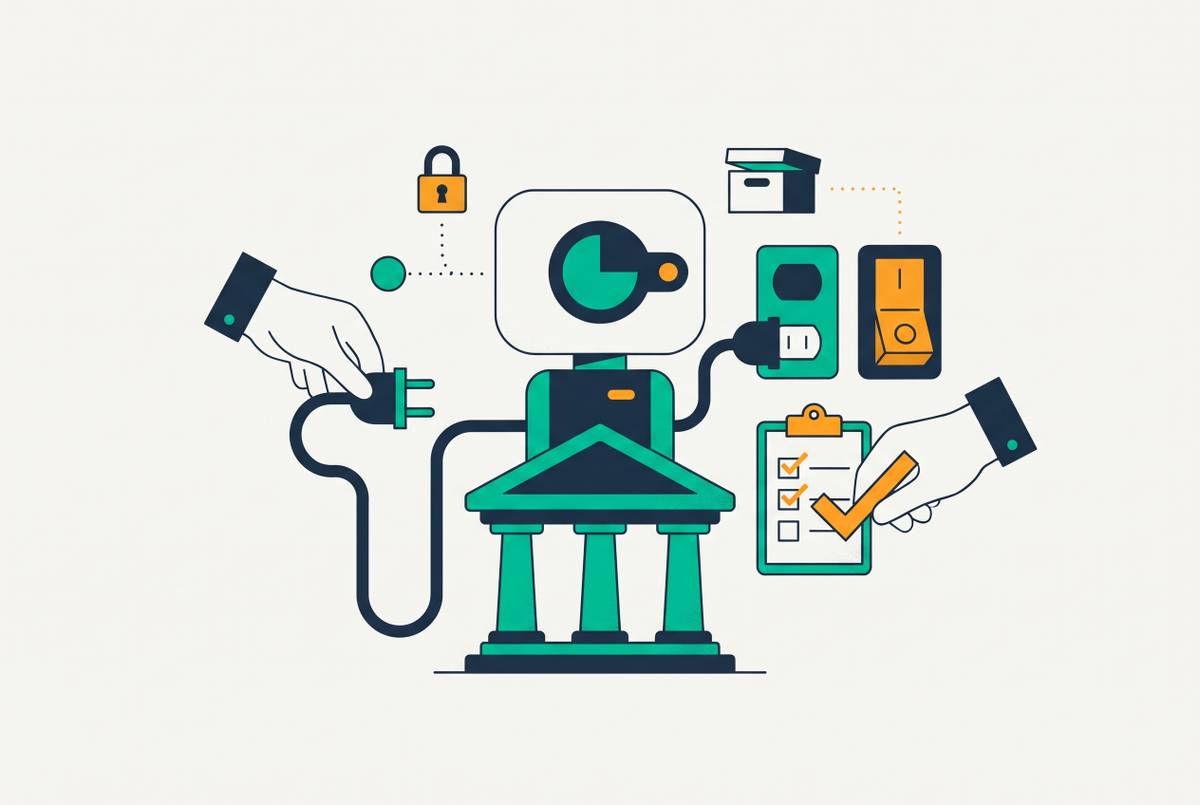
Human-in-the-loop checkpoints must be configurable, not optional extras. You decide which action types require human approval before execution, not the vendor. Those rules need to be enforceable at the platform level, not just described in policy documentation. A checkpoint that exists only as a written policy is not a checkpoint.
Multi-agent architectures introduce a specific risk. When one agent delegates to another, accountability can fragment. Ask the vendor how authority is maintained and traced across agent boundaries, not just within a single agent session. A delegation chain without a clear authority trail is a dispute waiting to happen.
Fiserv's agentOS, launched May 14, 2026, embeds kill switches, human-in-the-loop checkpoints, and permission scoping by design as architectural features of its governed agent environment. That's the design standard to benchmark other vendors against. Then put this question to every vendor: "Show me, in your system today, how I would restrict this agent from executing any transaction above a defined dollar threshold without a human approval step, and show me what the audit record looks like when that threshold is hit."
Auditability: what the institution can prove after an agent acts
A resolution rate or containment metric is a sales figure. An audit trail is what an examiner actually reviews. Treat these as entirely different categories of evidence. The distinction sounds obvious until you see how many procurement teams accept the first as proof of the second.
Minimum audit log requirements for agentic banking are specific. You need a timestamped, replayable record of every action the agent took, every system it touched, every decision branch it followed, the data it accessed, and the authority under which it acted. Not a summary. A complete record.
NCUA examiner expectations come from the agency's AI Compliance Plan published September 2025, and they give you a concrete list to verify. Member disclosures logged per interaction. Authentication events recorded. Agent actions timestamped. Human handoff records preserved. Interaction histories maintained. Each of these is a discrete field to check in vendor demos, not a general claim about "comprehensive logging."
Eltropy's Safe AI Framework, launched March 2, 2026 for its 750+ community financial institution clients, surfaces full visibility into what an agent did, why, with what data, and under what authority. Any vendor that cannot answer those four questions from its logs is architecturally deficient for a regulated environment. The firms that struggle most with regulators are those that deployed AI for speed and must now reconstruct why a model made a decision months after the fact. That work is expensive, slow, and rarely convincing to an examiner.
Here's the test. Ask the vendor to pull the complete audit record for a sample transaction during the demo. Not a dashboard summary. The underlying log. Then verify it answers: who authorized this action, what data was used, what decision was made, and what the member was told.
Compliance readiness: what the vendor can demonstrate before go-live
SOC 2 certification is a baseline, not a differentiator. It establishes that security controls exist and are audited. It does not certify that an agent's actions are compliant with banking-specific obligations. Don't accept SOC 2 as a proxy for banking compliance. The distinction is not subtle, and vendors will not volunteer it.
At the vendor level, verify AML and KYC procedural alignment. Verify Regulation E and Regulation DD constraint enforcement in agent logic. Verify BSA transaction screening integration. Verify fair lending safeguards in any AI touching loan decisioning. These are not the same as general security hygiene. They are the specific obligations your charter imposes.
NCUA's examiner framework makes third-party vendor risk management a first-class examination item when lending, servicing, collection, or payment functions are outsourced to a vendor. The due diligence file you maintain on the AI vendor is itself an examination artifact. Treat it that way from the start. Your AI governance inventory, every AI system in use with its owner, data access, validation status, and escalation procedures, must include vendor-supplied agents, not just internally built ones. NCUA's own AI Compliance Plan models this as a centralized, publicly accessible inventory.
The exception process matters more than most institutions expect. You should be able to document why any deviation from your AI governance standards was granted, who approved it, and when it expires. The vendor should support that documentation, not complicate it. And before go-live, ask whether the vendor has previously completed a third-party risk management review at a federally examined institution. Request references from compliance or audit leads at those institutions, not from the IT or product teams that bought the system.
Infrastructure integration: deploying on existing rails without creating new risk
The right architectural question is not "will this vendor replace our core?" It's "how does this agent connect to our existing rails?" FIS, Fiserv, Jack Henry, Q2. What does that connection look like from a permission and audit standpoint? That question, not the replacement pitch, is where integration risk actually lives.
Persistent memory in agentic systems introduces a specific integration risk. Memory stores that persist across sessions are vulnerable to manipulation and may retain data in ways that conflict with your data governance and retention policies. Ask how the vendor handles memory architecture and what controls govern it. A memory layer that doesn't align with your retention schedule is a compliance issue waiting to be discovered.
Require a documented integration map. It should show exactly which core systems the agent connects to, what credentials it uses, what data it reads versus writes, and how those connections are monitored and logged. This document becomes part of your third-party risk file. If the vendor can't produce it in a usable form, that's an answer in itself.
Vendor governance architecture: how the vendor governs its own AI, and what that means for you
A vendor's internal AI governance practices are a direct indicator of your downstream risk. If a vendor cannot explain its own model validation process, its own incident response procedures, or its own approach to model drift, it will produce governance problems for the institutions it serves. The problems don't stay on their side of the contract.
Put these questions to any AI agent vendor in a procurement meeting. Does the vendor maintain its own model inventory? How does it validate and monitor agent behavior in production? What is its process when an agent produces an incorrect or harmful output? How does it notify client institutions of material changes to agent behavior or underlying models? A vendor that hesitates on any of these is telling you something useful.
Vendor financial stability and roadmap continuity are governance questions, not just commercial ones. An AI agent embedded in core payment workflows creates a critical dependency. Understand the vendor's ownership structure, funding runway, and contractual obligations around continuity of service and data portability. If the vendor disappears, so does your ability to reconstruct what its agents did.
Change management obligations cut both ways. You must be notified before the vendor makes material changes to agent logic, permission architecture, or data handling. Make this a contractual requirement, not a vendor courtesy. A governed vendor environment, one that provides a unified architecture for building, governing, integrating, and deploying agents, reduces your governance burden compared to assembling point solutions from multiple vendors. Eltropy's Safe AI Framework does this for community financial institutions. Fiserv's agentOS does it for bank and credit union clients. Fewer integration seams means fewer places for accountability to leak.
What ongoing oversight of a deployed agent actually looks like
Procurement is the beginning of governance, not the end. An agent that passes every pre-deployment check will drift. It will encounter novel inputs. Regulatory expectations will shift. Ongoing monitoring must be designed before the agent goes live, not after the first incident. If you set the cadence now, you determine whether drift becomes a finding later.
NCUA's AI Compliance Plan models annual review cycles. Each office must provide detailed information about current and proposed AI applications for security, privacy, and technical reviews. Apply the same cadence to vendor-supplied agents. A formal AI system inventory with named owners, documented data access, permission scopes, validation status, and escalation procedures, maintained and updated continuously, makes ongoing oversight operational rather than aspirational. The inventory is the artifact that turns a policy into a practice.
Test human escalation paths regularly. Don't assume they work because they're configured. Containment rates that look strong on a dashboard can mask a pattern of incorrectly resolved edge cases. Periodic sampling of agent-handled interactions against human review is basic quality control. And treat exceptions as governance instruments. A permission scope granted beyond policy, a human checkpoint waived for a specific workflow, must be documented, time-limited, and reviewed on a defined schedule. Open exceptions that are never revisited are a finding waiting to happen.
Build compliance checks into every stage of the agent's production lifecycle, not just at launch. A failed compliance check at any point should be treated as a dealbreaker for that agent's continued operation in that scope, regardless of its business value. That's the governance posture NCUA's own plan describes for its internal AI systems. The institutions that deploy AI successfully are not those that eliminate human judgment. They deploy AI for execution while retaining human governance. That's the model that makes agentic banking both productive and examiner-defensible, and it's what this entire checklist has been building toward.