Batch Payment Processing Windows and Settlement Timing at Banks
Banks settle in batches, and missing a cutoff costs a day.

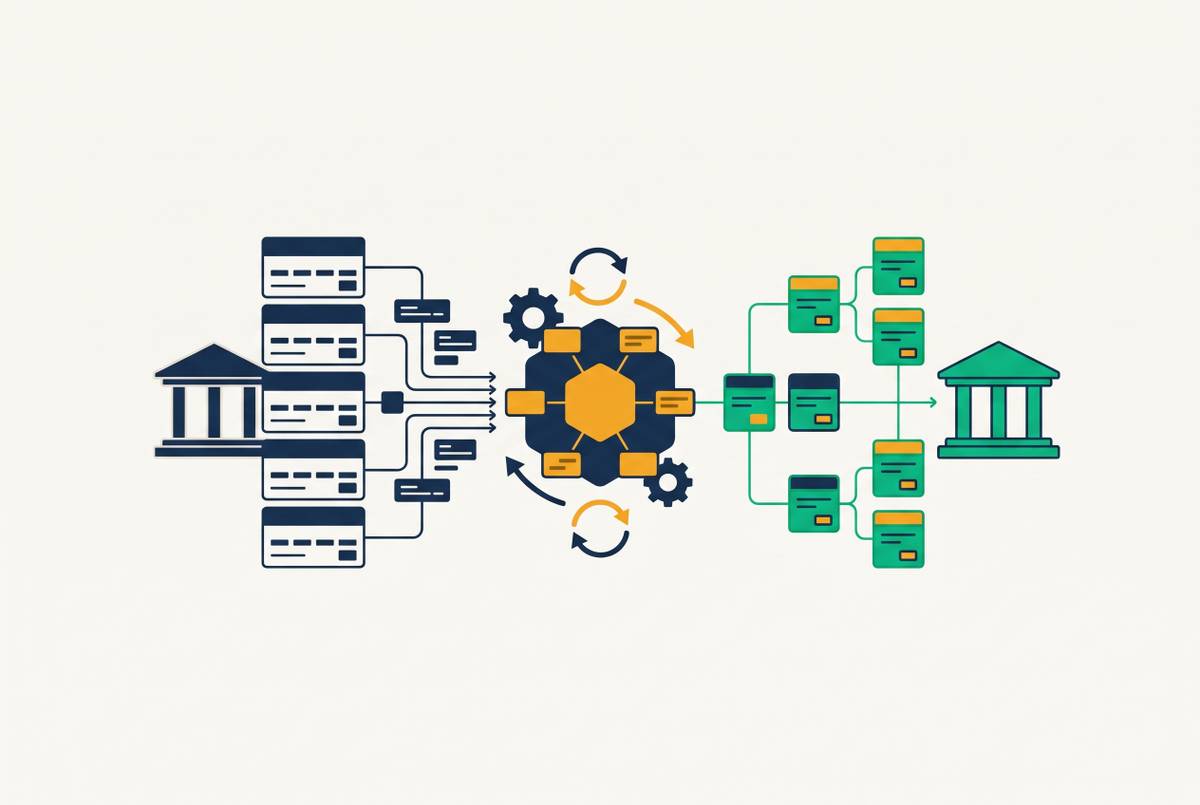
Batch payment processing is a deliberate design choice, not a leftover from an older era. Banks and card networks settled on this structure because processing millions of individual transactions one at a time, in real time, would be slow and expensive at scale. Instead, the system groups authorized transactions together and clears them at set intervals, all at once.
The idea to hold onto here: authorization and settlement are two separate events, not one. Authorization happens fast. The issuer checks the transaction, approves it, and sets aside the funds, often in seconds. Settlement happens later, in bulk, when a bank or processor gathers up a batch of these approved transactions and submits them for the money to actually move. That gap between the two is why a transaction can show as "pending" on an account for a day or more even though it was approved almost instantly. The approval already happened. The money just hasn't moved yet.
Two major payment types run on this same basic logic, but the mechanics differ between them. Card payments work through a merchant's point-of-sale system or payment gateway, which collects approved transactions into an open batch all day long. At some point, manually or on a timer, that batch closes and gets sent to the acquirer for clearing. ACH payments work a bit differently but follow the same principle. The ACH network is built as a nationwide batch-processing system for electronic funds transfers: payments are collected, bundled into files, and sent to a network operator at scheduled times, never one by one.
There are exactly two organizations that operate the ACH network: the Federal Reserve Bank, through FedACH, and The Clearing House, through EPN. Every single ACH payment in the country moves through one of these two operators. They're fully interoperable with each other and swap files back and forth multiple times a day, which is part of what keeps the system running smoothly despite its batch-based design.
How standard ACH settlement timing is structured
Nacha, the organization that writes the rulebook for ACH, sets maximum processing windows, leaving minimums open. That single fact explains a lot about why ACH timing varies from one payment to the next, and it points to where banks and businesses actually have room to speed things up.
ACH transactions split into two categories, and each follows its own clock. Credit transactions are push payments; you'll see this kind used for payroll, vendor payments, and reimbursements. Nacha rules require these to be processed within two business days, and in practice, most post within one to two business days. Debit transactions work the other way: they pull money from an account, which covers things like bill payments, subscription charges, and loan payments. Nacha gives these a tighter window, so they need processing within one business day. But funds availability can still stretch to two or three business days, because debits carry extra verification steps and a higher risk of insufficient funds.
Most people who receive an ACH payment can expect it to arrive somewhere between one and three business days after it's sent. Submit early in the day, and there's a good chance the money shows up the very next morning.
Weekends and federal holidays bring the whole system to a stop. ACH transactions do not process on those days. A payment sent Friday afternoon may not start moving through the system until Monday, with the recipient possibly not seeing funds until Monday or Tuesday.
Five stages make up the full ACH journey: initiation, batching at the originating bank, submission to the network operator, routing to the receiving bank, and finally posting to the recipient's account. Delays tend to build up across these steps rather than at any single point, which is exactly why knowing each stage matters. It shows where the timeline can actually be tightened, and where it can't.
How bank cutoff times compress the usable processing window
Bank cutoff times are the detail most people miss, and they're often the real reason a payment takes longer than expected. Each bank sets its own internal cutoff, typically 30 to 60 minutes ahead of the network's actual deadline, to leave room for preparing and sending the batch file.
Most internal cutoffs fall somewhere between 12:00 PM and 3:00 PM Eastern Time, but banks operating internationally sometimes cut off earlier to coordinate across time zones.
Picture a payment submitted at 2:55 PM against a bank's 3:00 PM cutoff. It looks like it made the window. But if that 3:00 PM mark is the bank's internal cutoff rather than the network deadline, the file preparation and transmission process may not finish in time, and the payment slips into the next batch, a full business day later. Five minutes of margin, and a full day of delay on the other side of it.
Card processing runs on a similar principle. Processors set one or more daily cutoff windows, and any batch submitted after that cutoff doesn't reach the card networks until the following business day. Close the batch before the deadline, and funds typically arrive a day sooner than they would otherwise.
There's an added risk layered on top of this for card merchants: authorization holds don't last forever. How long they last depends on the card network and the type of business involved. If a merchant misses their batch close window and an authorization expires before the batch goes out, that transaction may fail to settle. The goods or service has already been delivered, but the payment never completes. This risk hits hardest for businesses with long fulfillment cycles, hotels, car rental companies, and custom order shops among them, where the gap between authorization and delivery can stretch for days.
Auto-batch close solves the human error part of this problem. The batch closes automatically at a set time each night, with no one needing to remember to press a button, which keeps funding timing consistent night after night.
What Same Day ACH changed about the timing equation
Same Day ACH rebuilt the settlement schedule from the ground up, and it added multiple processing windows within a single business day. Instead of waiting days for funds to move, businesses can now cut that down to hours, settling the same day they initiate the payment.
The Federal Reserve runs three same-day transmission windows. Submit by 10:30 a.m. Eastern, and settlement happens at 1:00 p.m. Submit by 2:45 p.m., and settlement follows at 5:00 p.m. Submit by 4:45 p.m., and settlement lands at 6:00 p.m. That final 4:45 p.m. window exists specifically so businesses in time zones several hours behind Eastern time get a realistic shot at same-day settlement, even when their business day runs a few hours behind.
Same Day ACH carries a per-transaction limit of $1 million, which is generous enough to cover a wide range of B2B and consumer payment needs, from payroll runs to large vendor payments.
Eligibility comes with real constraints, though. Only domestic transactions between U.S. financial institutions qualify. Both the sending and receiving institutions need to participate in Same Day ACH. If either one hasn't opted in, the payment simply falls back to standard ACH processing timelines. You also need to clear enhanced fraud screening, and debit transactions still need proper customer authorization on file.
Using Same Day ACH isn't free. A Same Day Entry Fee applies to each transaction, and participating banks collect this fee monthly to cover the added processing overhead.
The structural shift from standard ACH comes down to this: standard ACH gives a business one processing window per day. Same Day ACH gives three. Miss a window under the standard system, and the wait is a full business day. Miss a window under Same Day ACH, and the wait is usually just a few hours until the next one opens.
Where real-time rails fit alongside batch settlement
FedNow and the RTP network tackle a problem batch processing was never built to solve. Both operate completely outside the business day calendar, settling payments in seconds, any hour, any day, weekends and holidays included.
ACH, for all its efficiency, stays tied to the business day. Its windows open and close on a schedule, and that schedule respects weekends, holidays, and cutoff times. FedNow and RTP don't carry that constraint. A payment sent at 2 a.m. on a Sunday settles the same way it would at 2 p.m. on a Tuesday.
FedNow has grown to thousands of participating institutions as of February 2026, though a meaningful share of eligible banks and credit unions haven't connected to it yet.
Speed this immediate brings a different kind of risk, one that batch processing never forced institutions to confront head-on. Once a FedNow payment goes out, the funds are typically irrevocable. There's little to no window to pull it back if something goes wrong. Fraud controls built around batch processing and delayed settlement, where there's time to review a transaction before it finalizes, don't hold up under these conditions. Instant payments demand a pre-payment fraud decision in under 300 milliseconds, and that's a wholly different operational task than reviewing a batch of transactions after the fact.
None of this makes real-time rails a replacement for batch settlement. Batch and real-time serve different payment types, different risk tolerances, and different operational situations. A payroll run doesn't need to settle in two seconds. An emergency vendor payment on a Saturday might. Banks need to understand both rails well enough to know which one applies to which situation.
Why back-office systems lag behind front-end settlement speed
The real bottleneck in faster settlement usually isn't the payment network. It sits inside the bank, in reconciliation and compliance systems that were built to run on a batch schedule and were never designed to operate continuously.
Front-end authorization systems have mostly caught up to real-time expectations. Back-office systems, the ones handling reconciliation, compliance screening, and settlement confirmation, largely haven't, because they were built for batch cadences from the start, not for nonstop operation. That mismatch creates friction at precisely the point where speed matters most. A payment can clear the network in seconds and still sit in a queue waiting for a back-office review process that only runs on a fixed schedule, maybe once an hour, maybe once a day.
For a business waiting on funds, this is a cash-flow issue. Settlement timing determines when money is actually usable, and from the outside, a delay caused by back-office review looks exactly like a delay caused by the network itself. There's no way to tell the difference without knowing where to look.
The IMF has studied this tension directly, examining how agentic AI may affect payment systems across authorization, liquidity, settlement, compliance, and resilience. One point the IMF raises stands out: there's friction between the probabilistic nature of AI decision-making and the deterministic requirements that payment infrastructure depends on. Payment systems need predictable, rule-bound outcomes. AI models, by nature, work with probabilities. Reconciling those two isn't automatic.
Wire repair shows this tension in a very concrete form. A payment flagged for something as simple as a formatting error drops into a manual queue, and from there, the repair cycle, not the network, decides when the payment actually clears. The network did its job in seconds. The institution's internal process is what takes the time.
Automation and AI agents in batch timing management
Missed cutoffs, manual wire repairs, delayed reconciliation, slow fraud review: these are the exact problems batch processing creates, and they're also exactly the kind of work rule-based automation and AI agents are now being built to handle.
A few specific applications are already taking shape. Automated wire repair systems can tell a genuine error from a false positive without a human stepping in, while still documenting the reasoning behind each decision for audit purposes. Sanctions screening tools can separate real matches from false positives at high volume, and they produce explainable outputs that compliance teams can actually review and trust. Anomaly detection can flag unusual transaction patterns before the funds move, not after, catching problems at the one point where they're still easy to stop. Pre-payment fraud scoring has to meet the sub-300 millisecond decision window that real-time rails demand. An AI scoring pipeline can work at that speed in a way manual batch-era review never could.
BCG's 2026 Global Payments Report states the institutional stakes: transaction banks need to move their operations closer to zero-touch and build an intelligence layer directly into their platforms. Control over that orchestration layer, the report argues, will determine which service ends up holding the client relationship in a machine-to-machine payment environment. That's a meaningful claim. The bank that owns the smartest orchestration, not necessarily the fastest rail, may be the one clients stick with.
The Federal Reserve's own infrastructure is moving in this same direction. Federal Reserve Financial Services rolled out a network intelligence API for FedNow on April 28, 2026, so participating financial institutions now get receiver account-level data and historical FedNow data to generate instant, actionable risk insights. This is a network operator building intelligence tools directly into the rail itself, rather than leaving that work entirely to individual banks.
None of this works without governance attached to it. The FSB's 2026 consultation on responsible AI adoption takes on the governance challenges that agentic AI raises directly, and it asks whether the practices being proposed actually strike the right balance for managing the risks involved. One point from that consultation deserves attention: the hardest supervisory problem isn't observing a final transaction after it happens. It's observing the relationship between an instruction given to an AI system and the action that system takes in response. Monitoring that relationship is harder than monitoring a settled payment, and regulators are still working out how to do it.
The model banks and credit unions should actually deploy is AI handling the mechanical steps of batch management, monitoring cutoffs, preparing files, managing repair queues, running reconciliation, while human stakeholders keep full visibility into what's happening, configurable controls over how the system behaves, and a complete audit trail of every action the system takes. Batch processing was built to make millions of transactions manageable at scale. The next stage of that same idea is making the institutional side of settlement just as manageable, without losing the oversight that payments have always required.