Payment Exception Handling in Automated Bank Disbursement Systems
AI can diagnose and propose payment repairs, but people release the money.

Payment exception handling exposes a gap in automated bank disbursement systems. Software catches failed payments, but people still have to work out how to repair them. Agentic AI can close that gap by diagnosing failures, proposing repairs, and routing validated proposals for approval. The governing distinction is between preparing a repair and releasing money. AI can take on the former while a human retains authority over the latter.
Why automated disbursement systems keep producing exceptions they cannot resolve
Automated disbursement systems handle volume, speed, and consistency well. Incorrect account details, insufficient liquidity, compliance alerts, network errors, and duplicate instructions can all push a payment out of straight-through processing and into an exception queue. The system can identify a problem and route it, but that does not mean it can reason about the cause or establish a valid repair. Detection and resolution are separate jobs.
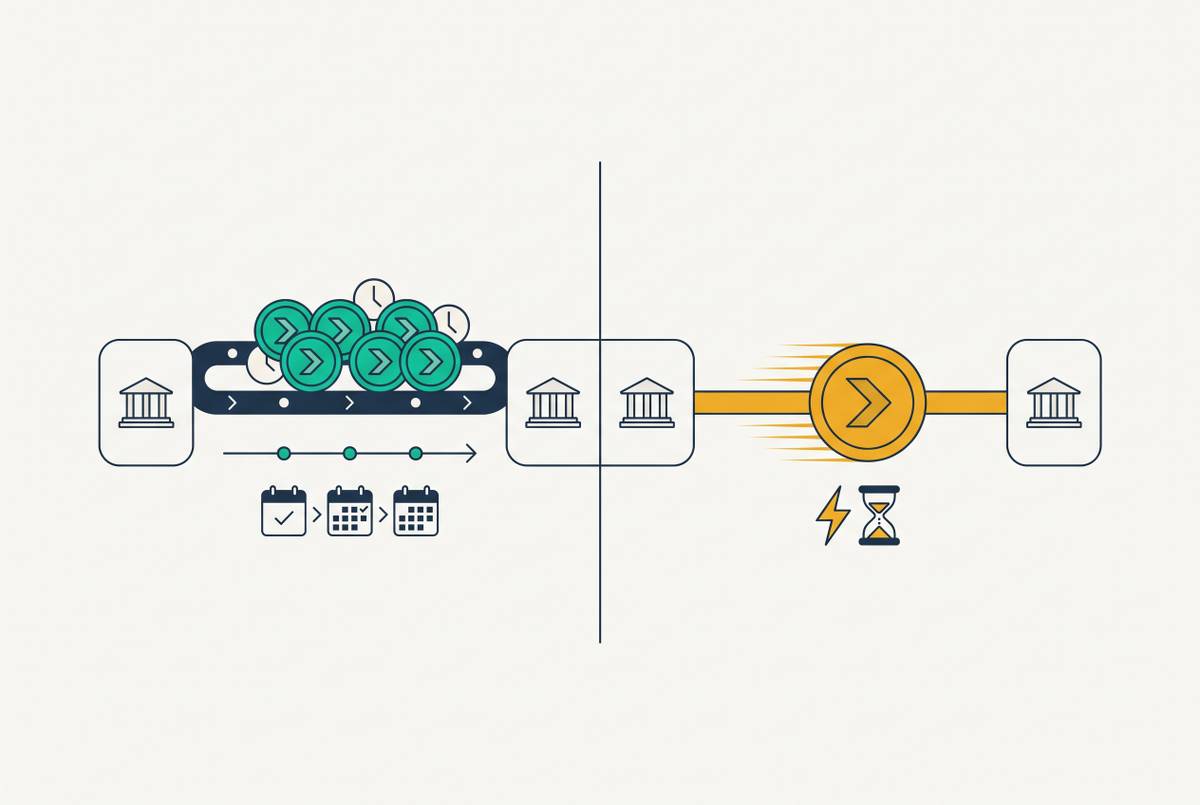
That separation leaves people doing the investigative work. A payment operations employee must pull transaction data, trace it through the systems involved, work out why the payment failed, and check a proposed repair against scheme rules. The queue organizes the work without completing it. Manual triage has to wait for staff to be available, even when the software that produces exceptions runs around the clock.
Mobile banking, fintech platforms, and instant payment networks add to that pressure because transactions keep flowing through them. Even when the error rate is small, the queue can grow large each day. Real-time settlement also makes the delay harder to absorb, because an exception raised at 2 a.m. can wait overnight for resolution while the payment network remains active. These systems lack a repair layer because their detection and routing functions were never designed to perform that work.
What "agentic AI" means in the context of payment exception handling
Agentic AI interprets an objective, breaks it into tasks, and interacts with digital services with limited human input. An agent can examine field-level data for meaning, diagnose the reason for rejection, and propose a correction. It can then validate the proposal against scheme rules and route it to the appropriate person with the context needed for a release decision.
The April 2026 note, How Agentic AI Will Reshape Payments, identifies the central tension in this arrangement: AI makes probabilistic decisions, while payment infrastructure requires deterministic outcomes. A plausible repair is not necessarily a permissible repair. Deterministic guardrails are fixed, rule-based checks that the model cannot override, so a proposal must pass the controls that apply to it, however convincing the agent’s explanation sounds. The note separates intent formation and orchestration, authorization and control, and settlement to show where reasoning can operate and where firm safeguards must hold.
Applied to payment exceptions, an agent could propose corrected account details, a different route, or a resolution to a compliance flag, subject to those controls. Continuous monitoring can also identify anomalies before a payment fully fails. Neither capability gives the agent authority to release funds. Instead, the human role shifts from assembling an investigation to judging a prepared proposal. Human approval is a required part of the architecture from the outset.
How BNY built the propose-validate-approve pattern in production payment repair
BNY’s payment repair agent reads each field for meaning as well as format. It checks syntax against ISO 20022 and considers whether the payment as a whole makes sense as the movement of value it claims to represent. A correctly formatted field is only one test. The semantic check addresses the relationship between the data and the payment’s purpose, while deterministic guardrails vet the proposed repair. A person makes the judgment call that releases money.
BNY launched Eliza in 2024 as a model-agnostic platform bringing Anthropic, Google, OpenAI, and other models under one governed roof. That design separates the agent layer from any single model and places governance above model selection. The bank established the platform and built workforce fluency before deploying autonomous agents in core operations. Sequence preceded autonomy. Payment validation agents then cleared validations in a fraction of the time they had taken before and cut the number of open payment investigations sharply.
Employees who previously spent most of their day manually repairing payments now identify data-quality patterns, benchmark clients on data quality, and contribute to client strategy. Rachel Lewis, BNY’s Head of Payments and Treasury Services Operations, explains how the work is split. “The digital employee works around the clock, which is obviously very different to our human counterparts. It's really focused on very specific repetitive tasks that allow our human employees to do much more human, intense, interesting-type roles.”
BNY’s arrangement also gives the IMF’s framework a practical expression. The agent handles diagnosis and orchestration, rules and human approval retain authorization and control, and settlement remains deterministic. AI is entrusted with investigating and proposing. This production pattern is not confined to one bank’s internal platform, as infrastructure vendors are embedding the same separation into products for smaller institutions.
How infrastructure vendors are embedding the same pattern for community banks and credit unions
Fiserv launched agentOS on May 14, 2026, as an agentic AI operating system built on AWS Bedrock AgentCore, with OpenAI as a strategic collaborator. First Interstate Bank and Boulder Dam Credit Union are piloting it. Salem Five, City National Bank, Bank OZK, and SouthState are among those helping to develop it. These deployments bring the agent layer into infrastructure that institutions already use. Access therefore need not depend on building a platform from scratch or replacing core systems.
For credit unions, the staffing context is particularly important. They face the same compliance and operational demands as larger banks, but with leaner teams. Agentic exception handling offers a way to expand triage throughput and continuous coverage without a proportional increase in headcount. Agentic exception handling changes how much investigative work must be completed before an employee can make the release decision, including for exceptions raised outside normal working hours.
Finastra and Fiserv share the same underlying design choices. Both deploy on existing banking rails, embed human approval at release, and treat auditability as a requirement. The institution’s size does not change that boundary. A community credit union and a global custodian may obtain their agent capabilities differently, but both need a defensible link between the proposed repair, the rules that permit it, and the person approving the movement of money.
What governance must look like when AI proposes payment repairs
What is the agent permitted to propose, and who remains accountable when the proposal changes a payment? Opacity, legal uncertainty, and correlated behavior across institutions are legitimate concerns. These risks call for clear controls that go beyond a broad promise to keep a person involved. Human accountability must be preserved at each step where money could move, and the institution must be able to reconstruct how a decision was reached.
The IMF identifies mandate-based authorization as one emerging mitigation approach. Under that approach, an agent works within explicitly scoped permissions. Architectural separation then keeps the component that reasons about a repair distinct from the component that executes it. The distinction must hold in the system itself. Programmable payment controls provide rule-based checks that the model cannot override, while agent identity frameworks make actions attributable to a particular agent instance.
Audit trails supply the evidence behind those controls. They must preserve every proposal, validation step, and human approval in a retrievable form. With tiered human involvement, some steps in an investigation can go ahead without review, but a person must still approve the release of funds. A regulator’s question can be very specific. If asked why a payment was repaired in a particular way, the bank must be able to show the agent’s reasoning, the rules it checked, and the name of the human who approved release.
The regulatory position also needs careful interpretation. The Fed, OCC, and FDIC jointly rescinded SR 11-7 in April 2026 and replaced it with SR 26-2, which explicitly excludes generative and agentic AI from its scope. Consumer protection laws and data-privacy rules govern most agentic banking AI rather than the traditional model risk guidance, so institutions need to establish which regime applies to their deployment. A governed technical design cannot substitute for that legal assessment.
The IMF also identifies correlated agent behavior as a systemic risk channel. If many institutions deploy similar agents that react similarly to the same payment anomaly, their combined response could amplify a shock. Local controls do not settle that wider question. Within an institution, however, the BNY and Fiserv architectures make the control requirements concrete through permission scoping, deterministic validation, kill switches, and human release decisions. Before the agent handles live payments, those controls must be in place, even if it already produces answers that help with repairs.
What a responsible deployment sequence looks like for a bank building this capability today
For a bank preparing to deploy, the lesson from BNY is to establish the platform first, build workforce fluency second, and introduce autonomous agents into core operations only after those foundations are stable. Teams should look for exceptions that occur in large numbers, are simple to repair, and have repairs that can be checked against rules. Incorrect reference data, format errors, and ISO 20022 field mismatches are good places to start. Compliance holds and fraud flags require more careful limits on the agent’s authority.
Before the agent touches production, the bank should define what it can propose, which rules it must check, and which actions require human approval. The audit trail belongs in that initial workflow. Escalation needs equal attention. Teams should set up kill switches and decide what happens when confidence falls below a threshold, a reviewer rejects a proposal, or a payment is outside the categories the agent is allowed to handle. These boundaries turn a broad aspiration to automate into a controlled assignment.
Training should then give payment operations staff hands-on practice with agent proposals and release decisions. The aim is practical judgment. BNY’s approach included self-guided e-learning, bootcamps, hackathons, and hands-on building, while its Head of AI Enablement described hands-on experimentation as critical to adoption. For an exception team, fluency means being comfortable reviewing the proposed repair and making the release decision with confidence.
After deployment, measurement should distinguish speed from quality and control. Resolution time should be tracked by exception category, with attention to whether work takes minutes or hours. Human review provides a separate diagnostic signal. The share of proposals modified or rejected, and the reasons for those decisions, shows where the agent’s reasoning needs refinement. Straight-through processing rates for the categories it handles and audit-trail completeness round out the assessment, including whether the institution can answer an inquiry about any AI-proposed repair within a defined time window.
Waiting for the technology to mature may sound cautious. Yet the architecture has already matured in production at BNY, BNP Paribas, Deutsche Bank, HSBC, and Citi, and infrastructure vendors now offer access to it. Readiness is a sequencing question, beginning with a bounded queue, enforceable controls, and staff prepared to exercise judgment. Each quarter spent waiting without building those foundations leaves the institution absorbing the latency of manual triage.