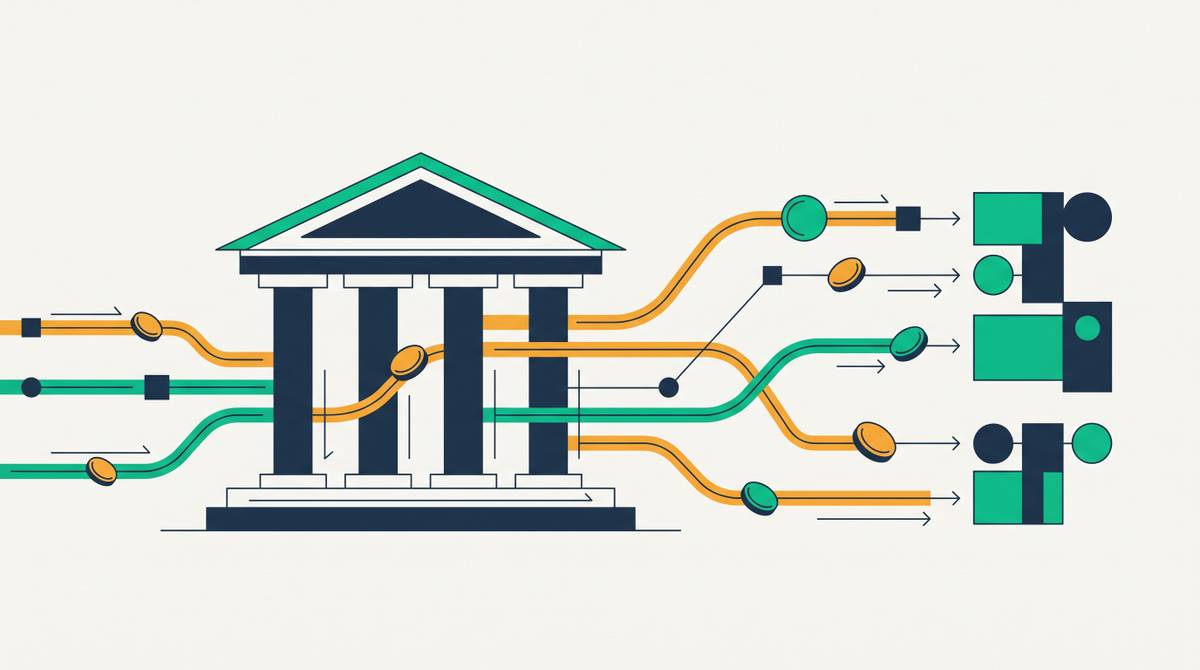
Dual Control Policies for High-Value Automated Payment Approvals
Tiered thresholds, independent approvers, and out-of-band checks keep AI payments safe.

High-value automated payment approvals need more than a human sign-off added to an AI workflow. Dual control must be rebuilt around the agent’s authority, with tiered thresholds, independent approvers, and out-of-band verification before the largest payments leave. The aim is to keep the protection of the four-eyes principle while letting routine payments move without needless delay.
Why the four-eyes principle breaks down when AI initiates payments
Dual control rests on a familiar separation. One person enters a transaction, another authorizes it, and neither can complete the chain alone. An AI agent changes that arrangement when it both decides to pay and can trigger execution. Initiation and a form of implicit authorization then sit with the same automated actor, creating the single point of control the original policy was meant to prevent.
IMF Note 2026/004 describes authorization becoming “structural and mandate-based,” shifting away from transaction-level instructions. That creates a problem of authorization traceability. If an agent acts under a broad mandate, what establishes consent for the particular payment it chooses to make? The note locates the core danger not in probabilistic reasoning itself, but in allowing adaptive systems to execute irreversible transactions without checks or accountability at execution. A wire or ACH debit cannot be recalled with certainty once it leaves, so a review afterward cannot substitute for authorization beforehand.
What existing governance frameworks do and do not cover
An arXiv paper on AI governance gaps documents that NIST AI RMF, ISO/IEC 42001, and the EU AI Act contain no references to “agent,” “agentic,” or autonomous AI systems. The IMF note itself treats existing frameworks as active governance tools, but they do not supply a ready-made design for agentic payment approvals. Institutions still face the gap between accountability rules that assume a human initiated a transaction and an agent acting as the transacting party.
The IMF’s proposed Know Your Agent approach addresses the identity layer through verifiable identities for financial bots linked to legal entities. Knowing which agent acted does not establish whether it had authority for that transaction or who independently approved it. The note also describes how AI risk committees, board-level oversight, and adapted model risk management could help govern these systems. Those bodies can authorize the institution’s approach, but the institution must still construct the payment controls that enforce it.
How tiered thresholds define the architecture of a dual control policy
The design starts with thresholds, because some payments need more checks than others. Institutions must set those thresholds to fit their own risk profile. Below an operational floor, routine, low-value, pre-authorized payments can execute autonomously with full audit logging. No human gate is required at that tier. Above the floor but below a senior threshold, an authorized reviewer who is independent of the role that configures the agent must approve the payment before it goes through.
Above the senior threshold, approval must come from a named person in a specified role. At the highest tier, out-of-band verification is required before the payment can clear. Each tier adds a distinct safeguard. A single gate for every payment would instead give a small ACH transfer and a large wire identical review, despite their different exposures.
ApprovalMax’s AP controls guide ties who can approve a transaction to its value, with both department and finance approval needed for higher amounts. The guide also separates who can create payment batches, approve them, and access banking platforms. Applied to agentic payments, that logic places the agent in the create role and a structurally separate human in the approval role. The thresholds therefore define more than when someone receives a notification. They define which authority must enter the chain before money moves.
Role assignment: who the second approver must be, and why "any authorized user" is not enough
What makes the second approver genuinely independent? In an agentic system, the answer must reach back into the configuration chain. The person who sets the agent’s payment permissions, thresholds, and operating rules must not also be eligible to approve its payments. Otherwise, one administrator controls both what the agent may start and whether those payments go through. Two recorded actions would conceal one point of control.
This follows the guide’s rule that vendor creation, invoice entry, spend approval, and payment release must be kept separate. That separation must now include the agent’s initiating role and the people who govern it. At the highest payment tiers, a named individual in a role such as CFO or Head of Treasury must approve, rather than the next available member of a broad group. Availability is not the same as accountability. Proper assignment also places approval across organizational lines, such as operations and finance, although it cannot eliminate fraud when two parties conspire.
The same boundary applies to payee changes. The person who updates bank account details must be separate from the person who approves payments to that payee. An agent that can both update payment instructions and start payments brings those risks together. Role design must explicitly prohibit that combination rather than assume the presence of a human approver resolves it.
Out-of-band verification as the non-negotiable gate for the highest-value transactions
For the highest-value tier, another approval inside the payment system is not enough. The same attack or error that compromises initiation could also compromise an in-channel confirmation. An agent-generated payment could, in theory, produce its own confirmatory message within that environment. Another message is not an independent check. The verification must leave the initiating channel entirely.
In practice, this means a voice call to a pre-registered number. The number must come from a prior, uncompromised session. Accepting a number supplied with the payment request would allow an attacker to choose the supposed verifier.
The policy must also specify who makes the call and who receives it as named roles. That choice cannot be left to improvisation when a large payment is waiting. The caller, recipient, time, and outcome must be logged against the specific transaction. Without that link, the institution cannot demonstrate that the required verification preceded the payment.
What the audit trail must capture when an agent is the initiating party
A complete record of an AI-initiated wire begins before the human approval. It identifies the agent, its configured permissions, and the policy version under which it acted. It then records the payee, amount, payment rail, and initiation timestamp. The record must also explain what the agent decided and why. Otherwise, the log shows the instruction but does not show how it was within what the agent was allowed to do.
The authorization chain follows in the same record, identifying the human roles that approved, their sequence, and their timestamps. Where out-of-band verification applies, the entry includes its channel, parties, time, and outcome. Threshold overrides, emergency approvals, and manual interventions need their reasons recorded too. Exceptions cannot remain outside the history. The guide’s requirement to show who approved, edited, or paid an invoice and when extends here to the agent’s actions with the same specificity.
Permission verification at execution time must itself be auditable. This lets an investigator follow authority from the agent’s first decision through human approval to execution. If the permission record is missing, that chain has a gap even when every human sign-off is there. The resulting log must be write-protected after the fact. An agent that can rewrite its own execution history provides no dependable audit assurance.
How production deployments are building these controls into agentic banking architecture
Fiserv agentOS, launched May 14, 2026, embeds policy controls, human oversight, identity-bound execution, and auditability in an agentic operating system for banks and credit unions. Backbase’s AI-native Banking OS, launched April 2026, uses its Sentinel authority layer to check every actor’s permissions against bank policy before execution and log each action. Both place controls in the operating architecture.
Eltropy’s governed agentic AI platform, launched March 2026 and serving more than 750 credit unions and community banks, brings agent creation, governance, integration, and deployment into one environment under its Safe AI Framework. It provides visibility into what an agent did, why, with what data, and under what authority. Nymbus MCP Server, launched April 2026, exposes tools including customer lookup, account management, money movement, and debit card controls. Its access layer remains explicit. Token-based authentication, role-based access controls, PII masking in logs, and full audit logging sit between the conversational interface and those tools.
Across these deployments, the shared pattern is permission scoping before execution, human checkpoints at defined thresholds, and kill switches as a backstop. All of these implementations kept the core banking infrastructure in place, because the governed layer sits above the payment rails already in use.
The legitimate objection: human checkpoints slow down what automation was supposed to accelerate
Human approval does reintroduce delay, and that objection deserves more than reassurance. For routine, low-value, pre-authorized payments, the extra gate can cost more in friction than it adds in protection. This holds for recurring vendor payments, payroll that stays within set limits, and pre-approved transfer amounts. Automation should not reproduce avoidable waiting. That is why the lower tier permits autonomous execution with logging.
The trade-off changes for high-value, non-recurring, or anomalous payments. A few minutes for approval on a seven-figure wire are not equivalent to a human interruption on every routine transfer. The IMF’s three-layer model keeps intent formation and orchestration, authorization and control, and settlement separate, so payments in pre-authorized categories can go through without a person reviewing each one while people still govern authorization.
Designing the dual control policy as a living document, not a one-time configuration
A sound launch policy can drift as agent capabilities, payment volumes, and fraud tactics change. Institutions must revisit threshold calibration at least annually and after significant changes in payment volume or fraud loss experience. When staff change, the named approvers must be updated too. Agent updates need a parallel review of permission boundaries, because a broader capability set can change the effective reach of permissions granted at launch.
Preserving logs is not enough to detect that drift. Regular review can reveal approvals concentrated in one individual, transactions repeatedly arriving just below a control tier, or turnaround times that suggest rubber-stamping. Those patterns test whether the policy works in practice. They also connect audit evidence to decisions about thresholds, roles, and agent scope, rather than leaving the record untouched until an investigation.
The IMF note places board-level oversight and AI risk committees within the possible governance structure for agentic systems. The dual control policy belongs in that structure as well as in operational settings. The next action is to assign ownership to a named function, such as risk, compliance, or treasury operations, responsible for keeping it accurate. That owner must establish the review cadence and put the policy on the board agenda. Approval rules then become an ongoing institutional responsibility, with someone accountable for changing them when the system they govern changes.