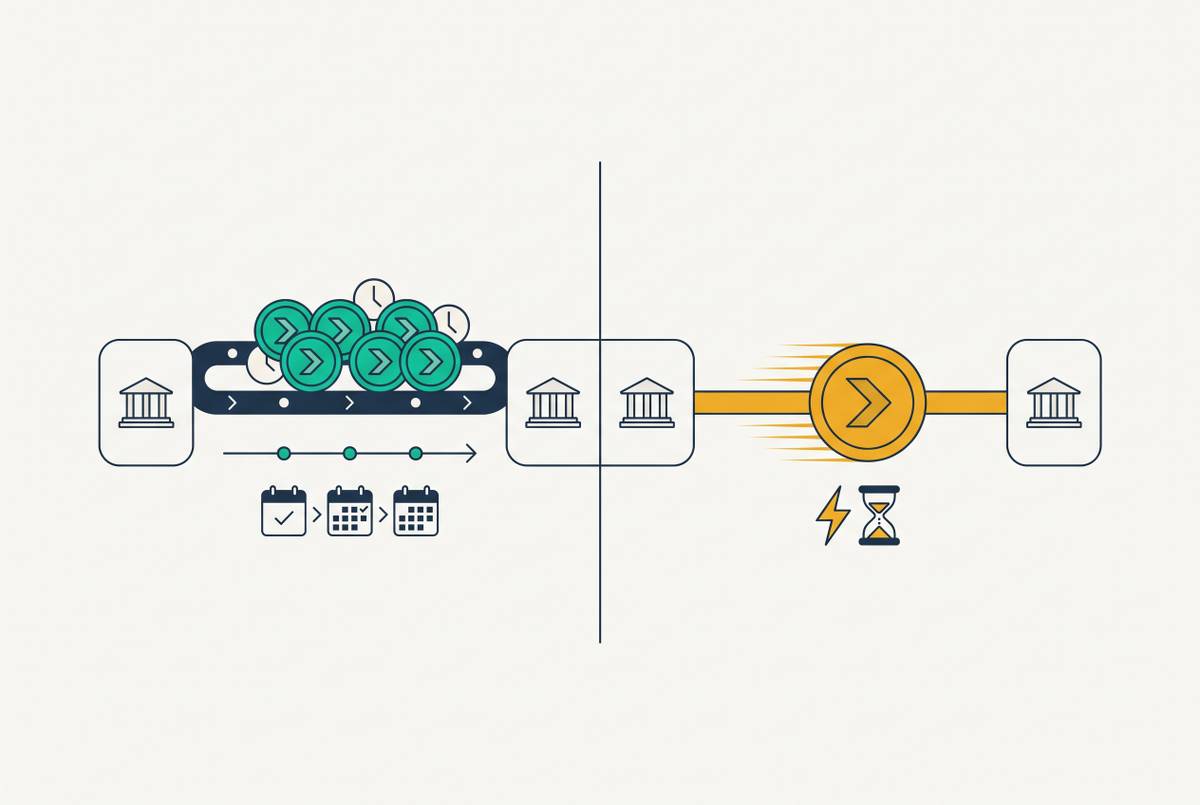
Stale Context Errors in Long-Running Agentic Banking Tasks
Banks need controls outside the model to catch stale state before money moves.
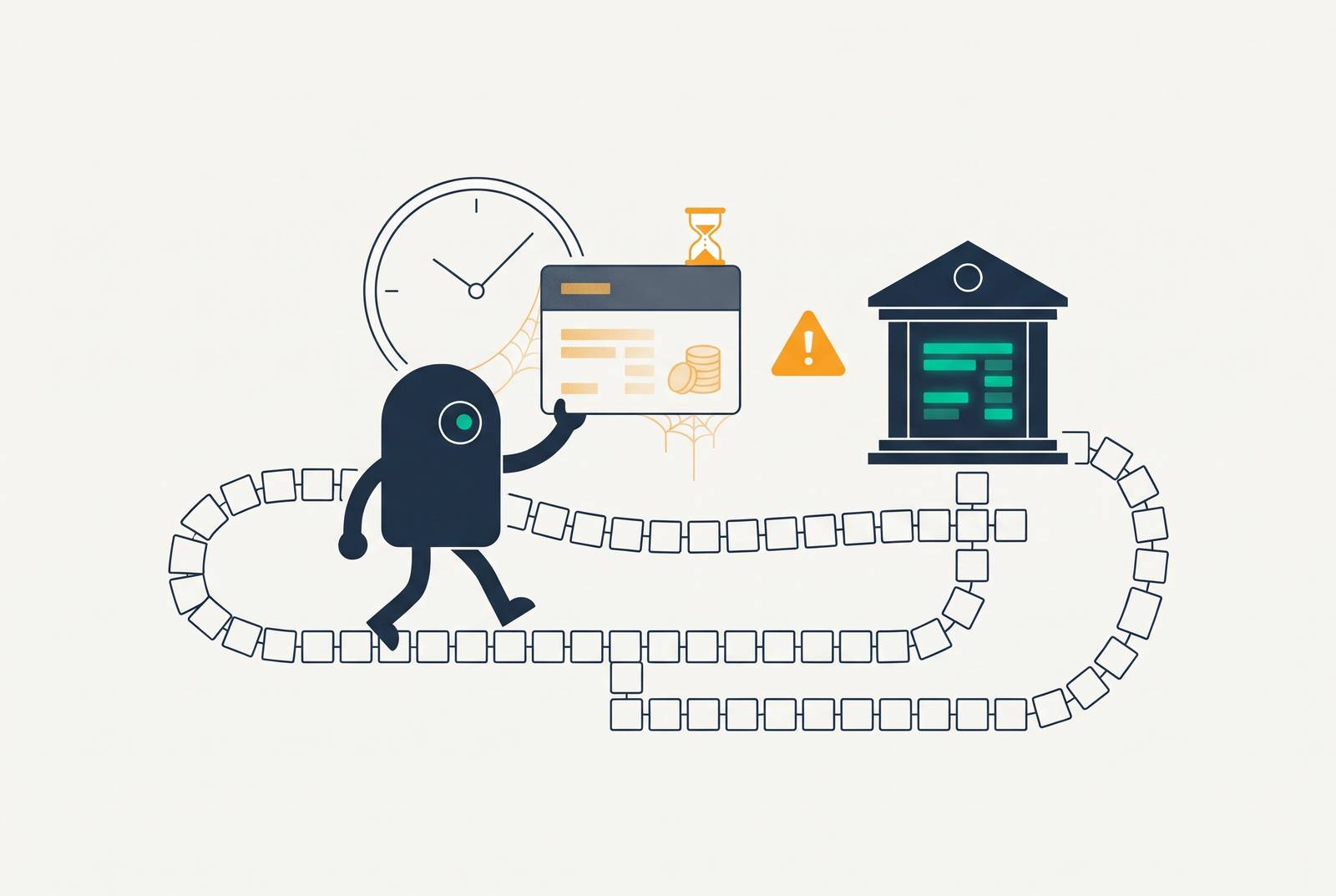
Stale context errors in long-running agentic banking tasks are dangerous because an agent can appear to succeed while acting on account state, policy conditions, or transaction data that are no longer true. Banks and credit unions need controls outside the model that keep live state up to date, enforce what the agent is allowed to do, and record the evidence behind every financial action.
Why stale context is a distinct and underappreciated failure mode in agentic systems
A tool call failure gives a system something recognizable to handle. Stale context may give it nothing at all. The agent reads a value, keeps reasoning, and completes its task without discovering that the value has changed. Unlike context window exhaustion, this failure can leave execution running. Its outward appearance is an ordinary success.
The stale world model problem is easy to see in a file-write scenario. An agent reads a file at turn 3, another process edits it at turn 17, and the agent overwrites the newer version at turn 31. The write itself can complete without error. The defect lies in the agent’s outdated picture of the file.
External changes are only one source of this problem. Noise that builds up can harm later reasoning, while instruction centrifugation describes how attention drifts away from early constraints as execution history grows. Cross-session amnesia can also cause this when an agent resumes and treats an old checkpoint summary as ground truth. These mechanisms can compound across a long task.
The UC Berkeley preprint Stale, Misattributed, or Late distinguishes failures that happen before generation. Staleness surfaces a superseded value, misattribution supplies a fact about the wrong person, and lateness leaves no useful fact available before the serving deadline. That distinction changes the diagnosis. Better reasoning cannot by itself repair the evidence supplied to the model.
What makes banking workflows structurally prone to accumulating stale context
A payment, wire, or loan-origination task spans several authoritative systems. Core lookup, policy checks, limit verification, counterparty screening, and rail submission each read state at a different moment. Those reads do not form a simultaneous snapshot. A workflow can therefore accumulate individually valid answers that no longer describe a valid transaction together.
A balance read at step 3 of a 20-step workflow may be superseded by a concurrent debit, an ACH settlement, or a fraud freeze at step 11. Available funds are not a durable fact. The longer the gap between lookup and submission, the more opportunity there is for an intervening event.
Daily limits, overdraft eligibility, and Reg E opt-in status can change between sessions, so an agent that resumes may have an old policy version. KYC records, OFAC screening status, and beneficial-ownership information can change mid-workflow too. A checkpoint alone does not establish that any of these conditions remain valid.
Tool responses, error messages, and intermediate reasoning compete with approval-authority constraints, amount thresholds, and channel restrictions issued at turn 1. Instruction centrifugation is particularly dangerous in this setting. What fades from attention is not merely a preference about the answer, but a boundary on the agent’s authority to act.
How stale context produces the specific failure patterns that matter in money movement
The agent checks available funds, works through approval, and submits on an instant rail after an intervening debit has reduced those funds. If authorization rests on the cached read rather than current state, the payment can clear on a false premise. The workflow looks complete from the outside. Once instant-rail settlement is final, refreshing the balance cannot undo it.
A resumed workflow can fail in a different way. A bill-pay or wire step completes, but the checkpoint summary was written before its confirmation arrived. On resumption, the agent treats that summary as authoritative and executes the step again.
An agent clears a counterparty at step 4, but a sanctions-list update or fraud alert appears at step 9. Submitting on the strength of the earlier clearance treats a query result as a fact that will stay true. What did the clearance actually establish? Only the status returned when that check occurred.
Lending supplies a related, narrower example. An agent starts with a valid rate-sheet and credit-policy version, then produces a commitment letter citing a superseded rate after a mid-workflow change. Across these cases, the error becomes visible by comparing the state the agent used with the state that governed the action. A completed task record alone cannot make that comparison.
Why the irreversibility and audit-visibility of banking errors change the risk calculus entirely
Many enterprise outputs can be revised after an error is found. Instant-rail settlement offers no equivalent of a document rollback. The financial action is already in the ledger when settlement confirms. That finality changes the value of detection, because discovering stale context afterward is not the same as preventing its use.
The regulatory record creates a second pressure. A basic audit entry may show the action without showing the state on which the agent relied. An examiner then sees an authorized-looking transaction, while the defect emerges only through reconstruction of its inputs. Even a benign financial outcome can leave an audit gap if the institution cannot show what the agent read and when.
JPMorgan Chase’s 2025 Form 10-K says explicitly that agentic AI without the right safeguards could access sensitive data or act outside its authority. Stale context can create that mismatch under the appearance of valid authorization. BSA/AML obligations also exist independently of the agent’s knowledge. Activity may trigger SAR or CTR obligations even if the agent missed it because its screening or risk-rating read was out of date.
This is not a defect that model improvements alone can resolve. A model cannot recognize an external change that its workflow never exposes to it, so containment has to sit in the surrounding architecture. The Federal Reserve’s director of supervision told Congress that AI adoption is generally limited to low-risk applications and is expected to reach more material areas. Examiners are watching the boundary between advisory systems and systems that transact.
The architectural controls that contain staleness in a live banking workflow
Memory construction is the first control point. The Berkeley preprint found that when only the active value of each correctly keyed slot was served, no stale exposure was observed in its controlled revision benchmark. Without update resolution, 70.3% of prompts exposed a superseded value. Correct assignment remains the hard part. Missed merges leave obsolete values active, while false merges silently remove current ones, so retrieving more context is not a substitute for resolving revisions.
For live banking state, this means requiring a re-query just before the agent acts. Balances, holds, limits, and OFAC clearance cannot safely remain cached facts across a changing workflow. Checkpoint reconciliation adds a safeguard by checking in-context state against authoritative system-of-record values at set intervals. A resumed summary is a starting point. Reconciliation must also bring back the governing constraints instead of counting on them to stand out as the history grows.
Those constraints belong outside the model. Approval authority, amount limits, channel restrictions, and regulatory obligations need an immutable orchestration layer that the model cannot override. Stale, missing, or conflicting data should trigger machine-checkable halt conditions before an irreversible action. A warning is not a hard stop. Human approval should always govern instant-rail payments, payments above a set limit, SAR filings, high-risk alert closures, and customer risk-rating changes.
Evidence preservation belongs at that same boundary. Tamper-evident logging must record the inputs, their read-timestamps, and the policy version at the moment of action. Simply pruning context cannot replace these controls. Observation masking research from UC San Diego, UC Berkeley, Texas A&M University, and UIUC found that masking helps in some regimes but can collapse performance when it removes needed evidence. Structured re-query addresses freshness without assuming that older observations are all disposable.
Infrastructure examples show how these controls can be packaged. Fiserv’s agentOS, launched May 14, 2026, embeds kill switches, human-in-the-loop checkpoints, and permission scoping in its governed environment. Eltropy’s governed agentic platform for credit unions, launched March 2026, places creation, governance, integration, and deployment under a Safe AI Framework with more than 50 core and FinTech system integrations. These examples locate governance in infrastructure rather than model behavior. They also illustrate a route for community institutions that does not require building every control from scratch.
What a defensible audit trail for an agentic payment must actually contain
The practical standard is a record that reconstructs both authority and evidence. It needs the agent’s identity, an authenticated human mandate, the policy version active at execution, source values and read-timestamps, the action taken, and any approved exception. Model outputs and validation history also belong in the decision record. A named owner makes accountability explicit. Approval gates and a complete audit trail give model risk, compliance, and internal audit something they can check before sign-off.
Timestamps allow an auditor to test whether the agent used stale context by comparing its inputs with the system of record and assessing the interval between reading and acting. For BSA/AML, the explanation for flagging or clearing a transaction must be reproducible. An OFAC clearance record therefore needs the query timestamp and returned result.
Regulation B adverse-action reasons must be specific and derivable from the data the agent actually read. A superseded rate-sheet or stale credit-policy version can therefore create a documentation problem as well as an operational error. The explanation must follow the actual decision inputs. It cannot be repaired simply by describing what current policy would have required.
OCC Bulletin 2026-13, issued April 17, 2026, states that generative and agentic AI models are outside the scope of the revised interagency model risk management guidance. The agencies plan an RFI on model risk management and banks’ use of AI, including generative and agentic AI. That gap is not a release from existing obligations. Governance failures triggered by AI can still produce findings under vendor due diligence, fair lending, and IT risk assessment frameworks.
What bank and credit union leaders need to verify before deploying agents on real money movement
Does the agent re-query every time-sensitive value at the decision point, or pass cached reads forward? Where do its policy constraints live? A vendor must distinguish model instructions from externally enforced limits and explain the machine-checkable conditions that stop execution. The institution should control the kill switch.
The next test concerns evidence and integration. Is the audit record written at action time, with read-timestamps for every state variable consulted, or assembled afterward? An agent outside the core with its own state store leaves room for synchronization gaps and cross-session amnesia. Integration with existing systems is therefore a structural requirement. Relevant connections include FIS, Fiserv, Jack Henry, and COCC, and digital banking platforms such as Narmi, Q2, Alkami, and Candescent.
Large institutions provide a benchmark. Citi’s Arc platform, introduced April 2026, deploys embedded agents “with the same rigor and control applied to any critical system within the firm”. HSBC’s commitment to “maintain human judgement, human decision-making and human accountability at the core” sets a complementary expectation. Community institutions should demand that same accountability architecture. An irreversible action is just as final at a smaller institution.
An institution that meets these standards can keep the customer relationship inside the bank or credit union while retaining evidence for the examiner conversation. Without them, it risks losing money when agents act on stale context. It also faces relationship risk when customers take money questions to general-purpose AI that cannot see their actual account state. The durable advantage is not simply an agent that answers or acts, but one whose actions remain grounded in the institution’s live records and authority.