Cooperative Governance Models for AI System Approval
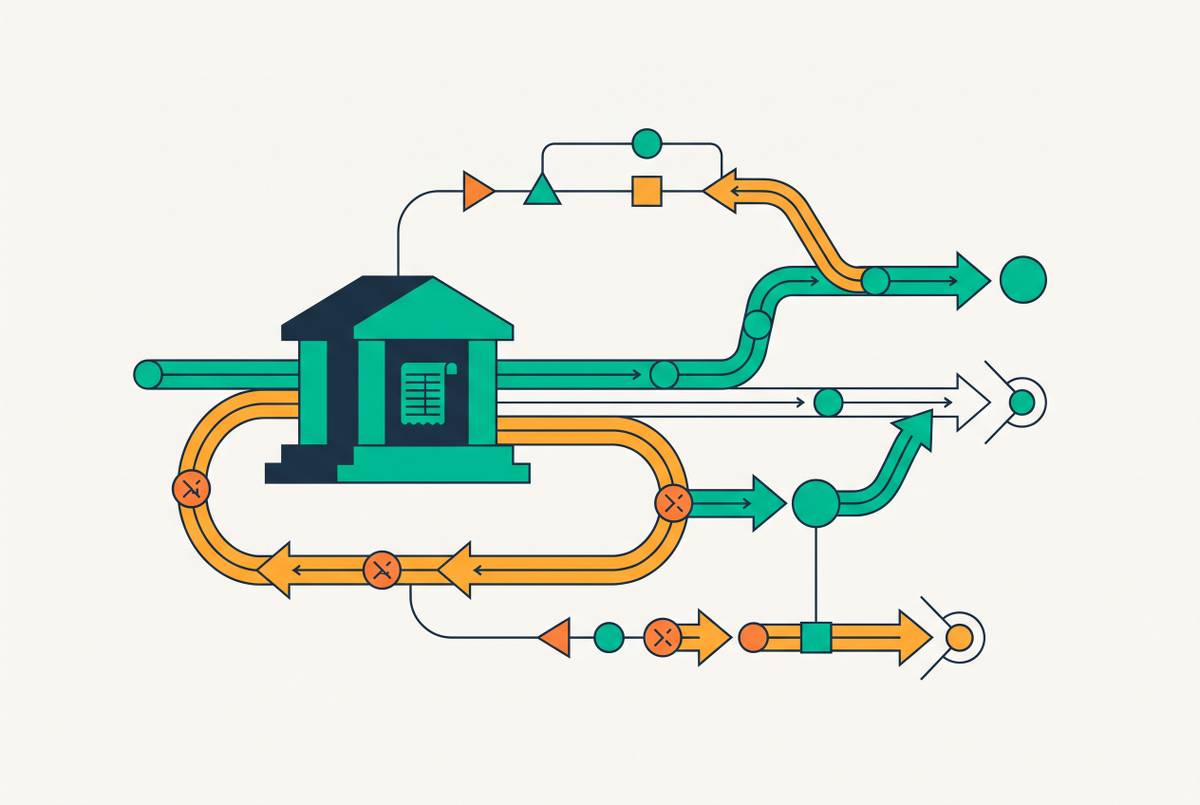
Tiered approval spreads agent authority across named roles, giving banks accountability.

Agentic AI approval is a question of who may authorize an action, under what limits, and with what evidence. Cooperative governance answers it by distributing authority across named roles rather than handing responsibility to one approver or a vendor. For banks and credit unions deploying agents on live banking rails, that structure makes automation compatible with human accountability.
Why no single layer of a bank or credit union can govern agentic AI on its own
An agent has routed a payment or issued an adverse-action notice. Who had authority over that act? The board set risk appetite, compliance mapped the obligations, and operations managed the workflow, but none of those responsibilities alone establishes who approved the execution. Agentic AI exposes that gap because it plans, reasons, and executes multistep workflows across systems with limited human intervention. Its consequences can arrive before a function has time to intervene.
Boards cannot watch each transaction in real time, and compliance usually has no authority to stop an operational workflow. Operations controls execution but rarely has the mandate to set the outer limits of autonomous action. An agent crosses boundaries that institutional authority follows vertically.
Cornerstone Advisors’ 2026 report found that a majority of credit unions had deployed generative AI and more than half discussed agentic AI at board level. Discussion is not an approval architecture, however. Under their cooperative ownership model, credit unions also share authority among members, boards, and management. Without explicit approval paths, that distribution leaves uncertainty at the moment an agent acts.
Why federal guidance leaves the approval architecture entirely to the institution
The revised interagency model risk guidance issued April 17, 2026 explicitly excludes generative and agentic AI because these models are novel and rapidly evolving. OCC Bulletin 2026-13 and SR 26-2 supersede SR 11-7 and SR 21-8 with a principles-based, risk-tiered approach. The agencies also plan a separate request for information addressing model risk management and AI. None of that supplies an agentic approval checklist.
The banking activity still has to meet the obligations already in place. NCUA’s 2026 supervisory priorities letter names credit risk, interest rate and liquidity risk, earnings and capital adequacy, payment-system security, fraud prevention, and BSA compliance, without a standalone AI category. An agent used in lending or payments still comes under scrutiny as part of those functions. An unexplained decision can become an underwriting or vendor-management finding without being called an AI finding.
Three obligations make the institution’s responsibility concrete. Fair lending requires explainable, provably non-discriminatory decisions, while adverse-action obligations require reproducible denial factors for a specific applicant. Third-party risk management keeps the institution accountable for outcomes produced by technology it did not build. Vendor opacity does not transfer that responsibility away, even when the institution cannot inspect training data, model internals, or the use of its own data. With no applicable agentic approval framework supplied from outside, the institution must build its own architecture, and cooperative governance gives that architecture a practical form.
What cooperative governance actually distributes — and how it differs from a single approver model
Cooperative governance assigns approval authority, accountability, and the obligation to preserve evidence to named roles at defined risk thresholds. It is not committee decision-making for every action. Each use is classified by what it can do without human intervention, and that tier determines who approves, what evidence is required, and how approval is recorded.
A single approver cannot cover those distinctions well. Having IT or compliance approve everything can slow the work and leave that function judging actions outside the work it knows. When a vendor deploys a system with no map of who approves what inside the institution, an even more basic question goes unanswered. Who approved this action?
The three-tier structure separates those responsibilities. Tier 1 informs and requires no prior human approval because it changes nothing. Tier 2 recommends, with a named role or configured deterministic rule approving before anything happens. Tier 3 acts and requires dual control, board approval to enter the tier, and attribution of every write action to an approving human or logged rule. Under that structure, compliance is responsible for audit requirements and fair-lending testing, while operations approves the deterministic rules that govern Tier 2 recommendations.
The useful test is what happens if an output is wrong before a human notices. Nothing changes in Tier 1, a person can decline a poor recommendation in Tier 2, and the accountholder feels the consequence first in Tier 3. When data is sensitive, it calls for more controls within the same tier. A Tier 1 tool that looks at member PII needs default masking and a query log, which the same tool does not need when it looks at branch traffic counts.
How the tiered approval structure maps onto live banking execution contexts
Payment authorization belongs in Tier 3 by default. The IMF’s 2026 note on agentic AI in payments identifies authorization traceability, opacity, correlated agent behavior, cybersecurity, and unresolved legal and liability questions as risks. Payment decisions already happen faster than a person can approve them. The governance response is to record every authorization with an input snapshot, a named approving rule, and a human-readable audit trail that compliance can examine without developer support. Prior approval of the governing rules makes accountability possible without requiring a person to stop each transaction.
Lending draws the boundary at who makes the decision. Credit decisions, underwriting, pricing, and adverse-action notices belong in the institution’s core or loan origination system. A vendor that proposes to make the credit decision itself moves the use into Tier 3, requiring board awareness and approval. Adverse-action obligations also mean keeping the inputs, linked to the version of the model that made the decision, so they can be reconstructed months later. Deterministic logic is a design requirement for compliance decisions because a plausible but unexplainable output is not enough.
Fraud detection crosses the same boundary when an agent acts on what it recommends. The FSB’s October 2026 report describes a large bank that operates internationally and whose in-house agentic fraud system tracks tens of millions of signals each day across transactions, card payments, and digital banking. The system drives the majority of the bank’s card fraud rules and materially reduced fraud losses in the first half of the 2026 financial year. A model inventory, documented approval path, and monitoring of inputs remain necessary whether an agent suggests a rule or executes an intervention.
Conversational interfaces show why classification must follow the action. A balance inquiry is Tier 1, a product recommendation is Tier 2, and a transfer or payment is Tier 3, even within the same interface. RFI Global’s survey found that a large majority of consumers would trust their bank’s AI more if a human were clearly accountable for the outcome. Disclosure serves a separate purpose from approval. The EU AI Act’s customer-facing transparency obligations apply from August 2, 2026, requiring customers to know when they are interacting with AI.
How named ownership and audit trails make cooperative governance examinable
Approval becomes examinable when someone outside the development team can reconstruct it. For Tier 3, the proposed governance model requires an input snapshot at execution, the approving role or rule, the active model version, and a timestamp. It requires those records to be kept for seven years and reproduced without help from developers. These requirements must be met before deployment.
Tier 2 needs a record of recommendations, approvals, and overrides. Both directions count. The record must capture a human approving against the agent’s recommendation as well as declining something the agent flagged as low-risk. Otherwise, an auditor cannot distinguish the agent’s judgment from the human decision that followed it.
Vendor systems can break that chain of evidence. An institution may be unable to show the factors behind a specific applicant’s denial, even though it is still responsible for meeting the adverse-action timeline. The practical test is to ask the vendor in writing whether it can supply those factors. An answer involving a support ticket and several days exposes a gap between the product’s evidence and the institution’s obligation. Silent retrains create another gap by changing the model’s risk profile without changing the contract, so the approval path needs notification and documentation of what changed.
IBM/Ponemon Institute research cited in CSI’s 2026 Banking Priorities found that 63% of organizations had no AI governance policy. That finding describes organizations broadly. The examiner’s test is more specific. A named approving role and logged approval must answer who authorized the action. Their absence is a finding regardless of whether it receives an AI label.
How CUSOs and shared governance structures make this model economically viable for community institutions
A credit union may not be able to fund a model risk team or enterprise-grade audit systems alone. Credit union service organizations, or CUSOs, let institutions pool their resources and pay for technology together. By investing together, institutions can support the infrastructure for distributed approval without each having to build it on its own.
Commonwealth Credit Union and Zest AI launched the CU Lending Collective in February 2026 as the first CUSO designed specifically for AI lending. Its model gives smaller institutions access to enterprise-grade lending technology through shared investment and governance. This is a specific ownership arrangement, not a description of every credit union. It demonstrates how the cooperative structure can fund capabilities that individual participants cannot sustain alone.
Vendors offer another route to shared infrastructure. Eltropy launched a governed agentic AI platform for credit unions in March 2026 that serves 750 community financial institutions and has more than 50 core and fintech integrations under its Safe AI Framework. Fiserv announced agentOS on May 14, 2026, allowing institutions to run Fiserv-built, institution-built, or third-party agents within one governed architecture. Its controls include kill switches, human-in-the-loop checkpoints, permission scoping, and auditability. Even when institutions share technology, each still needs to name who has approval authority.
The practical minimum remains modest enough to describe plainly. It includes a model inventory, a documented approval path, input monitoring, and documentation that survives staff turnover. An inventory can begin as a spreadsheet. The shared-ownership constraint is that institutions must govern exposure affecting all participants, while the opportunity is to fund that work together. That makes the choice more concrete than whether a small institution can afford an enterprise program of its own.
What institutions deploying AI on existing banking rails must build into the approval architecture from the start
For an institution preparing to deploy, the first step is to classify each use by whether it informs, recommends, or acts, and by the data it touches. Attach controls to those capabilities. Assign a named owner to every agent capable of a write action, documenting that person’s authority, the agent’s permitted scope, and the escalation path at its limits. Obtain board approval before entering Tier 3. If no Tier 3 system is in production, the policy should state that explicitly and require board approval before entry.
Set the requirements for vendors as part of that design before deployment. Require SOC 2 Type 2 attestations from vendors whose AI touches member data or decision workflows, together with written notification of retrains and documentation of changes. Keep scored-decision inputs linked to the active model version in a form that can be reproduced without help from developers. Use deterministic logic for compliance decisions rather than relying solely on probabilistic generative outputs. These commitments define what a product must support.
Human review also needs a defined place in execution. Give each agent written limits that it can go beyond only with human authorization, and have legal counsel review those limits and share them with examiners. Build those checkpoints into the banking rails already in place, without building a separate set of infrastructure. The agentOS model illustrates how governed deployment can sit within existing core architectures. The controls should follow the agent’s actions wherever it operates.
After deployment, put the AI inventory before the board quarterly as evidence of continuing governance. Monitor input distributions as well as output accuracy, because changes in approval rates or fraud detection can arrive after decision quality has deteriorated. At vendor renewal, ask again in writing whether machine learning or automated decisioning is now used anywhere in the workflow. Members Cooperative Credit Union shows how Tier 2 can work through its standing rule that associates must disclose AI use and have a human review all outputs.
Automation and accountability do not require a trade-off. Building the approval architecture before deployment lets agents act fast while keeping a name and a log entry for actions that have consequences. Deferring that work leaves the institution responsible for the decisions without the evidence needed to defend them.