ACH Return Codes and Resolution Workflows for Banks
Mapping each return code to a prescribed path cuts rework and proves compliance.
ACH return codes tell banks more than why a payment failed. They determine what must happen next, how quickly it must happen, and whether another attempt is allowed. For banks, the central task is to turn those differences into prescribed resolution paths. A code-mapped workflow cuts the work needed to handle returns and creates a record that shows they were handled correctly.
Why ACH return codes are a workflow design problem, not a reference problem
In a generic return queue, whoever opens a case must work out what its code calls for. That person must find the deadline, work out the right response, and decide whether the return needs compliance review before work can begin. A reference table may explain the reason for failure, but it does not assign responsibility or control the next action. The gap between understanding a code and acting on it is where exception work accumulates.
Each code carries three operational dimensions, namely a timeframe for the receiving bank, or RDFI, a handling response, and a compliance implication for the originating bank, or ODFI. Those dimensions do not move together. A return that permits another attempt after account funding calls for a different response from one that requires the originator to stop debiting. Routing both to the same queue leaves that distinction unenforced until someone intervenes.
How the 85 return codes divide into operationally distinct families
The 85 NACHA-defined return codes are easier to use when grouped into families based on how they must be handled. The administrative and data-error family includes R02 (Account Closed), R03 (No Account/Unable to Locate), R04 (Invalid Account Number Structure), R13 (Invalid ACH Routing Number), and R17 (File Record Edit Criteria). These returns typically have a 2-banking-day return timeframe. They all call for upstream correction, which may mean re-verifying an account, fixing a format, or fixing an error in enrollment. Retrying unchanged data does not resolve the reason for the return.
Funds-availability returns require a different branch. R01 (Insufficient Funds) and R09 (Uncollected Funds) also have a 2-banking-day timeframe and concern the availability of money. Their resolution path allows a retry after time for account funding, without requiring re-authorization.
The authorization family includes R05, R07, R10, R11, and R29. R05 means an unauthorized consumer debit used a corporate SEC code, while R07 means the customer revoked authorization. R10 concerns an unknown or unauthorized originator, R11 concerns an entry that did not follow the authorization’s terms, and R29 concerns a corporate customer’s unauthorized debit. Consumer authorization returns can arrive up to 60 calendar days from settlement, and resolution requires compliance review.
A further branch covers R06 (ODFI Requested Return) and R08 (Payment Stopped). These should remain distinct from data repair and funds-availability handling. The map establishes shared routes while preserving the conditions that require a separate decision.
Why the authorization family carries disproportionate compliance risk
Authorization returns place the burden of proof on the originator. Correct account details and sufficient funds do not answer whether the debit was permitted. The workflow must surface the authorization evidence and determine what, if anything, can happen next.
NACHA’s 2020 rule change separated R10 from R11, making that evidence more important to interpretation. R10 now identifies cases where the customer does not know the originator or did not authorize the debit. R11 instead identifies an error with an otherwise authorized payment, such as the wrong amount or date. The distinction is not a matter of severity alone. One calls for proof that authorization existed, while the other calls for investigation of how an authorized instruction was executed.
R05 and R07 require the originator to stop origination at once. For R07, fresh written authorization is required before any retry. Meanwhile, the consumer return window can extend to 60 calendar days, so a dispute may concern an origination well outside the current work queue. R29 has a shorter 2-banking-day window for corporate accounts, but it still counts against the unauthorized return threshold just as R10 does.
How NACHA's three-tier threshold structure turns return rates into institutional exposure
Under NACHA’s return rate structure, the enforcement rules differ by family. The unauthorized debit return rate covers R05, R07, R10, R11, R29, and R51. Its limit is a fraction of a percent, and NACHA designates it as a hard threshold. Exceeding it is an automatic rule violation. Even returns with different causes and deadlines can therefore contribute to the same institutional exposure.
The administrative return level and the overall debit return rate operate differently. NACHA designates these as levels, so crossing them triggers monitoring and scrutiny. Administrative returns consequently call for sustained correction of data and enrollment problems. Unauthorized returns require much tighter attention to threshold proximity. A single overall return measure cannot show whether the bank is approaching the most consequential line.
The ODFI bears this monitoring burden for its originators. Enforcement fines land on the bank first, although the bank may pass them to an originator under its contract. Egregious violations that involve willful or reckless conduct above the set volume or value limits can lead to large penalties each month. Workflow design is therefore more than a service-efficiency choice. The bank relies on workflow design to distinguish routine correction work from a pattern that exposes the institution to enforcement.
What a code-mapped resolution workflow looks like in practice
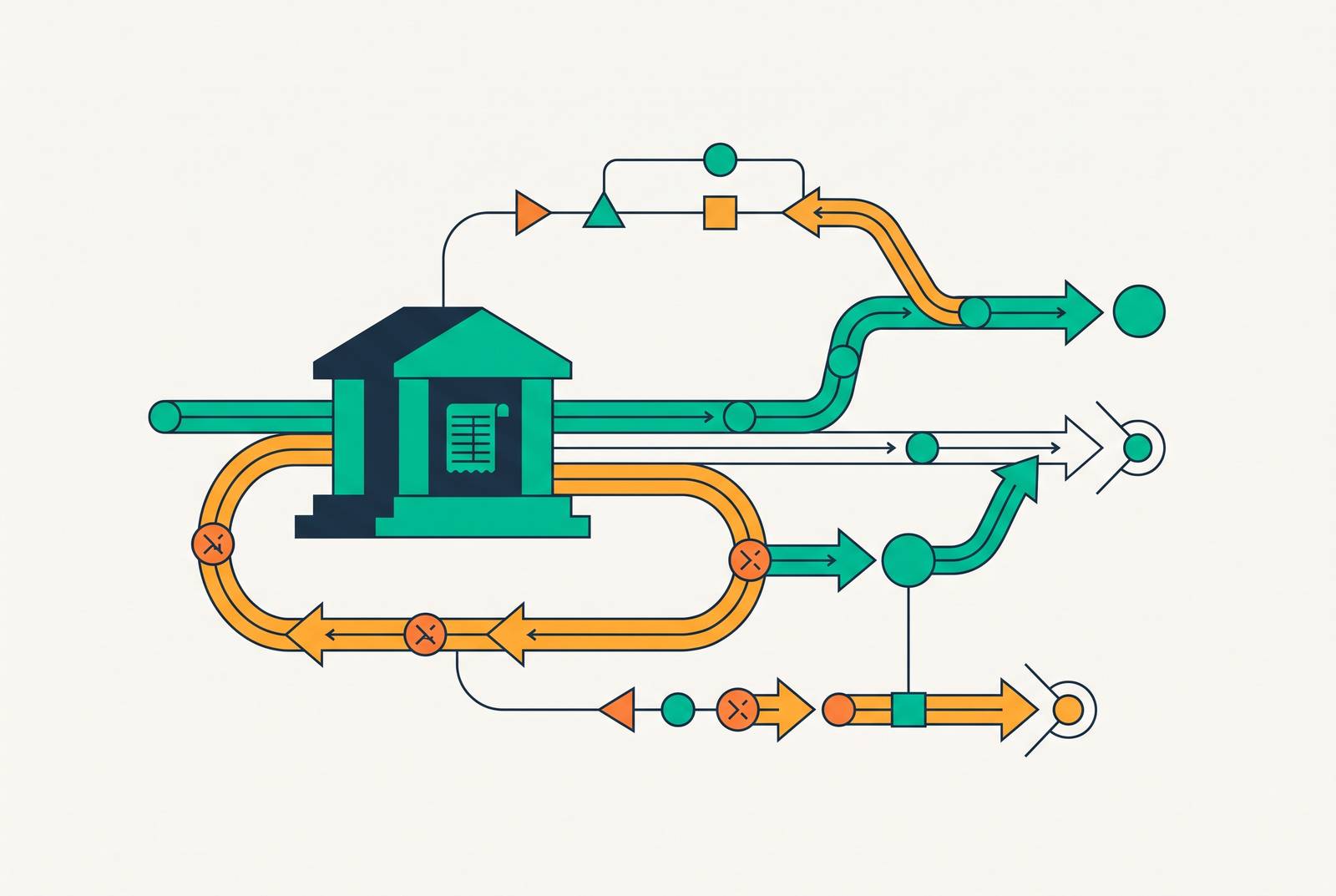
A code-mapped workflow is a routing map with conditions attached to each branch. Administrative returns go to operations, but the next step depends on the defect. R02 and R03 trigger customer contact to obtain updated account information, with no retry until the new data is confirmed. R04 and R17 lead to formatting or data-validation review in the origination system before resubmission. R13 belongs on the routing-number correction path.
For R17, that review includes routing numbers, account number structure, SEC code accuracy, and addenda formatting. The review must correct the source of the defect across the batch. Funds-availability returns instead go to a scheduled retry with customer notification. The schedule allows time for funding before re-origination. When R01 returns keep coming from the same account, they leave automated retry and go to account management.
Authorization returns take the compliance branch. R10 and R05 require further debits to cease while compliance checks for a relationship or authorization documentation. R07 stops debits and requires fresh written authorization if the customer agrees to continue. For R11, the bank must look into the billing discrepancy before a new transaction, while R29 goes through the escalation path for corporate accounts.
For R06, the teams must work together on the ODFI’s request, while R08 needs its own stopped-payment handling. Both must stay out of the automatic funds-availability retry path. Across all branches, each routing decision should record the code received, the team assigned, the action taken, and when it occurred. That action record makes the process inspectable without requiring someone to reconstruct why a case moved.
Where pre-transaction controls reduce the return volume that workflows have to absorb
The best resolution design still spends effort on a failure that has already occurred. Pre-origination controls cut that work by catching predictable defects before the payment is submitted. Account verification at enrollment can catch the closed-account and no-account conditions behind R02 and R03. Checking the format of the routing number and account number can prevent R04, R13, and many R17 returns. These controls address the same data problems as the administrative workflow, but at an earlier point.
That earlier point is not always the payment submission screen. R17 defects can come from legacy billing software, manual file uploads, or third-party data systems. When an integration introduces a missing, invalid, or misformatted field, the prevention work belongs at that integration. Correcting the returned entry alone leaves the source intact.
Authorization disputes are less amenable to a simple pre-submission check because customers may dispute a debit long after origination. Even so, clear and specific authorization language, documented consent timestamps, and accurate entry descriptions reduce ambiguity between an unauthorized debit and an incorrectly executed one. They also support the evidence review if a dispute arrives. Prevention gives the authorization workflow a clearer starting point.
How agentic AI fits into return code triage and resolution without creating a governance gap
Once the routing rules are explicit, automation has a defined job. Agentic AI can perform prescribed routing, customer notification, retry scheduling, and compliance escalation on existing banking infrastructure. That makes it a way to execute the decision tree at scale, rather than a reason to replace the tree with open-ended judgment. Each action must remain tied to the code and the rule that permitted it.
Fiserv launched agentOS on May 14, 2026, as an agentic AI operating system built to work across existing banking platforms. Its scope includes core, payments, issuer processing, and servicing, with policy controls, auditability, and human oversight embedded in the design. First Interstate Bank and Boulder Dam Credit Union are running pilots. With this platform approach, banks can add automation to the infrastructure they have and keep their core. It does not remove the need to define ACH-specific controls.
For return handling, every automated routing decision must produce a plain-language audit trail linking the code, the rule applied, the action, and the timestamp. R10, R05, and R07 should trigger human review before any originator-facing action, with automation handling the routing and stop while a person confirms the compliance response. Regulators require automated decisions affecting payment status to be traceable to specific inputs and logical rules. Whether the bank uses an established platform or a purpose-built agent, explicit rules and an immutable action record are the conditions for governed automation.
Building a return code workflow that serves as its own compliance record
A completed return case shows that one exception was handled. A consistent set of case records can show whether the bank recognizes and corrects a systemic problem. Under NACHA’s return rate monitoring regime, ODFIs must show that they know about return trends and have acted on them. The workflow therefore needs to preserve more than the final outcome. Codes, routing decisions, retries, and compliance escalations together provide the evidence of how the bank responded.
That evidence is especially important for unauthorized returns. A distinct compliance queue for R10 and R05, with logged stop-origination actions and documented authorization reviews, supports a defensible account of the bank’s handling. Treating those returns like R01 retries does not. The aggregate record should also feed ongoing monitoring by code, originator, and SEC code type. This connects individual resolution work to the patterns that matter at the institutional level.
The practical standard is a documented resolution sequence for every code family, a timestamped record of every execution, and a return rate dashboard that flags threshold proximity before it becomes a violation. Each element serves the next. The sequence directs the action, the record explains it, and the dashboard reveals where repeated failures need attention. Banks and credit unions that design the process this way are not adding a second layer of compliance work. The workflow itself becomes the compliance program, because the work that resolves the return also proves how the institution manages its risk.