Intraday Liquidity Monitoring in Automated Payment Environments
AI can watch payment liquidity around the clock, if rules still decide settlement.

Intraday liquidity monitoring in automated payment environments is becoming a continuous infrastructure discipline. AI can provide the visibility and coordination that always-on payments demand, but its usefulness depends on institutional control. The sound approach separates adaptive reasoning from authorization and settlement, so that faster decisions remain explainable, bounded and auditable.
Why intraday liquidity monitoring can no longer be treated as a periodic treasury task
Traditional treasury worked around a predictable rhythm. Funding decisions were made in the morning, cash positions were reconciled at end of day, and intraday exposure was largely invisible between those points. Real-time payment networks have broken that rhythm because settlement can occur across weekends, holidays and hours when treasury staff are away. A funding shortfall that once would have surfaced during an end-of-day review can become a settlement failure before anyone reaches their desk.
That change makes the timing of liquidity visibility as important as the position being measured. An adequate balance at one review point does not explain whether funds will be available when payments need to settle later. Basel III requirements, including LCR and NSFR, set minimum liquidity floors but do not by themselves address this within-day exposure. Treasury needs a view that moves with payments.
What agentic AI can actually do inside a payment system's liquidity layer
Agentic AI can interpret objectives, plan multistep actions and interact with digital services with limited human intervention. In liquidity management, that capability begins with following transactions as they execute and recalculating counterparty exposure. Recalculating counterparty exposure can make limit breaches visible immediately. Predictive models forecast intraday funding needs so decisions can account for pressure before it hits as well as respond when it does.
IMF Note 2026/004 cites BIS 2025 findings that generative AI can continuously perform recognizable cash-management tasks: maintain precautionary liquidity buffers, prioritize urgent payments and balance liquidity costs against settlement delays. EY's intraday liquidity analysis describes machine learning as an enhancement to payment throttling, using near-real-time data and liquidity, regulatory and firm-specific rules to decide which payments to hold or release. Agents can also select payment rails and sequencing to reduce liquidity drag.
The systemic risk that correlated agent behavior introduces into settlement infrastructure
Institutions using similar signals and agent logic may release or hold payments in step, concentrating demand. The IMF note warns that “correlated agent behaviour… can lead to synchronised payment flows, thus increasing intraday liquidity demand and potentially straining settlement capacity”. The risk resembles the dynamics of algorithmic trading more than traditional retail or commercial payment risk, and existing liquidity frameworks were not designed to anticipate it.
Other infrastructure choices can compound that pressure. Atomic settlement removes counterparty risk through simultaneous finality but requires prefunding, increasing intraday liquidity demand. Dependence on a small number of cloud and model providers adds concentration risk that traditional financial-services outsourcing rules inadequately address. These are not problems that a more accurate forecast alone can solve. The IMF note's proposed response is structural separation, keeping probabilistic reasoning upstream while preserving deterministic authorization and settlement. That distinction accepts AI's uncertainty as a continuing condition.
How the three-layer payment architecture contains AI risk without disabling AI capability
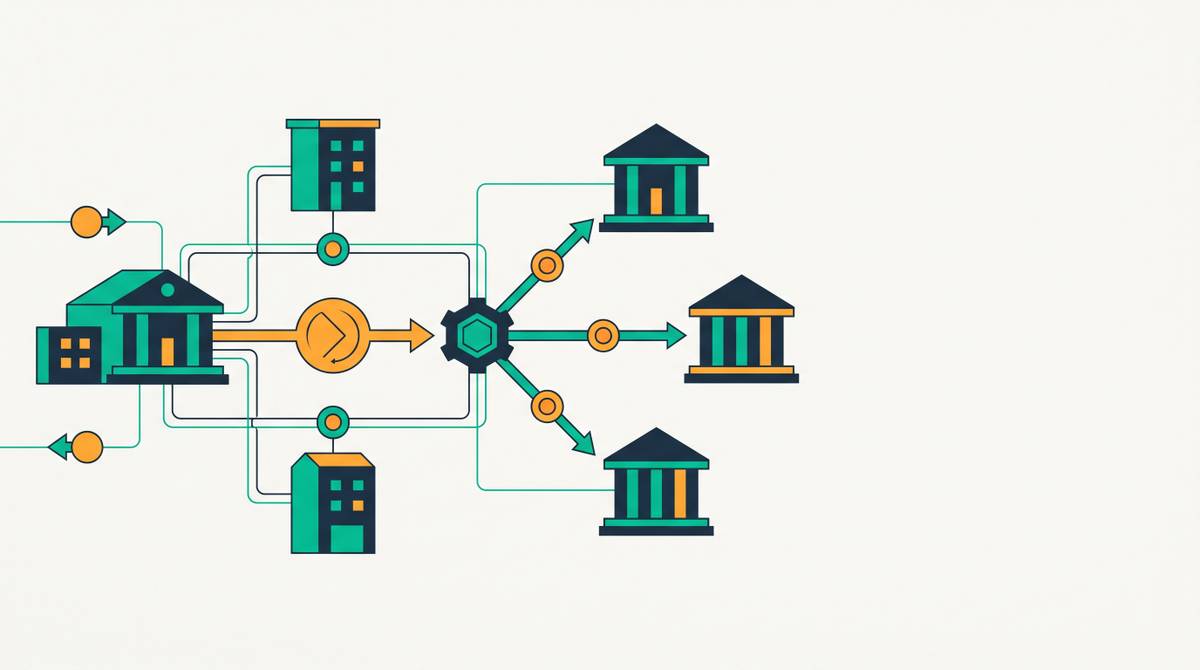
The IMF note divides the payment journey into three layers, each with its own job. In Intent and Orchestration, agents work out what goals call for, plan actions and coordinate liquidity decisions. Forecasting, buffer management and payment prioritization belong here. This layer can adapt because its reasoning does not itself establish legal finality. Its output still has to pass through the institution's controls before reaching settlement.
Control and Authorization is the second layer, where deterministic rules govern what an agent may execute. Human-in-the-loop checkpoints sit here, separating a proposed action from permission to perform it. If upstream agents produce synchronized outputs, authorization rules can act as a circuit breaker before those outputs reach settlement. The distinction is between judgment and authority. An agent's confidence in a decision does not replace the institution's rules.
Settlement is the third layer, where deterministic processing achieves legal finality and agentic algorithms are intentionally excluded. This preserves a firm boundary around the part of the payment journey that must not depend on probabilistic reasoning. The architecture requires AI's authority to remain bounded downstream.
What the regulatory environment actually requires from institutions deploying AI in liquidity functions
Federal Reserve SR 26-2 and OCC Bulletin 2026-13, issued April 17, 2026, describe generative AI and agentic AI models as “novel and rapidly evolving” and place them outside the revised model risk guidance's current scope. Institutions are directed to rely on their own risk management and governance practices for tools it does not cover. FINRA's 2026 oversight report adds that how an agent is supervised may need to depend on its type and scope, including which systems it can access, how it handles data and where people oversee it.
The IMF note discusses audit trails and transparency but does not prescribe a specific compliance standard requiring evidence auditors can review. Its governance discussion should not be presented as a binding rule. Nor does financial services yet have an enterprise-agent certification standard analogous to DO-178C in avionics or ISO 26262 in automotive functional safety. Internal documentation therefore bears a substantial burden. While formal standards take shape, strong rules on access, clear ownership of controls and complete audit trails give examiners a record the institution can defend without waiting for outside rules.
What governance-first deployment of AI liquidity monitoring looks like in practice
Fiserv's agentOS, launched May 14, 2026, has governance built into its agent platform. It supports Fiserv-built, institution-built and third-party agents, with kill switches, human-in-the-loop checkpoints, permission scoping and auditability embedded in its design. Those controls address whether an agent may act, when a person must intervene and how activity can be examined.
BNY frames APIs, automated sweeps and agentic AI as essential infrastructure for managing liquidity without round-the-clock staffing. Governance supplies the oversight layer rather than requiring people to watch every movement themselves. These examples illustrate different aspects of deployment while leaving open whether every liquidity use case has been solved. Their shared lesson is that controls must be present when autonomous operation begins, rather than added after a demonstration has persuaded the business to proceed.
Why deploying on existing banking rails matters for liquidity monitoring specifically
Liquidity data is generated across core banking, payment processing and treasury management systems at the same time. A monitoring system that cannot integrate across them in real time may present an incomplete position as a complete one. That is a dangerous kind of visibility. Integration with existing infrastructure preserves data continuity and audit lineage, while replacing core systems introduces a transition period without the old system's reliability or the new system's full capability. The argument for existing rails is therefore about control.
Banking platforms increasingly offer LLM-agnostic operation, private cloud or on-premises deployment, and business logic that executes outside the model. Those choices help make AI a governed infrastructure component rather than an opaque dependency, consistent with the operational resilience direction of DORA. Plaid's Guaranteed Payments, launched May 19, 2026, illustrates the existing-rails principle in ACH transfers. It uses real-time monitoring powered by Plaid Signal and Plaid Protect, which monitors fraud patterns across over 500 million accounts, to approve transfers at once while taking on financial liability for settlement. Approval is not a new settlement mechanism. The capability rests on integrated data.
The governance attributes that make AI-driven intraday monitoring auditable rather than opaque
ECB Supervisory Board representative Pedro Machado stated in February 2026 that “if a bank cannot explain why an AI model behaves the way it does, then it cannot truly control that model”. For liquidity monitoring, that means connecting an action to its inputs and authority. An output alone is not enough. Eltropy's Safe AI Framework and agentOS embed records of what an agent did, why it acted, what data it used, under what authority, and what human reviewed or could have reviewed it. Such records make scrutiny part of the system's design.
Controls also need to reflect the institution being governed. Liquidity thresholds, payment priorities and buffer requirements vary by institution, product line and regulatory regime, so fixed logic cannot reliably fit every risk profile. Configurable rules let continuous monitoring support real-time enforcement and flag deviations for human review. SOC 2 certification supplies a baseline for data handling and operational controls, though it is not legally mandated and is insufficient on its own. It does not replace an explanation of a liquidity decision or evidence that the institution's own limits governed it.
Where banker skepticism about AI liquidity monitoring is legitimate and how to address it honestly
Banker skepticism is rational when control standards are still forming and financial consequences are immediate. The confidence gap is substantial, with a minority of banking leaders fully confident that their AI controls would survive an independent review in the near term and a majority citing governance and compliance barriers to AI performance. Consumers also have limited trust in AI that handles their financial data. Bankers remain accountable to those customers. Calling that caution resistance to innovation overlooks bankers' concern over whether they still control the decisions they delegate.
The credible adoption path is deliberately narrow. An institution should begin with one high-volume, bounded-risk intent, such as a specific intraday monitoring alert or a single payment queue, and integrate only that journey. It should run fully disclosed and fully logged, expanding by adjacency once the audit trail demonstrates performance. This approach also permits an honest comparison with inaction, including the possibility of a settlement failure at 2 a.m. on a weekend.
What institutions should require from an AI liquidity monitoring system before deployment
Before deployment, institutions should require separation between AI reasoning, deterministic authorization and settlement, with no agent logic controlling finality. They should also require it to connect in real time to data from core banking, payment processing and treasury management while keeping the existing infrastructure. A system cannot support continuous liquidity oversight if its view has gaps or its reasoning can bypass institutional rules. The institution whose payments and obligations are at stake must make that assessment.
That assessment should require complete, reviewable logs of observations, decisions, execution and authority, supported by explanations a risk officer or examiner can follow. The institution must set its own liquidity thresholds, payment priorities and buffer requirements and be able to change them without bringing in a vendor. SOC 2 certification and compliance readiness should be deployment prerequisites, without being mistaken for proof of adequate liquidity controls. Decisions above defined thresholds or outside normal operating parameters must be referred for human review. The goal is not to remove human judgment from liquidity management, but to make it available when decisions need it instead of spreading it across tasks that AI can handle continuously and accurately.