Testing and Validation Protocols for AI Banking Agents Before Production
Six evidence gates let banks prove an AI agent is ready for production.
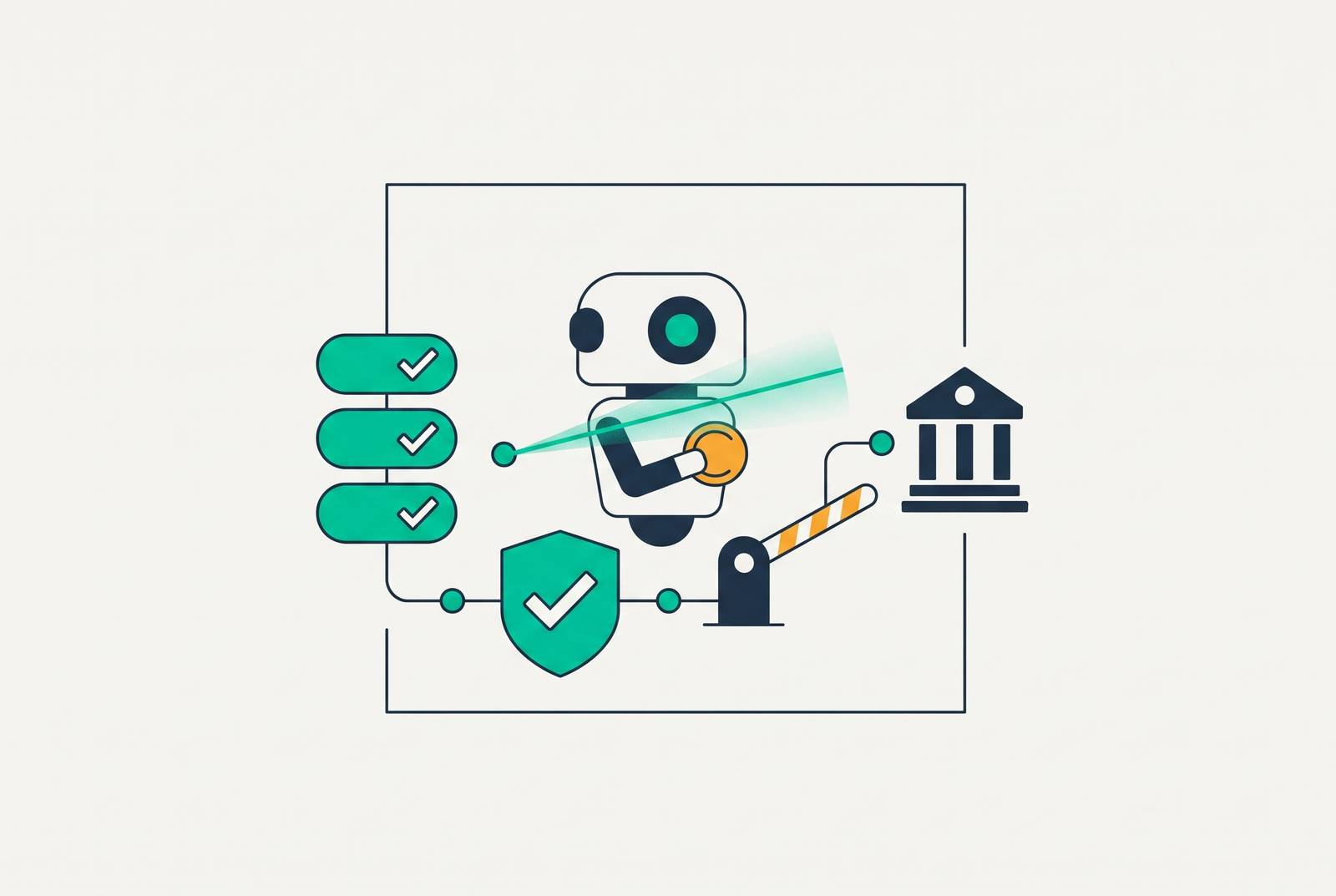
Moving an AI banking agent from pilot to production requires more than a successful demonstration and a final approval. Testing and validation must pass through six gates that produce evidence, from risk classification to vendor resilience. Together, these gates give compliance and risk teams a defensible answer to the central question of production readiness. Can the bank explain, constrain, and maintain the agent’s behavior once real customers and transactions are involved?
Why a single sign-off fails for AI banking agents moving to production
Consider a pilot that “passed,” with positive customer responses and lower handle times. Then a compliance leader asks who is liable under federal consumer financial law. The demonstration cannot answer that question on its own. A missing register entry, an undocumented data flow, or a test that was not repeated after a model change are evidence gaps the demonstration cannot fill.
Agentic systems make these gaps harder to contain because they use planning, tool use, memory, and adaptation over a series of steps. A correct answer does not establish a safe trajectory. Compliance exposure from before the rollback also remains when an agent is taken offline. A gate model therefore separates the claims a bank must prove, so that performance cannot stand in for governance and an approval cannot conceal missing evidence.
The regulatory frame that shapes every gate
No regulator has a single checklist for deploying an AI agent. The relevant instruments instead establish different parts of the evidence burden, with important differences in scope and legal force. SR 11-7 sets out the familiar basis for model-validation, with checks for accuracy, stability, independent review, and policy alignment. SR 26-2 replaces it as the governing model risk management guidance, but does not establish enforceable standards or prescriptive requirements. Its exclusion of generative and agentic AI leaves institutions responsible for scrutinizing these systems through their own risk management practices.
Banks must also meet consumer protection obligations that are separate from model risk guidance. UDAAP, Reg E for electronic fund transfers and disputes, FDCPA for collections, and CFPB complaint handling expose customer-facing agents to the same rules as human agents. Exposure begins when the agent speaks. The NCUA has issued no AI-specific rules, but states that existing technology-neutral rules apply and that credit unions must conduct appropriate due diligence on vendors’ AI.
The EU AI Act establishes binding requirements for high-risk systems covering risk management, data quality, logging, documentation, human oversight, robustness, cybersecurity, and accuracy. High-risk obligations apply from December 2027 for Article 6(2) and Annex III systems, and from 2 August 2028 for Article 6(1) and Annex I systems. Classification cannot simply be assumed. The Financial Stability Board’s October 2026 final report on sound practices for responsible adoption of AI is a reference that works across jurisdictions without prescribing what banks must do. Across these instruments, the evidence requirements concern inventory and risk tier, known data flows, tested performance, human oversight and stop capability, reconstructible decisions, and vendor change survivability.
Gate 1: Inventorying the agent and assigning a risk tier
How an agent is classified sets how strict each later gate must be. The FSB’s Practice 5 calls for systematic assessment of materiality and risk at inception and thereafter. BaFin’s ICT-risk guidance requires identification, classification, documentation, and continuous monitoring of AI components, including datasets, model implementations, software libraries, and hardware. FINMA observed that narrow definitions of AI were making inventories incomplete. An agent’s label is therefore less useful than a record of what it can actually affect.
Tier 1 covers critical-impact agents that trigger regulatory, financial, or legal actions, including filing SARs, blocking payments, and conducting sanctions checks. These require comprehensive validation consistent with SR 11-7, fallback controls, and immutable logs. Tier 2 covers moderate-impact assistance such as onboarding support, fraud triage, and KYC workflows, where explainability and human-in-the-loop review address the influence on human decisions. Tier 3 covers lower-impact knowledge searches and report drafting, with lighter controls and reclassification if their impact grows.
Legal classification adds a separate question to operational tiering. Annex III 5(b) lists creditworthiness evaluation and credit scoring as high-risk, while most customer-support, AML, and KYC agents will not fall under Annex III. That conclusion still needs a documented basis. Each register entry must identify the owner, purpose, model and version, data sources, callable tools and permissions, autonomy level, materiality score and criteria, sign-off date, and reassessment triggers. Without the tool inventory, a sandbox pilot can reach go-live with its potential reach still unknown.
Gate 2: Mapping data flows and establishing data integrity
The data map establishes whether the classified risks can be examined. It must show where data comes from, where it flows, and where it is processed before performance testing begins. The inference gateway, which sits between the user and the model, must mask or tokenize personal data so that unnecessary sensitive information does not reach the model. Where synthetic data is derived from production datasets, validation must also assess privacy leakage and membership inference risk.
Access rights need equally precise boundaries before release. Least privilege means separating read, draft, recommend, approve, and execute rights. Each right must be bound to identity, role, purpose, environment, and time. The runtime must also fix the model version and configuration at deployment. Otherwise, testing may describe a state that a silent update has already displaced, weakening both explainability and the basis for approval.
An Agent Operational Envelope brings these boundaries into one declared scope. Toward Pre-Deployment Assurance for Enterprise AI Agents: Ontology-Grounded Simulation and Trust Certification proposes using that envelope to formalize permissions, domain constraints, safety properties, governance rules, and autonomy levels. The declared scope then anchors scenario generation for later testing. This gate establishes what is permitted and what data is available, rather than claiming that behavior within those boundaries has already been proven safe.
Gate 3: Performance testing that covers trajectories, not just outputs
Beyond Component Testing: Validating Agentic AI Systems maps 262 papers and identifies five mismatches with classical testing assumptions. Determinacy fails because the same input can produce different trajectories. Decomposition fails because orchestration can cause errors even when individual components work correctly. Specification is incomplete when goals such as “escalate appropriately” depend on context, while the environment can change during execution. When agents interact, they can also behave in ways that tests of each agent alone cannot show.
Policy fit review must check both whether the final label was correct and whether a transaction was denied for the right reason or suspicious behavior was flagged under BSA/AML rules. Historical backtesting must examine decision accuracy, false positives, false negatives, and risk across the decision path. Rephrasing or randomizing inputs probes whether superficial changes alter behavior. End-to-end testing must then check whether those paths stay acceptable as the conditions in which the system works change and its components interact.
Adversarial testing targets the agent’s powers as well as its prose. Prompt injection, poisoned retrieval, unauthorized tool calls, data leakage, secret exposure, excessive agency, and unsafe fallback each challenge a different boundary. Bias and fairness audits must assess disparate impact in lending, fraud, or onboarding, track metrics by protected class, and document mitigation. Independent review provides a separate check on the builders’ conclusions. The final report must be signed outside the build team and understandable without developer support.
The pre-deployment assurance paper proposes automatically deriving regulatory, operational, and adversarial scenarios from the declared envelope through an ontology-to-scenario generation pipeline. This connects the test set to the agent’s permitted scope and supplements manually written cases. It supplements component testing by extending validation to the interactions and trajectories that make an agent different from a single model response.
Gate 4: Human oversight controls and transaction limit enforcement before any live execution
Successful testing does not itself constrain live execution. For material, irreversible, customer-facing, financial, or regulated actions, human approval or dual control must be enforced by architecture. The distinction is especially important for payments and transfers. Permission scoping and transaction limits must operate as controls on execution. The production gate asks whether the system enforces the boundary.
The FSB treats human oversight as an ongoing operational responsibility. Embedded fallback paths make that responsibility concrete by taking conservative default actions or routing decisions to a human reviewer when output quality drops. Platform-level kill switches offer a separate way to stop the agent. A QA layer adds periodic sampling and structured review of decisions, as applied to human decision-makers.
Required language about fees, Reg E dispute rights, and account terms must be delivered in real time. By the time a later review takes place, the exposure already exists. The oversight design must therefore distinguish between controls that prevent an unauthorized action, fallback paths that contain uncertainty, and sampling that detects problems after decisions occur.
Gate 5: Audit trail completeness and regulator-ready documentation
ECB Supervisory Board representative Pedro Machado stated in February 2026 that a bank cannot truly control an AI model if it cannot explain its behavior in terms meaningful for decision-making. Accuracy metrics cannot show why an agent took a given action. The audit gate must establish whether a second-line reviewer can reconstruct the decision without relying on the build team to interpret it.
An immutable audit log records and hashes every prompt, input, model version, and output so that reviewers can reconstruct what the model saw. An inference-time explainability layer records reasoning, confidence scores, and a one-line decision summary. With human-readable output, reviewers can use that record without help from a developer. Continuous monitoring adds automated dashboards and alerts for drift, outlier behavior, and performance degradation.
Decision reconstruction must also include context where policy permits. The record needs the version, input source, retrieved evidence, tool call, output, reviewer, override, action, time, and result, including decisions to retain or discard evidence. Conversation-level compliance needs its own trace. Reviewers must be able to establish which disclosure language was delivered, when it was delivered, and which customer statement prompted it.
The validation study identifies temporal validity as the least developed dimension of current agentic assurance. This is the question of how behavior evolves under changing conditions. A log of isolated outputs therefore leaves a gap. Auditability must preserve trajectory context so that reviewers can examine the circumstances and sequence behind a decision, rather than treating every output as an independent event.
Gate 6: Vendor resilience and model change controls
Vendor dependency creates exposure from the first day of production. DORA imposes binding obligations on ICT third-party dependency management, while BaFin applies the same risk logic to AI model vendors. As a go-live condition, a bank must demonstrate that it can operate, modify, or replace a vendor-supplied component without operational disruption. Passing the other gates does not establish that the bank can maintain the validated system through a vendor change.
The fixed model version and configuration established earlier are prerequisites for controlled change. Before launch, change control must define notice requirements, regression test thresholds, approval authorities, rollback procedures, emergency disablement paths, and vendor incident communication protocols. Any model update requires repeated validation. A previously acceptable system may cross a policy boundary after a change, even if its purpose remains the same.
Community banks and credit unions may not have the engineering staff or skills to validate a change to the underlying model on their own. Contractual change-notice and regression-testing rights therefore become gate conditions. Evidence must also survive the transition between vendors. The pre-deployment assurance paper proposes a trust certificate that holds the validated operational envelope, test results, and governance sign-offs. That portable record supports examination without making the evidence depend entirely on the current vendor.
What ongoing validation looks like after go-live
Do the controls still work under real call volume, customer variability, and regulated topics that surface only at scale? The measurement framework must track more than containment. Task quality, customer effect, cost-to-serve, latency, adoption, overrides, complaints, incidents, and financial outcome together form the production evidence base.
A defined validation cadence gives that evidence an operational purpose. Real-time dashboards and alerts detect drift, outlier behavior, and performance degradation, while reassessment follows the triggers recorded for each agent. New tools, new model versions, and new data require the register, validation records, and risk assessment to be revisited. Periodic review and triggered reassessment serve different needs. One maintains regular scrutiny, while the other responds to changes that can invalidate earlier evidence.
For banks deploying agents on existing rails, speed and cost reduction remain part of the business case. Ongoing validation shows whether the bank can still defend that case to regulators and auditors as the system changes. Launch approval records a decision at a point in time. The bank must be able to keep validating the system and producing the evidence needed to justify keeping it in use.